Transfer learning: how knowing one Romance language makes the next one easier
Knowing one Romance language gives you a real head start on the next. Here's what the research says about how transfer learning works.
If you already speak Spanish and you're picking up Portuguese, you've probably had this experience: you open a textbook, read the first page, and think, "Wait, I already understand like 80% of this." That number isn't just a feeling. It's surprisingly close to what linguists actually measure.
The phenomenon is called cross-linguistic transfer, and it's one of the most reliable advantages in language learning. Your brain doesn't start from zero when it picks up a related language. It recycles. It borrows. It takes shortcuts. And for the most part, those shortcuts actually work.
What transfer learning actually is
Transfer learning is a term borrowed from machine learning, but the concept maps cleanly onto human language acquisition. When you learn a new language, your brain doesn't build a fresh neural architecture from scratch. It leans on what it already knows: patterns, vocabulary, grammatical logic, even intuitions about how sounds map to meanings.
This transfer happens at every level of language. Phonology (how sounds work), morphology (how words are built), syntax (how sentences are structured), and the lexicon (the words themselves). The closer two languages are genetically, the more transfer you get for free.
And Romance languages are close. Really close.
The numbers are kind of wild
A 2019 study by researchers at the University of Groningen measured mutual intelligibility between Romance languages. Portuguese and Spanish speakers could understand roughly 50-60% of each other's written texts without any training. Spanish and Italian came in around 55%. Even French and Portuguese, which feel quite different when spoken aloud, shared enough written overlap for readers to piece together the gist.
Lexical similarity tells a similar story. Ethnologue's data puts Spanish and Portuguese at 89% lexical similarity. Spanish and Italian sit around 82%. French and Portuguese come in at about 75%.
For context, English and German share a common ancestor and only clock in at around 60%. That's a massive gap.
What this means in practice: if you know 5,000 Spanish words, you can probably recognize or guess the meaning of 3,000-4,000 Portuguese words on your first day. That's not fluency, but it's a massive head start.
Where the free lunch comes from
The biggest source of transfer is cognates, words that share a common ancestor and still look or sound alike. Família (Portuguese), familia (Spanish), famiglia (Italian), famille (French) all mean "family." You learn it once, you basically have it four times.
But transfer goes beyond vocabulary. Romance languages share structural DNA:
- They all mark grammatical gender (mostly masculine/feminine)
- They all conjugate verbs to indicate person, number, and tense
- They mostly follow subject-verb-object word order
- They all have a subjunctive mood (the bane of learners everywhere, but at least you only have to wrap your head around the concept once)
A 2017 study published in Bilingualism: Language and Cognition found that L3 learners (people acquiring a third language) transferred grammatical structures from whichever previously known language was most typologically similar, not necessarily the one they knew best. So even if your English is stronger than your Spanish, your brain will preferentially pull from Spanish when learning Portuguese.
It's smarter than you think. And weirdly, you have very little conscious control over this process. Your brain just does it.
The trap: when transfer goes wrong
Here's the catch. Transfer isn't always positive.
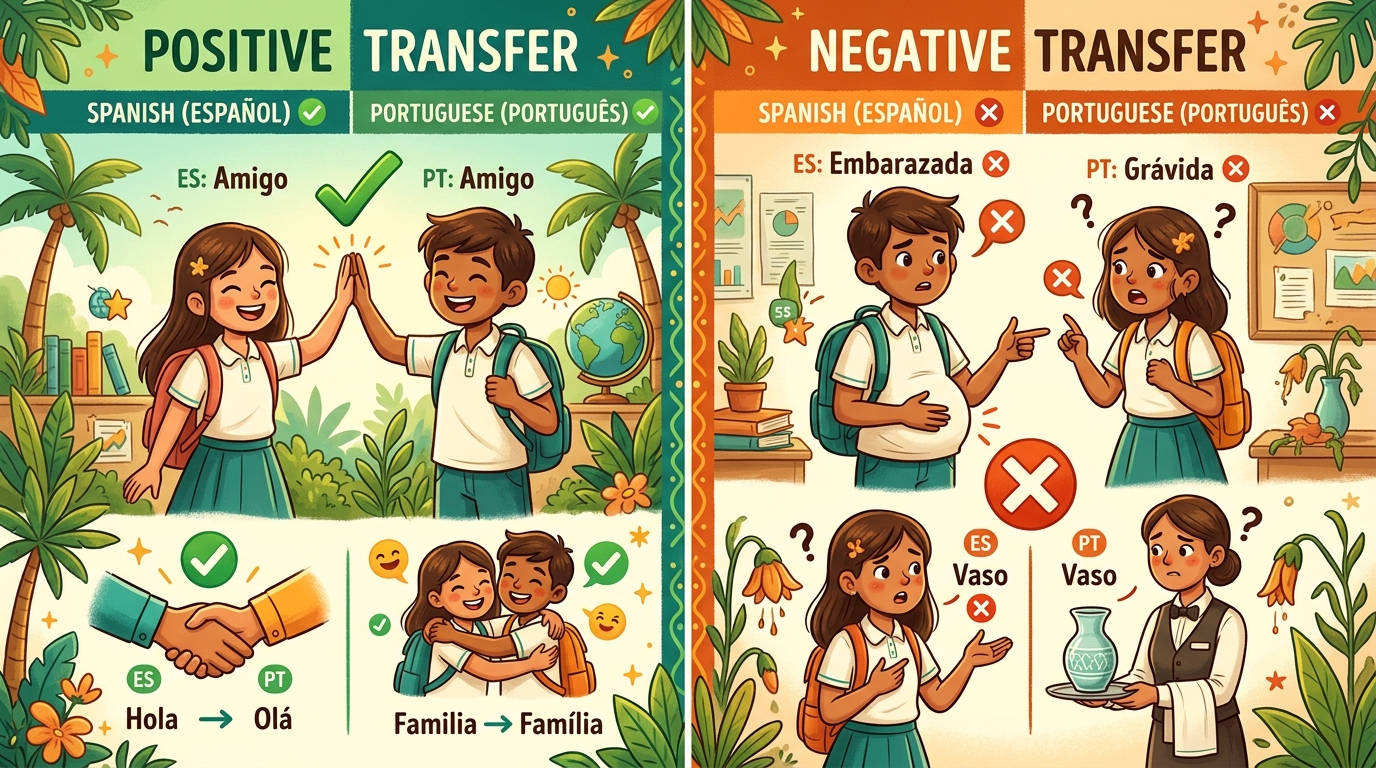
Negative transfer is when your brain assumes a pattern from Language A applies to Language B, and it doesn't. Spanish speakers learning Portuguese run into this constantly. The word exquisito in Spanish means "exquisite" or "delicious." In Portuguese, esquisito means "weird" or "strange." Telling someone their cooking is esquisito will not land the way you intended.
We've covered a whole set of these traps in our article on Portuguese false friends that trip up English speakers, and frankly, the false friends between Spanish and Portuguese are even more dangerous because the languages are so similar. You let your guard down.
A 2007 study by Odlin found that negative transfer is most frequent (and most persistent) between closely related languages. The similarity breeds a kind of complacency. Learners assume everything transfers, and the exceptions become fossilized errors that are genuinely hard to unlearn later.
The practical lesson: treat cognates as gifts, but verify them. When a word looks the same in both languages, check whether the meaning actually matches before you commit it to memory.
How to maximize positive transfer (and minimize the negative kind)
If you're learning your second Romance language, here's what the research suggests:
Start with what you know. Don't pretend you're starting from zero. A 2020 study in The Modern Language Journal found that learners who were explicitly encouraged to use their L1/L2 knowledge as a scaffold for L3 learning progressed 40% faster in reading comprehension over 12 weeks compared to a control group that was taught as beginners.
Read in your new language early. Like, week one early. Because of cognate density, you'll be able to read intermediate texts much sooner than someone starting cold. This builds confidence and exposes you to the real patterns of the language, not just textbook exercises.
Flag false friends deliberately. Make flashcards specifically for words that look like something you know but mean something different. These need extra attention precisely because your brain wants to skip over them. This is where spaced repetition really earns its keep, because it forces you to actively recall the correct meaning instead of letting your L2 assumption go unchecked.
If you're using Decko, this becomes straightforward: you can build a focused deck of false friends and high-confusion pairs, and the spaced repetition algorithm will keep testing you on the ones you mix up most. Give it a try if you're moving between Romance languages and want to lock in the differences.
Focus your study time on what doesn't transfer. Pronunciation is a big one. Portuguese nasal vowels (ão, ãe, õe) don't exist in Spanish. French's liaison rules have no equivalent in Italian. These are the areas where transfer won't help you, so they deserve disproportionate practice time.
The "third language advantage" is real
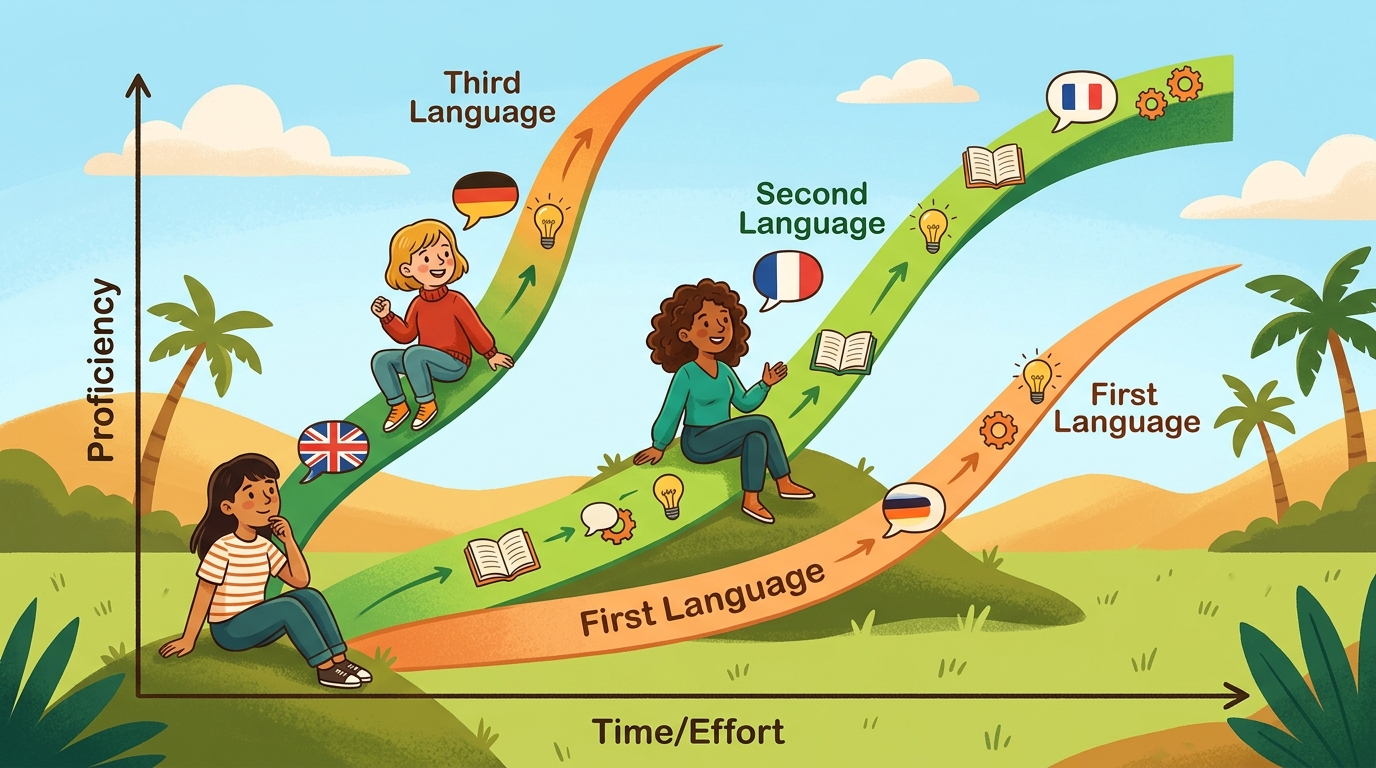
Here's something that surprised me when I first encountered the research. It's not just that knowing Spanish helps you learn Portuguese. It's that the experience of having learned any second language makes you better at learning a third one, even if the languages aren't related.
A meta-analysis by Grey et al. (2015) in Studies in Second Language Acquisition found that multilingual learners showed consistent advantages in grammar learning and metalinguistic awareness compared to monolinguals, regardless of how similar the languages were. Part of this is strategic: you've already figured out what works for you. Part of it is cognitive: juggling two language systems seems to make the brain more flexible about acquiring a third.
So if you've learned any language to a decent level, you've built a kind of learning infrastructure that pays dividends every time you start a new one. Each language gets a little easier. Not because the languages themselves are simpler, but because you are better at learning.
I find this genuinely encouraging, because it means the first language you learned (probably with a lot of struggle) wasn't just valuable for itself. It was an investment in every language after it.
What this means for your study plan
If you're an English speaker considering Portuguese or Spanish, it almost doesn't matter which one you start with. Either one will make the other much easier later. Spanish has more structured beginner resources and a clearer pronunciation system. Portuguese has richer phonology and will train your ear for a wider range of sounds. Pick based on which culture pulls you in. Or which one has better food, honestly.
If you already speak one Romance language and you're eyeing another, stop treating yourself like a beginner. You're not. Test yourself on intermediate material first. You'll probably surprise yourself with how much you already understand, and you can focus your energy on the gaps instead of re-learning concepts you already own.
Your next language doesn't start at zero. That much is clear from the research. You've already done more of the work than you think.
Ready to put this into practice? Decko uses spaced repetition and conjugation drilling to make vocabulary stick. Start learning Brazilian Portuguese with flashcards that actually work.
Try Decko Free