Interleaving beats blocking: the counterintuitive way to study vocabulary
Mixing topics feels harder than studying one at a time. That's exactly why it works better. Here's what the research says about interleaving vocabulary.
Here's a weird thing about learning. The study method that feels most productive is usually the one that produces the worst long-term results. And the method that feels frustrating, slow, and slightly chaotic? That's the one your brain actually needs.
This is the story of interleaving versus blocking, and once you understand it, you'll probably want to rearrange how you study vocabulary tomorrow.
What blocking looks like (and why it feels so good)
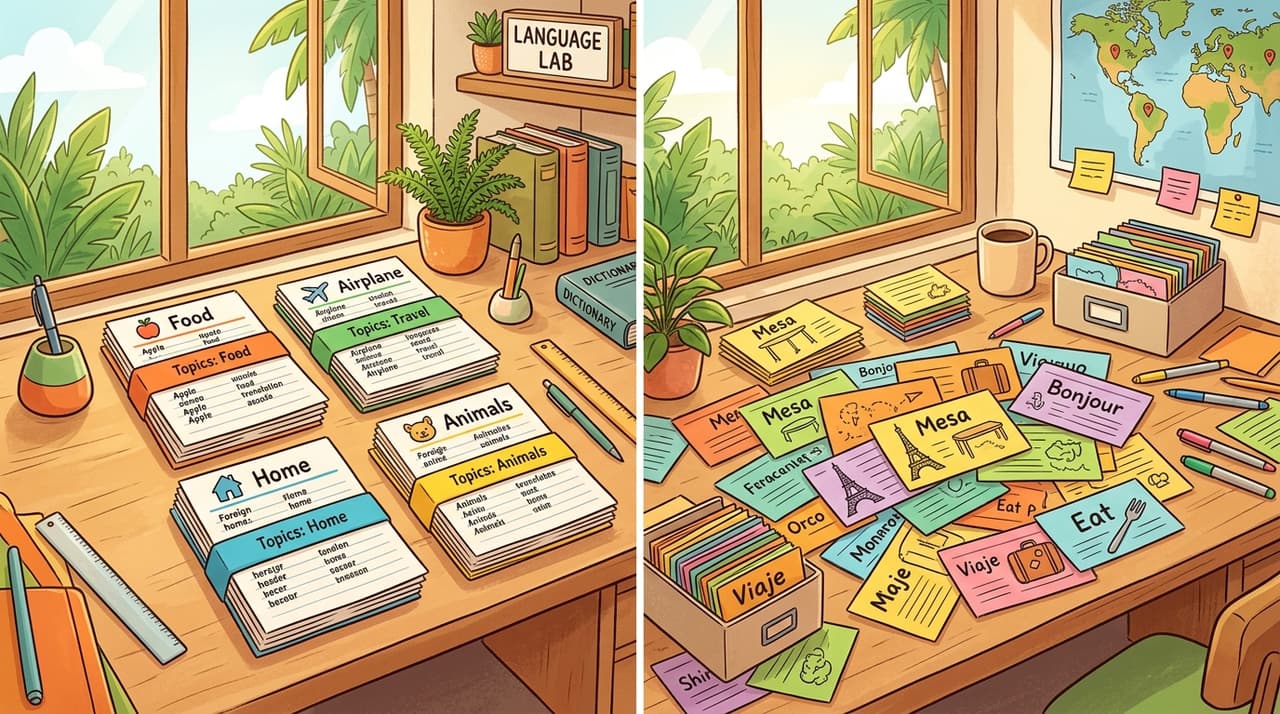
Blocking is the default. You sit down, open your textbook to the chapter on food vocabulary, and drill twenty food words until you've got them. Then maybe tomorrow you do clothing. The day after, body parts. One category, one session, clean and tidy.
It feels efficient because it is efficient, in the moment. By word fifteen, you're nailing every translation. You feel fluent. You close the book thinking, "I know this stuff cold."
A week later you can't remember half of it. What happened?
What the research actually found
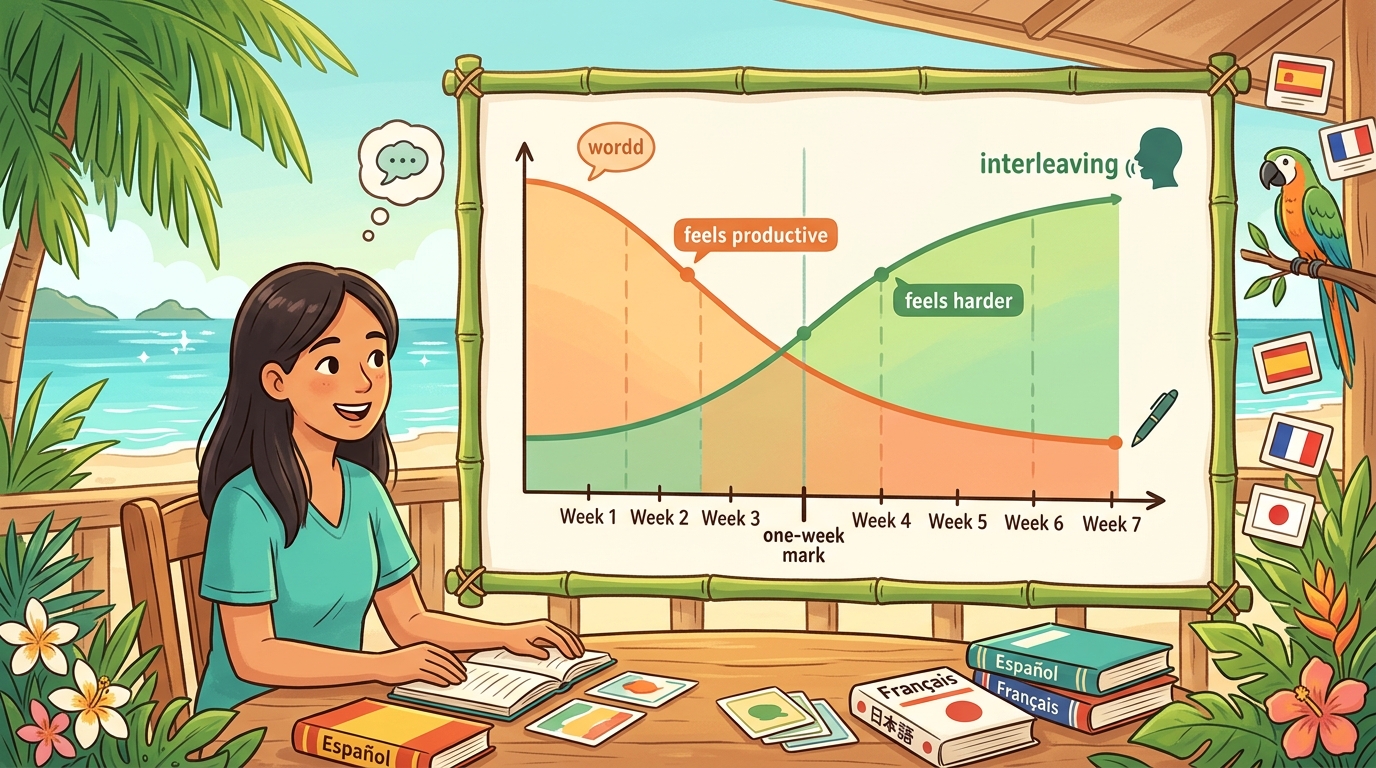
Rohrer and Taylor ran a study in 2007 where students learned math problems either blocked (all of type A, then all of type B) or interleaved (mixed up). During practice, the blocked group crushed it. They got 89% correct. The interleaved group struggled at 60%.
Then came the test, one week later. Blocked group: 20%. Interleaved group: 63%.
The students who felt like they were failing during practice ended up with three times the long-term retention.
This effect has been replicated across vocabulary learning, language grammar, motor skills, and visual categorization. A 2019 meta-analysis in Educational Psychology Review looked at dozens of interleaving studies and found a reliable benefit for delayed retention, especially for material that involves discrimination between similar items. The effect is real, even if it feels backwards when you're in the middle of a study session.
Why your brain prefers the messy version
The mechanism is called desirable difficulty, a term coined by Robert Bjork at UCLA. The idea is that struggle during learning forces your brain to do more work, and that work is what builds durable memory.
When you block, your brain figures out the pattern fast and goes on autopilot. You're not really retrieving each word, you're riding the momentum of the category. Your brain knows the next answer will be food-related, so it primes that whole semantic zone. Easy.
When you interleave, every card is a fresh problem. Is this a verb? A noun? About cooking or commuting? Your brain has to fully retrieve the answer from scratch every time, which is exactly the kind of effortful processing that builds long-term memory. The spacing effect research shows something similar: struggle now, remember later.
There's also a discrimination benefit. If you only ever see pedir (to ask for) next to other request verbs, you'll never have to distinguish it from perguntar (to ask a question). When they show up mixed together, your brain is forced to figure out which one fits, which is exactly what you'll need to do in real conversation.
What this means for vocabulary practice
If you're using flashcards, good news: you might already be interleaving without realizing it. A well-designed spaced repetition system pulls cards from your entire deck, mixing topics naturally. The card you just answered about saudade might be followed by one about subway directions, then a verb conjugation, then a food word.
This is one reason flashcard apps with proper scheduling outperform homemade study lists organized by chapter. The chaos is the feature.
Try Decko free if you want spaced repetition that mixes topics by default, the way the research says you should be studying.
But you can interleave outside of flashcards too. Some practical ways:
When you make vocabulary lists, don't organize them by theme. Shuffle them. Mix food words with body parts with travel verbs. It'll feel worse. It'll work better.
When you do grammar drills, alternate between verb tenses instead of doing twenty preterite conjugations in a row. Mix preterite, imperfect, and present. Your accuracy will drop in practice. Your test performance will climb.
When you watch shows or read articles, don't restrict yourself to one topic for weeks. A cooking video, then a news article, then a podcast about football. The variety forces your brain to keep reaching for different vocabulary sets.
When blocking actually makes sense
I don't want to oversell this. Blocking has a place, especially at the very start of learning something completely new. If you've never seen Portuguese verb conjugations before, drilling -ar verbs for a few minutes to get the pattern is fine. You need some familiarity before interleaving helps.
The research shows blocking works during the initial encoding phase, when you're just trying to understand what the thing is. The switch to interleaving should happen as soon as you can recognize the items individually, which is usually faster than you'd think. Maybe one session of blocked exposure, then mix it all up. Don't overthink the transition point.
The uncomfortable takeaway
The hardest part of interleaving isn't the technique. It's trusting it.
You'll have study sessions where you feel like you're regressing. You'll mix up traer and llevar for the twentieth time. You'll forget words you knew yesterday. Your brain will scream that this isn't working, that you should go back to the clean chapter-by-chapter approach where everything felt under control.
Don't. That feeling of fluency from blocked practice is, as Bjork puts it, an illusion of competence. It's your brain confusing familiarity for knowledge. The struggle of interleaved practice is what knowledge actually feels like being built.
This pairs naturally with active recall, another technique that feels harder than it should and works better than it has any right to. Both are versions of the same underlying truth: effortful retrieval is the engine of memory. Make it easy on yourself in the moment, and you pay for it later. Make it hard now, and the words actually stick.
So shuffle your deck. Mix your topics. Let the chaos in. Your future self, trying to remember the word for "napkin" at a restaurant in São Paulo, will thank you.
Ready to put this into practice? Decko uses spaced repetition and conjugation drilling to make vocabulary stick. Start learning Brazilian Portuguese with flashcards that actually work.
Try Decko Free

