
What fluency actually means (and why most people define it wrong)
Fluency isn't about knowing every word or sounding native. Here's what linguists actually mean by it, and why redefining it will make you a better learner.
Ask ten language learners what fluency means and you'll get ten different answers. Sounding like a native. Thinking in the language. Never getting stuck for a word. Watching movies without subtitles. Dreaming in Portuguese.
Most of these definitions are wrong. Or at least useless. They're wrong in a specific way: they set a bar so vague and so high that you'll never know when you've cleared it. Which means you'll spend years feeling like a fraud in a language you actually speak pretty well.
Let's fix that.
What linguists mean when they say "fluency"
In second language acquisition research, fluency has a technical meaning that has almost nothing to do with how impressive you sound. It refers to the smoothness and speed of speech production.
The classic framework comes from Peter Skehan's work in the 1990s, which broke second-language performance into three separate dimensions: complexity, accuracy, and fluency. Complexity is how sophisticated your grammar and vocabulary are. Accuracy is whether you're making errors. Fluency, in this narrow sense, is about flow: how many pauses you make, how long they are, how much you self-correct, how fast the words come out.
By this definition, a learner with a small vocabulary and basic grammar can be fluent. If they can string their limited resources together smoothly, without long hesitations, they're fluent within their range. Meanwhile, an advanced learner who knows the subjunctive cold but hesitates for three seconds before every sentence is not fluent, technically speaking.
This matters because the popular definition ("speaking like a native") conflates fluency with proficiency. The two really aren't the same thing.
Proficiency is the bigger picture
Proficiency is your overall ability in the language. The Common European Framework of Reference (CEFR) breaks it into six levels, from A1 (absolute beginner) to C2 (near-native mastery). Someone at B2 can hold a complex conversation, understand most TV, and work in the language. That's what most people actually mean when they say "fluent."
A 2018 study by Marije Michel and colleagues in the journal Language Learning showed that fluency (the technical, speed-of-speech kind) develops somewhat independently from accuracy and complexity. You can improve one without automatically improving the others. This is why some learners sound smooth but make consistent errors, while others speak carefully and correctly but haltingly.
So when you tell yourself "I'm not fluent yet," ask what you actually mean. Do you mean you pause a lot? That your vocabulary is limited? That you don't understand fast speech? These are different problems. They need different solutions.
Why the wrong definition wrecks your motivation
Here's what bugs me about the sounding-like-a-native definition: it's unachievable for most adult learners, and pretending otherwise is cruel.
Research on the critical period is complicated (I've written about this before in why adults actually learn languages faster than kids), but the specific area where child learners really do have an edge is pronunciation and accent. Most adults who start a language after puberty will keep some kind of foreign accent, no matter how good they get. That's not a failure. That's just how brains work.
If your definition of fluency requires zero accent, you've defined success as something you literally cannot achieve. You'll keep moving the goalposts. You'll always feel behind. I've watched perfectly capable B2-level learners describe themselves as "not really fluent" because they still occasionally have to ask what a word means. Meanwhile they're conducting job interviews in the language.
A more useful definition
Here's the definition I'd suggest instead, based on how researchers actually measure functional ability:
You're fluent when you can handle the situations you need to handle, in the way you need to handle them, without the language itself being the main obstacle.
This is deliberately relative. A tourist needs different fluency than a graduate student. A software engineer working remotely in Brazil needs different fluency than someone chatting with their partner's family twice a year. Fluency is task-specific.
Under this definition, you can actually check your progress. Can you order food and handle a mix-up? Follow a work meeting? Argue with your landlord? These are testable. "Sounding native" is not.
What this means for how you study
If fluency in the technical sense is about smoothness of production, then the way to build it is production practice. Lots of it. Not more grammar drills. Not more vocabulary lists.
Specifically, research on automaticity (the process by which effortful skills become automatic) shows that fluency comes from retrieving the same forms repeatedly under mild time pressure. This is exactly what spaced repetition with active recall trains: your brain gets faster at pulling up words and structures because it's done it hundreds of times.
Try Decko free if you want a system built around that. The point isn't to memorize more vocabulary. It's to make the vocabulary you already have come out of your mouth faster.
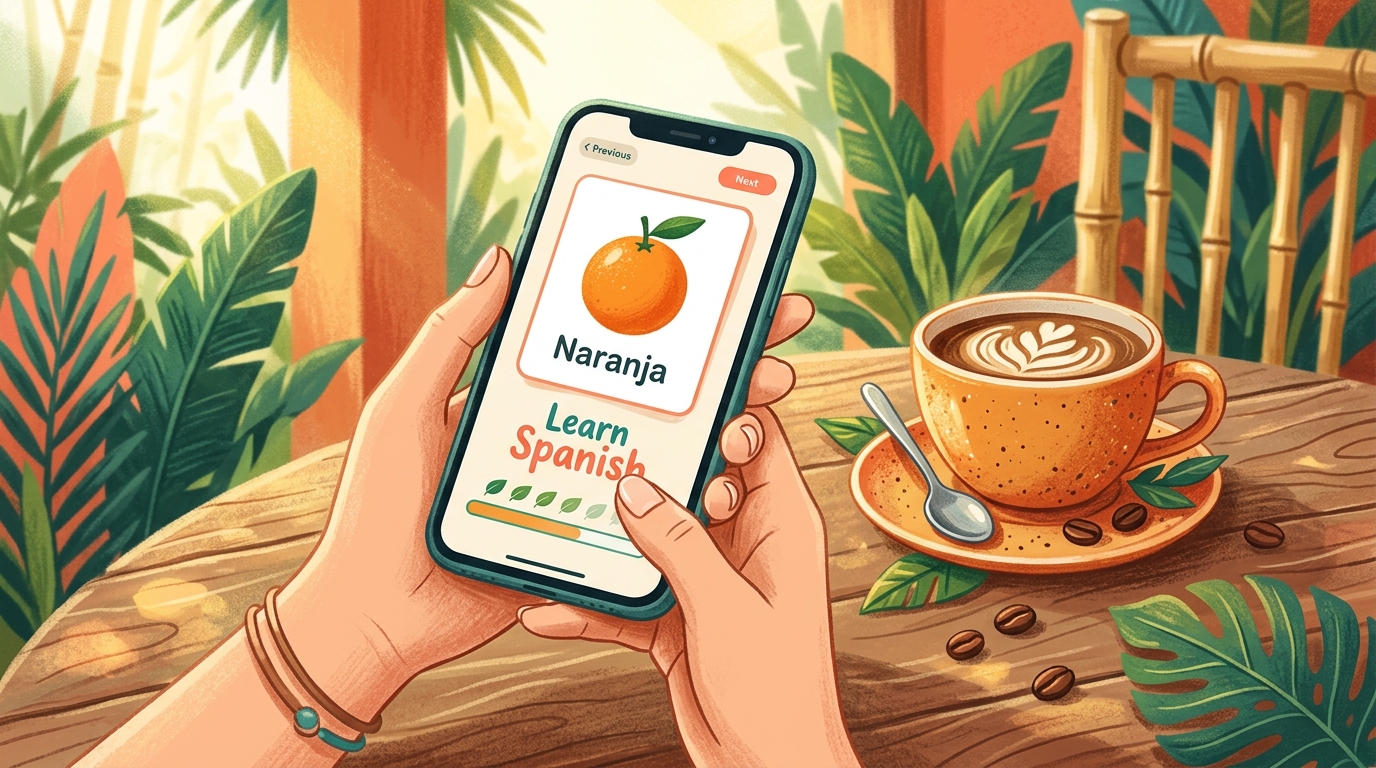
Beyond flashcards, you need output practice. Talk to yourself. Talk to language partners. Journal in the language. Every time you produce the language under time pressure, you're building the pathways that make future production faster. Reading and listening are important, but they build different skills. If you want to speak fluently, you have to speak. (And yes, talking to yourself in the shower counts. I do it constantly and it helps more than most textbook exercises.)
Redefine the goal, change the game
Drop the sound-like-a-native fantasy. It's a bad goal because it's not measurable, not achievable for most adults, and not actually what you need.
Replace it with something concrete. "I want to hold a 20-minute conversation with my Brazilian in-laws without switching to English." "I want to give a five-minute work presentation in Spanish." "I want to read a novel without a dictionary open."
These goals have finish lines. You'll cross them, probably sooner than you think, because you'll actually know what you're aiming at.
Ready to put this into practice? Decko uses spaced repetition and conjugation drilling to make vocabulary stick. Start learning Brazilian Portuguese with flashcards that actually work.
Try Decko FreeRelated Articles

Why adults actually learn languages faster than kids (the research is pretty clear)
6 min read
Interleaving beats blocking: the counterintuitive way to study vocabulary
6 min read

The spacing effect: why cramming fails and distributed practice wins
5 min read