
10 Portuguese False Friends That Trip Up Every English Speaker
These Portuguese words look like English, but mean something completely different. Don't get caught out by these sneaky false friends.
You're having a conversation in Portuguese. Things are going well. Then you confidently use a word that looks exactly like its English equivalent, and suddenly the person you're talking to looks confused, or worse, tries not to laugh.
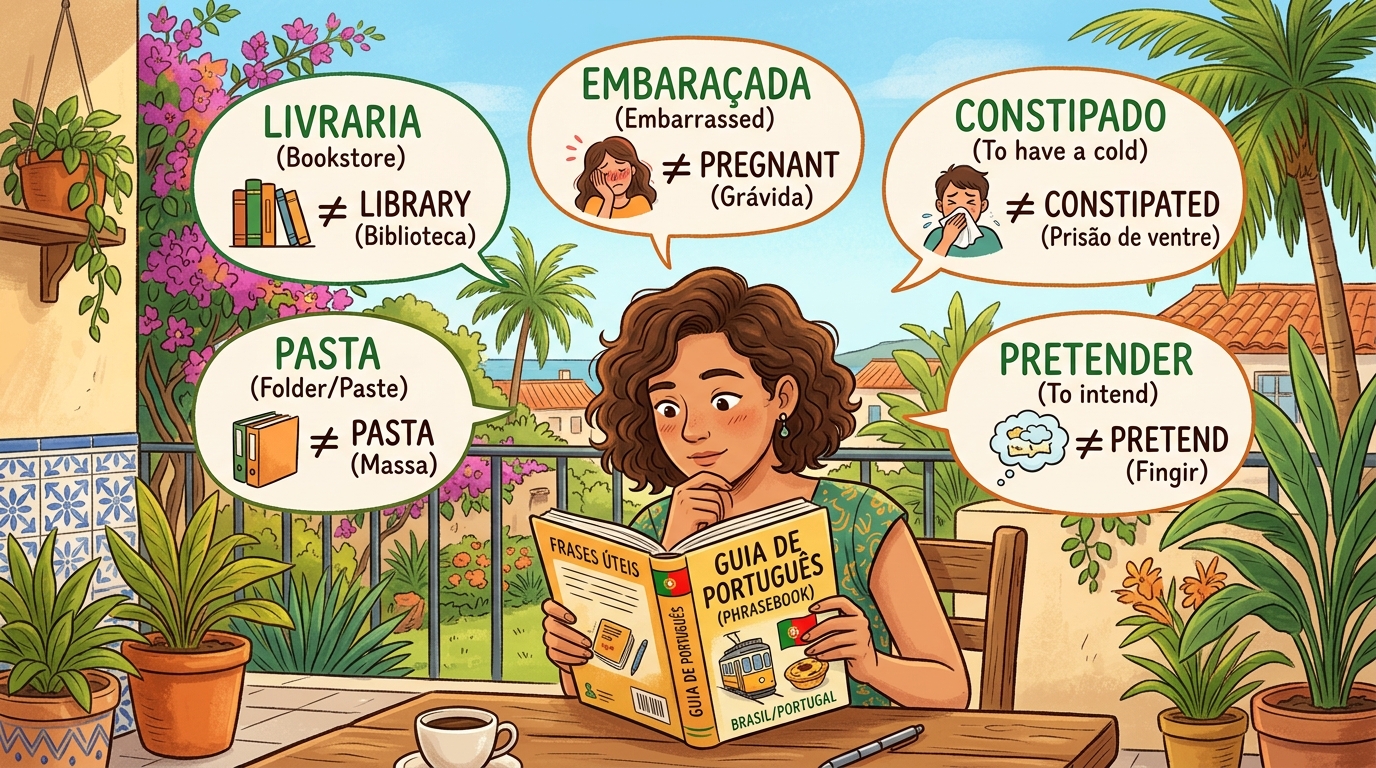
Welcome to the world of false friends (or falsos cognatos, as they're called in Portuguese). These are words that look or sound like an English word but mean something completely different. They're one of the most common traps for English speakers learning Brazilian Portuguese, and they can lead to some genuinely awkward moments.
Here are ten that come up all the time.
The Big Ten
| Portuguese Word | What You Think It Means | What It Actually Means |
|---|---|---|
| polvo | powder | octopus |
| borracha | a female donkey (burro) | rubber / eraser |
| pretender | to pretend | to intend / to plan |
| exquisito | exquisite | weird / strange |
| parentes | parents | relatives |
| costume | costume | habit / custom |
| actually (in reverse) | — | see na verdade below |
| gravidez | gravity | pregnancy |
| policia | policy | police |
| sensível | sensible | sensitive |
Let's look at the ones that cause the most trouble.
Polvo is not powder
If you're at a seafood restaurant and the menu says polvo grelhado, don't expect something sprinkled on your food. You're getting grilled octopus. The word for powder is pó. Mixing these up won't ruin your meal, but it'll confuse the waiter when you ask if the octopus contains gluten.
Pretender means to plan, not to fake
This one catches people constantly. If a Brazilian friend says pretendo viajar ano que vem (I plan to travel next year), they're not claiming they have fake travel plans. They mean I'm planning to travel next year. The verb for actually pretending is fingir. Getting these mixed up can make your sentences sound very strange.
Esquisito is weird, not wonderful
Spelling note: it's esquisito, not exquisito. If you tell someone their cooking is esquisito, you've just called it strange or odd, not exquisite. The Portuguese word you want for something genuinely impressive is requintado or just incrível (incredible). You'll avoid the awkward dinner table moment.
Parentes are not your parents
This trips up almost everyone early on. Meus parentes means my relatives, the whole extended family. Your actual parents are meus pais. So when someone asks about seus parentes, they might be asking about your cousins and aunts, not just the people who raised you.

Gravidez has nothing to do with gravity
The word gravidez means pregnancy. Gravidade means gravity (both the physical force and the seriousness of a situation). These are related etymologically, both coming from the Latin gravis (heavy), but in everyday conversation they're completely separate. Confusing them in a medical context would be extremely confusing for everyone involved.
Sensível means emotionally sensitive
If someone describes you as sensível, they're saying you're emotionally sensitive or easily moved, not that you're a sensible, practical person. For that, you'd want sensato or razoável. The distinction matters a lot in conversation, since these paint very different pictures of a person.
Costume is about habits, not Halloween
Costume in Portuguese means a habit or custom, something you do regularly. É costume aqui means it's the custom here. If you want to talk about an actual costume you wear, use fantasia. So if you ask where to buy costumes for Carnaval, you need to ask about fantasias, or people will think you're asking about local traditions.
Borracha is not a donkey
Okay, you might have been thinking of burra (female donkey) anyway, but the point stands. Borracha means rubber, and often refers to an eraser specifically. If a kid asks you for a borracha in class, they want to borrow your eraser. The material rubber itself (borracha) is used in everything from tires to flip-flops (chinelos), which are practically the national footwear of Brazil.
Learning vocabulary in isolation is one thing, but the real challenge is getting these distinctions to stick before they cause confusion in a real conversation. That's exactly what Decko is built for. When you add a false friend to a spaced repetition deck, you review it right before you'd forget it, which turns a confusing word into a reliable one over time. This is much more effective than a one-time cramming session.
A note on actually
This one works in reverse. English speakers massively overuse the word actually in conversation, and there's no single clean Portuguese equivalent. The closest is na verdade (in truth / actually) or de fato (in fact). But Brazilians don't pepper their speech with it the way English speakers do. If you're translating your English thought patterns directly into Portuguese, you'll sound a bit odd. This isn't a false friend exactly, but it's the same category of problem: assuming the languages map onto each other neatly.
How to actually remember these
The trick with false friends isn't memorizing a list once. It's encountering the correct meaning enough times that the wrong association stops feeling natural.
A few things that help:
Create a dedicated false friends deck. Keep them separate from your regular vocabulary. When you see sensível, you want your brain to immediately flag it as a potential trap, not just retrieve a meaning.
Add example sentences, not just translations. Ela é muito sensível (She's very sensitive) lands differently than just writing "sensitive" next to the word.
Note what you confused it with. If you keep thinking parentes means parents, write that down explicitly: "NOT parents, that's pais." Making the interference explicit helps your brain untangle it faster. Research on interference effects in vocabulary learning (including a 2019 paper in Language Learning by Laufer and Girsai) consistently shows that contrastive practice, working with the confusable pair together, outperforms studying each word independently.
False friends are annoying, but they're also kind of fascinating. The fact that polvo means octopus says something real about etymology and how languages drift apart from shared roots. Once you know these ten, you'll start noticing the pattern, and you'll be harder to trick.
Ready to put this into practice? Decko uses spaced repetition and conjugation drilling to make vocabulary stick. Start learning Brazilian Portuguese with flashcards that actually work.
Try Decko Free