Why adults actually learn languages faster than kids (the research is pretty clear)
The 'kids are language sponges' myth is mostly wrong. Here's what the research actually shows about age and language learning.
You've heard it a hundred times. Kids are language sponges. Adults have missed the window. If you didn't start Portuguese at seven, you're basically doomed to a lifetime of gringo accent and grammatical stumbling.
This is one of the most persistent myths in language learning, and it's mostly wrong.
I say mostly because there's a kernel of truth buried under decades of pop-science distortion. Kids do have an edge in one specific area. But when you look at the actual research on how quickly people acquire a second language, adults win almost every measurable category. The problem isn't your brain. The problem is that nobody told you what the studies actually say.
What the research actually shows
The most cited work here is from Catherine Snow and Marian Hoefnagel-Höhle back in 1978. They tracked English-speaking families who moved to the Netherlands and measured how fast different age groups picked up Dutch. The result surprised a lot of people: adults and adolescents learned faster than young children across almost every metric, including grammar, vocabulary, and pronunciation, in the first year. Kids caught up eventually, but they weren't the fastest learners. They were the slowest.
A 2018 study out of MIT (Hartshorne, Tenenbaum, and Pinker) analyzed data from nearly 670,000 people and found something more nuanced. The ability to reach native-like grammar mastery does decline with age. The drop-off starts around 17 or 18, not at puberty like older theories claimed. But here's what matters: that's a very specific measure. It's about hitting the ceiling of native intuition, not about learning quickly or communicating well.
Nobody tells you this part. Reaching native-like grammar and becoming fluent are not the same goal. Most adult learners don't need to pass as native. They need to hold conversations, read books, watch movies, work in the language. On all of those measures, adults have real advantages.
Where adults actually win
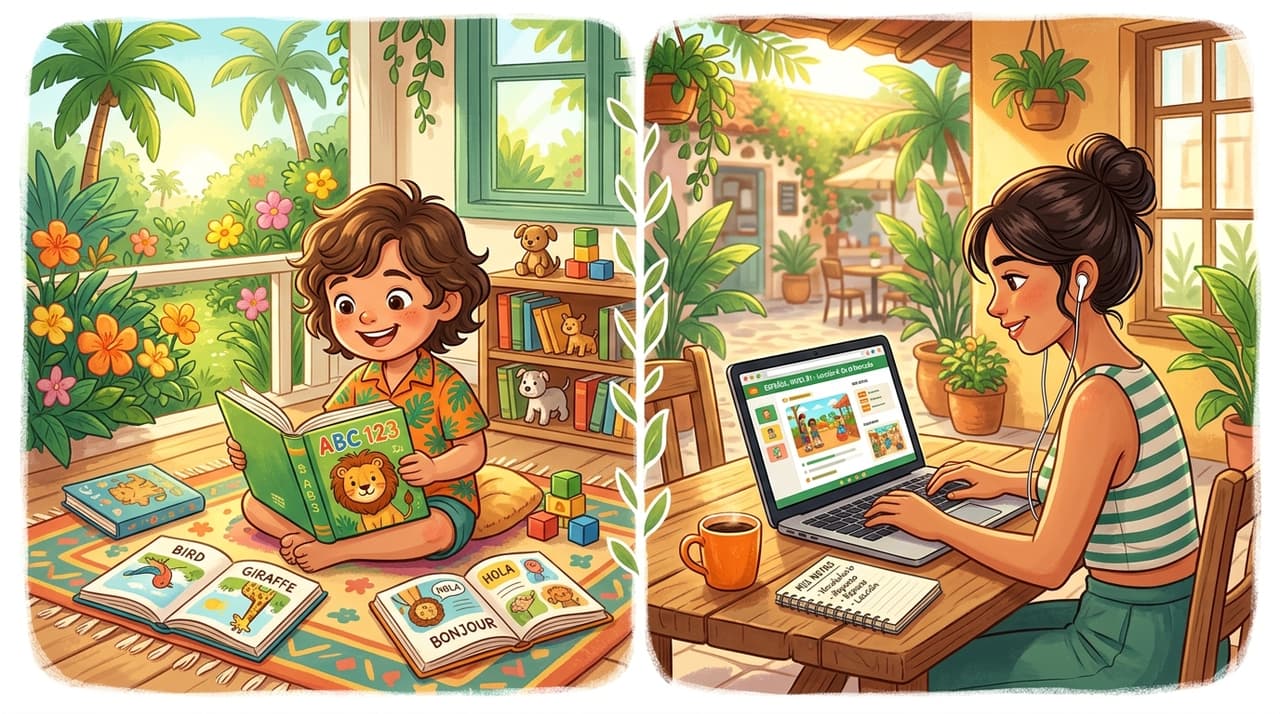
Think about what a five-year-old brings to learning a language. Not much, honestly.
They don't know how their first language works grammatically. They can't look up a word in a dictionary. They can't read explanations. They can't compare structures across languages or ask why something is the way it is. Every hour of their learning has to be raw exposure and pattern matching.
You, on the other hand, have:
- A fully developed native language you can use as scaffolding
- The ability to read grammar explanations and understand them
- Metacognition, meaning you can think about your own thinking and adjust your study
- Life experience that makes vocabulary meaningful (you know what a mortgage is, so hipoteca has something to attach to)
- The ability to sustain focus for more than four minutes at a time
A 2000 study by Krashen, Long, and Scarcella reviewed the literature and concluded that in rate of acquisition, older learners are faster than younger ones in the short term. The kids only pull ahead if you measure ultimate attainment after many years of immersion. Even then, the gap is smaller than the myth suggests.
The one thing kids really are better at
Pronunciation. This is the honest exception.
Getting a truly native accent gets significantly harder after puberty, and there's decent neurological evidence for why. The muscles and neural pathways involved in producing speech sounds calcify around the sounds you grew up with. Adults can improve pronunciation enormously, but hitting zero-accent native-like production is rare.
Having an accent is not the same as being hard to understand, though. Plenty of adult learners speak Portuguese so clearly that Brazilians compliment their command of the language without ever mistaking them for locals. Comprehensibility matters. A native accent is mostly cosmetic.
Why the myth persists anyway
I keep coming back to this question because the evidence has been out there for forty years and people still repeat the sponge metaphor. A few reasons, I think.
Kids look impressive because they start from zero and end up fluent. But they also spend roughly 15,000 hours immersed before they hit conversational competence in their native language. Nobody counts those hours. If you gave an adult 15,000 hours of pure immersion, they'd be extraordinary too.
Adults also embarrass more easily. A kid says something wrong in Portuguese and laughs. An adult says something wrong and goes silent for three weeks. This isn't a cognitive difference. It's a social one, and it shapes how much practice actually happens.
And there's the plateau problem. Adults often start strong and then hit the intermediate plateau, where progress feels invisible. Kids don't experience this as sharply because their whole world is language input. Adults interpret the plateau as evidence that their brain is failing them, when really it's just the natural shape of the learning curve.
What this means for how you should study
Stop apologizing for being an adult learner.
Use the tools kids don't have. Read grammar explanations. Compare Portuguese structures to English ones. Notice patterns and name them. If you already speak another Romance language, lean into that transfer instead of pretending you're starting fresh.
The adult brain is exceptionally good at building on what it already knows. That's the whole game. You don't need to become a child again. You need to use the machinery you have.
Ready to put your adult brain to work? Decko uses spaced repetition tuned for how memory actually works, so your study time compounds instead of evaporating.
The takeaway
Age is a factor. It's not the factor.
Motivation, time invested, method, and consistency all matter more than the calendar. A determined 45-year-old studying an hour a day with good methods will outpace a distracted 12-year-old in a classroom, and it isn't close.
The research has been saying this for decades. The pop-science headlines just haven't caught up. If you've been putting off learning Portuguese because you think you're too old, that excuse is retired. Your brain is ready. It's been ready. The only question is what you do with it.
Ready to put this into practice? Decko uses spaced repetition and conjugation drilling to make vocabulary stick. Start learning Brazilian Portuguese with flashcards that actually work.
Try Decko Free