The Forgetting Curve Is Working Against Your Portuguese (Here's How to Fight Back)
Your brain forgets 70% of new Portuguese vocabulary within 24 hours. Learn how the forgetting curve works and how spaced repetition fights it.
You spent an hour last Tuesday learning 30 new Portuguese words. You nailed them. Padaria (bakery), madrugada (early morning hours), saudade (that untranslatable longing). You felt great. But by Thursday, if someone had quizzed you, you'd have remembered maybe 9 of them. By the following Tuesday? Probably 5 or 6.
This isn't a failure of willpower or intelligence. It's the forgetting curve, a well-documented feature of human memory that directly affects your Portuguese learning.
What Ebbinghaus Discovered (and Why It Still Matters)
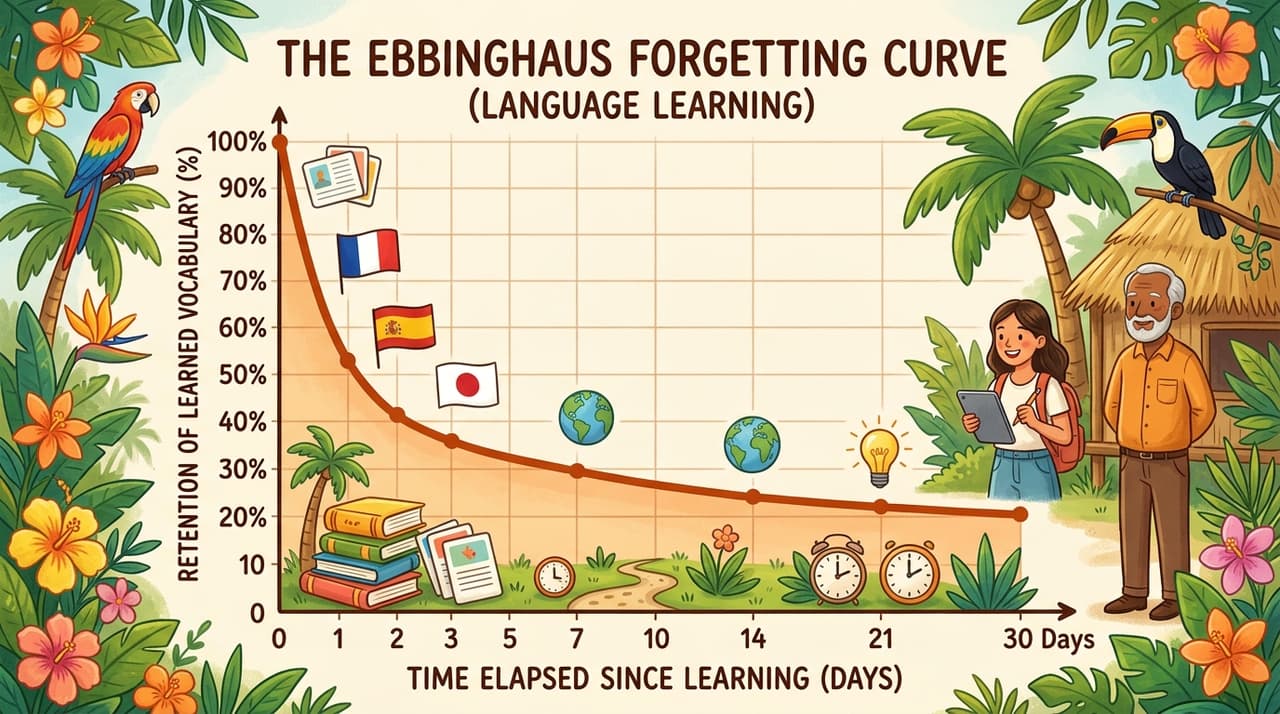
In 1885, German psychologist Hermann Ebbinghaus published Über das Gedächtnis (On Memory). He memorized lists of nonsense syllables (think "ZAT," "BUP," "WOL") and tested himself at increasing intervals to measure how quickly he forgot them.
His findings were striking. Within 20 minutes, he'd already lost about 40% of the material. After one hour, roughly 55% was gone. After 24 hours, he retained only about 33%. The curve then flattened, with the remaining memories decaying more slowly over the following days.
Ebbinghaus was memorizing meaningless syllables. Portuguese words aren't meaningless. They have context, emotional associations, and connections to words you already know. A 2007 study by Baddeley and colleagues in the Quarterly Journal of Experimental Psychology confirmed that meaningful material is retained better than nonsense, but the shape of the curve remains the same. You still forget most new information quickly, then more slowly over time.
The practical implication for language learning? A single study session, no matter how intense, is almost useless for long-term retention.
Why Your Portuguese Study Sessions Feel Productive But Aren't
Here's what typically happens. You sit down with a word list or a textbook chapter. You read through the vocabulary. Maybe you write each word three times. You quiz yourself and get most of them right. You close the book feeling accomplished.
This is what cognitive scientists call the illusion of competence. Robert Bjork at UCLA has spent decades researching this phenomenon. When information feels familiar during a study session, your brain interprets that familiarity as learning. But recognition and recall are very different. Recognizing abacaxi (pineapple) when you see it on a list is easy. Producing it from memory when you're at a fruit stand in São Paulo is hard.
The forgetting curve explains why. Your brain has no reason to consolidate a memory that it encounters only once. From an evolutionary perspective, information you encounter repeatedly at spaced intervals signals importance. Information you encounter once, even for an extended period, doesn't.
The Fix: Spacing and Retrieval
Two principles from cognitive science directly counteract the forgetting curve.
Spaced repetition means reviewing material at gradually increasing intervals. Instead of studying abacaxi five times in one session and never again, you study it once today, once tomorrow, once in three days, once in a week, then once in two weeks. Each successful retrieval strengthens the memory trace and extends the time before you'd forget it.
A 2019 meta-analysis by Latimier et al., published in Educational Psychology Review, examined 29 studies on spaced practice in educational settings. They found that spacing produced a moderate-to-large effect on long-term retention (Cohen's d = 0.62), with benefits increasing as the final test was delayed further from the study period. In plain language: spacing doesn't just help you remember longer, it helps more the longer you need to remember.
Active recall is the second piece. Instead of rereading a word and its translation, you look at the English word and force yourself to produce the Portuguese from memory. Or better yet, you type it out. This retrieval effort builds durable memory. A landmark 2008 study by Karpicke and Roediger in Science found that students who practiced retrieval remembered 80% of material on a delayed test, compared to 36% for students who only restudied.
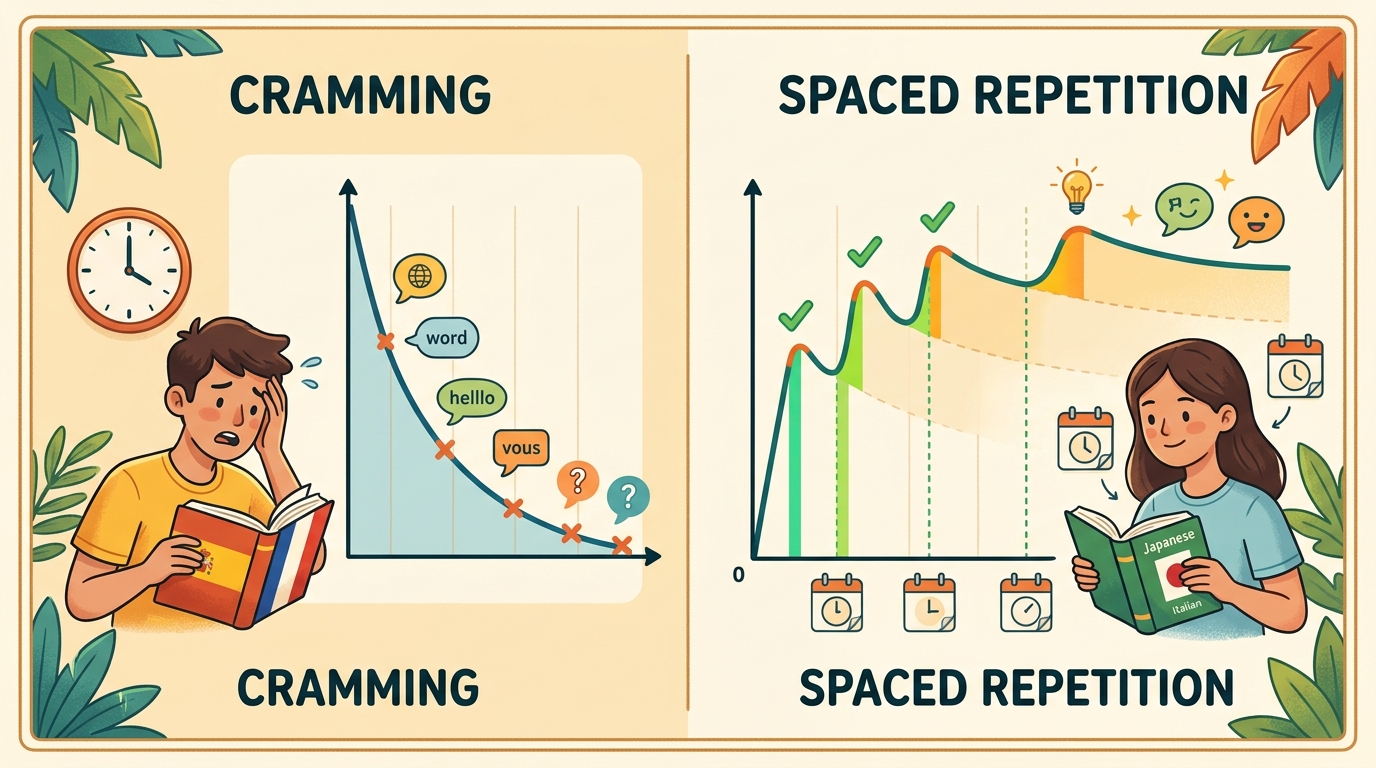
These two principles together are why flashcard systems built on spaced repetition algorithms outperform virtually every other vocabulary study method.
What This Looks Like in Practice
Let's say you're learning the tricky distinction between ser and estar. On day one, you study a card that asks you to fill in the blank: "Ela ___ cansada" (She is tired). You type está and get it right. The algorithm schedules your next review for tomorrow.
The next day, you get it right again. Next review: 3 days from now. Then 8 days. Then 18 days. Each time you successfully recall it, the interval grows. If you get it wrong at any point, the interval resets to something shorter.
This is exactly how Decko works. The algorithm tracks your performance on every card and schedules reviews at the optimal moment, right before you're about to forget. You're not wasting time re-studying words you already know well, and you're catching the ones that are about to slip away. If you want to put the forgetting curve to work for you instead of against you, give it a try.
The beauty of this system is efficiency. A 2016 study by Settles and Meeder at Duolingo (published at ACL) analyzed data from millions of language learners and found that a well-calibrated spaced repetition model could predict, with high accuracy, exactly when a learner would forget a given word. Personalized scheduling based on that prediction led to measurably better retention.
Practical Tips to Maximize Retention
Understanding the science is useful, but here's how to apply it day to day.
| Strategy | Why It Works | Example |
|---|---|---|
| Review daily, even for just 10 minutes | Prevents the steep initial drop of the forgetting curve | Morning coffee + review cards |
| Type your answers instead of flipping cards | Forces active recall instead of passive recognition | Type padaria instead of just thinking it |
| Add personal context to new words | Meaningful connections resist forgetting better than isolated facts | "I learned madrugada because my flight to Recife left at 4am" |
| Learn words in phrases, not isolation | Contextual encoding creates multiple retrieval cues | Learn dar uma olhada (take a look) instead of just olhada |
| Don't skip "easy" reviews | The algorithm needs data points to schedule correctly | Trust the system, even when a card feels too simple |
One thing to watch for: avoid the temptation to add 50 new cards a day. A 2021 study by Tabibian et al. in Nature Human Behaviour modeled optimal learning rates and found that learners who added new material at a pace they could sustainably review performed significantly better long-term than those who front-loaded their study. For Portuguese, 10 to 15 new words per day is a pace most people can maintain.

The Forgetting Curve as Your Ally
The forgetting curve isn't your enemy. It's a filter. Your brain can't hold everything, so it holds what seems important, and importance is signaled by repeated, spaced encounters. Every time you successfully pull a Portuguese word out of memory at just the right moment, you're telling your brain: keep this one.
This is why people who study Portuguese for 15 focused minutes a day, every day, consistently outperform people who do marathon 2-hour sessions on weekends. It's not about total hours. It's about how those hours are distributed across time.
So the next time you forget a word you "definitely knew yesterday," don't get frustrated. That's the forgetting curve doing its thing. The question isn't whether you'll forget. You will. The question is whether you have a system in place to catch it before it's gone.
And if you do, even tricky vocabulary like false friends and abstract grammar concepts start to stick. Not because you studied harder, but because you studied smarter, right at the edge of forgetting.
Ready to put this into practice? Decko uses spaced repetition and conjugation drilling to make vocabulary stick. Start learning Brazilian Portuguese with flashcards that actually work.
Try Decko Free