Words that change meaning with an accent mark in Portuguese
In Portuguese, a single accent mark can flip a word's meaning entirely. Here's how to stop confusing avô with avó (and other traps).
Portuguese has this small cruelty built into it: two words can look almost identical, differ by a single mark floating above a vowel, and mean completely different things. Grandfather versus grandmother. I speak versus he spoke. Peach versus sin.
Miss the accent, and you might tell someone you slept with their grandmother when you meant grandfather. That actually happens.
I want to walk through the pairs that trip learners up the most, why they matter, and how to stop mixing them up. This isn't about memorizing accent rules (that's a different rabbit hole). It's about knowing which specific words carry a heavier load than the accent mark makes them look like they should.
The accent marks you'll actually see
Brazilian Portuguese uses four main marks on vowels: the acute (á, é, í, ó, ú), the circumflex (â, ê, ô), the tilde (ã, õ), and the grave (à). Each one does a job. The acute usually opens the vowel sound. The circumflex closes it. The tilde nasalizes it. The grave marks a contraction (a + a = à).
Most of the time, accents just tell you where the stress falls or how to pronounce a vowel. But sometimes, they're the only thing separating two totally different words. Which is maddening when you're trying to read at speed.
The classic pair: avô vs avó
Every beginner learns this one the hard way.
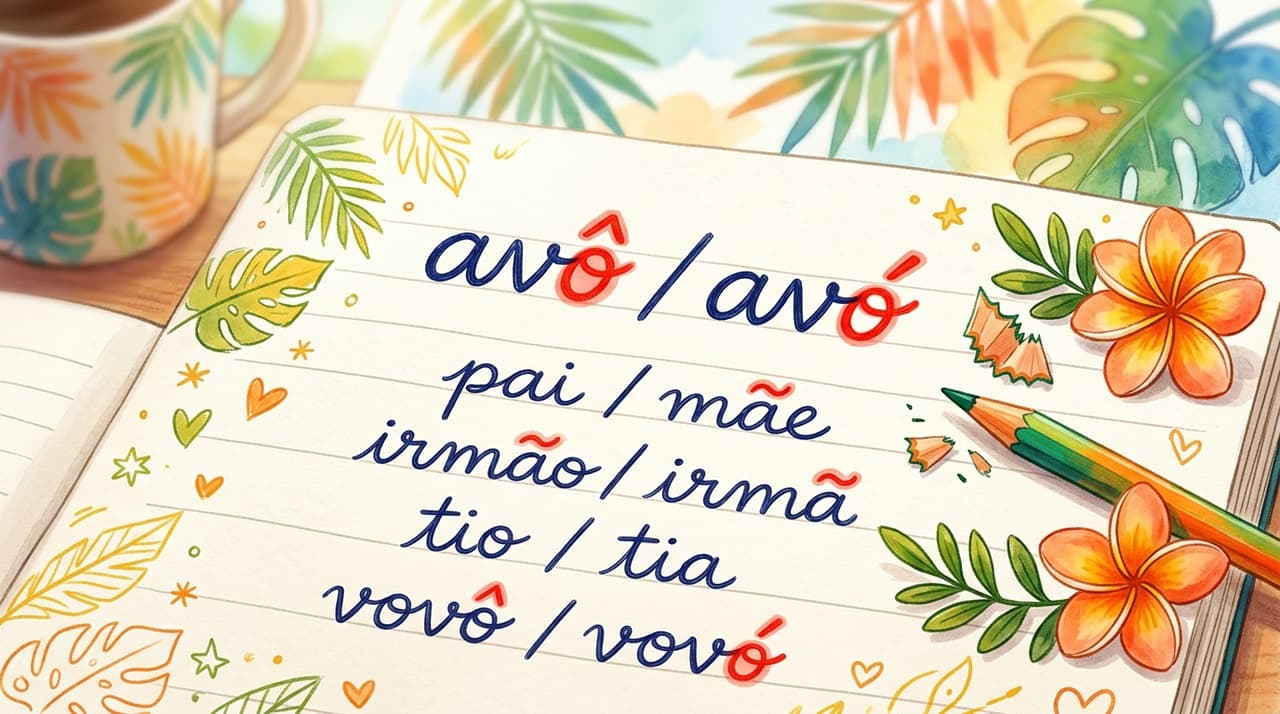
- avô (ah-VOH, closed O) = grandfather
- avó (ah-VAW, open O) = grandmother
Same letters. Different hat on the O. Different grandparent.
The circumflex closes the vowel, so avô sounds like it rhymes with "oh." The acute opens it, so avó sounds closer to the "aw" in "law." Brazilians hear the difference instantly. You will too, eventually. Until then, if you're not sure, just say avós (plural) and let context do the work. Problem solved, dignity intact.
Verbs that shift tense with one mark
Here's where accents get genuinely dangerous. You'll change who did what and when.
| Without accent | With accent | Meaning shift |
|---|---|---|
| falo (I speak) | falou (he/she spoke) | present → past, different person |
| esta (this, feminine) | está (he/she is) | pronoun → verb |
| para (for, to) | pará (stop! — imperative of parar in some dialects) | preposition → command |
| secretaria (secretariat, office) | secretária (secretary, the person) | place → person |
The esta / está confusion is the one I see constantly in writing. "Esta casa" means "this house." "Está casa" is nonsense (or means "is house," which isn't a sentence). When you're texting a Brazilian friend and autocorrect strips your accents, they'll figure it out. But if you're writing anything formal, this matters.
Speaking of practice: spaced repetition handles this well. Seeing avô and avó in different cards, spaced out over days, forces your brain to distinguish them instead of blurring them together. Sign up for Decko and you can build a deck of accent-sensitive pairs in about ten minutes. It's boring but it works.
Nouns that swap meaning entirely
Some pairs aren't just tense shifts. They're totally unrelated words that happen to share letters.
- pêssego (peach) vs pecado (sin) — okay, these aren't identical, but learners mix them up because both have that soft opening. The real trap:
- por (by, through) vs pôr (to put) — one is a preposition you use constantly, the other is a verb. "Por favor" means please. "Pôr a mesa" means to set the table. If you want the full breakdown on por, we have a practical guide to por vs para.
- serie (nothing, misspelling) vs série (series, season of a show) — you'll want série every time you talk about Netflix.
- cadê (where is...?) vs cade (not a word) — cadê is informal Brazilian for "where's my...?" It always has the accent.
I spent an embarrassing amount of time saying "cadê" wrong before someone corrected me. The accent isn't optional.

The tilde changes everything
The tilde (that squiggle over ã and õ) doesn't just tweak pronunciation. It creates a completely new word.
- pao (nothing) vs pão (bread) — you can't order breakfast without the tilde
- mao (nothing) vs mão (hand)
- nao (nothing) vs não (no)
- irma (nothing) vs irmã (sister)
Without the tilde, these aren't just wrong. They aren't words at all. Brazilians will understand what you mean from context, but if you're reading, you need to see that squiggle as a full letter, not decoration.
The plural forms are their own puzzle. Pão becomes pães. Mão becomes mãos. Irmã becomes irmãs. There's a whole logic to it that deserves its own article, honestly, because it follows patterns that make sense once you see them but look random at first.
The grave accent (à) has one job
You'll only see the grave accent on the letter A, and it means a contraction happened. Specifically, the preposition a (to) collided with the article a (the).
- vou a a praia → vou à praia (I'm going to the beach)
- até a as sete → até às sete (until seven)
The grave accent is honestly one of the more forgiving parts of Portuguese. Miss it in casual writing and nobody cares. Miss it on a job application and you'll look sloppy. Know the rule, apply it when it counts.
How to actually remember these
Don't memorize a list. Lists die in your notebook.
Pick five pairs that matter to you. Avô/avó is a good start. Put them in flashcards where you have to type the correct one from a context sentence, and review them over days, not hours. The reason typing beats reading is that it forces you to commit to one answer, which is when the memory actually forms. We wrote more about that in why typing beats reading every time.
And give yourself permission to mess these up out loud. Brazilians are patient. Most will just repeat the word correctly and move on, and that correction, delivered by an actual human in an actual conversation, is worth about fifty flashcards. Both help. Use both.
Ready to put this into practice? Decko uses spaced repetition and conjugation drilling to make vocabulary stick. Start learning Brazilian Portuguese with flashcards that actually work.
Try Decko Free