Active recall vs passive review: why typing beats reading every time
Research shows typing answers is up to 50% more effective than flipping flashcards. Here's why active recall works and how to use it.
You've been studying for thirty minutes. You've flipped through maybe sixty flashcards, tapping "I knew that" on most of them. Feels productive. Feels like you're crushing it.
Except you're probably not.
There's a dirty secret at the heart of most people's flashcard habits: recognizing an answer and producing an answer are two completely different cognitive processes. One of them builds lasting memory. The other mostly builds confidence.
The testing effect: one of the strongest findings in memory research
Cognitive psychologists have a name for what happens when you force your brain to retrieve information instead of passively recognizing it. They call it the "testing effect" (sometimes "retrieval practice"), and it's one of the most replicated findings in learning science.
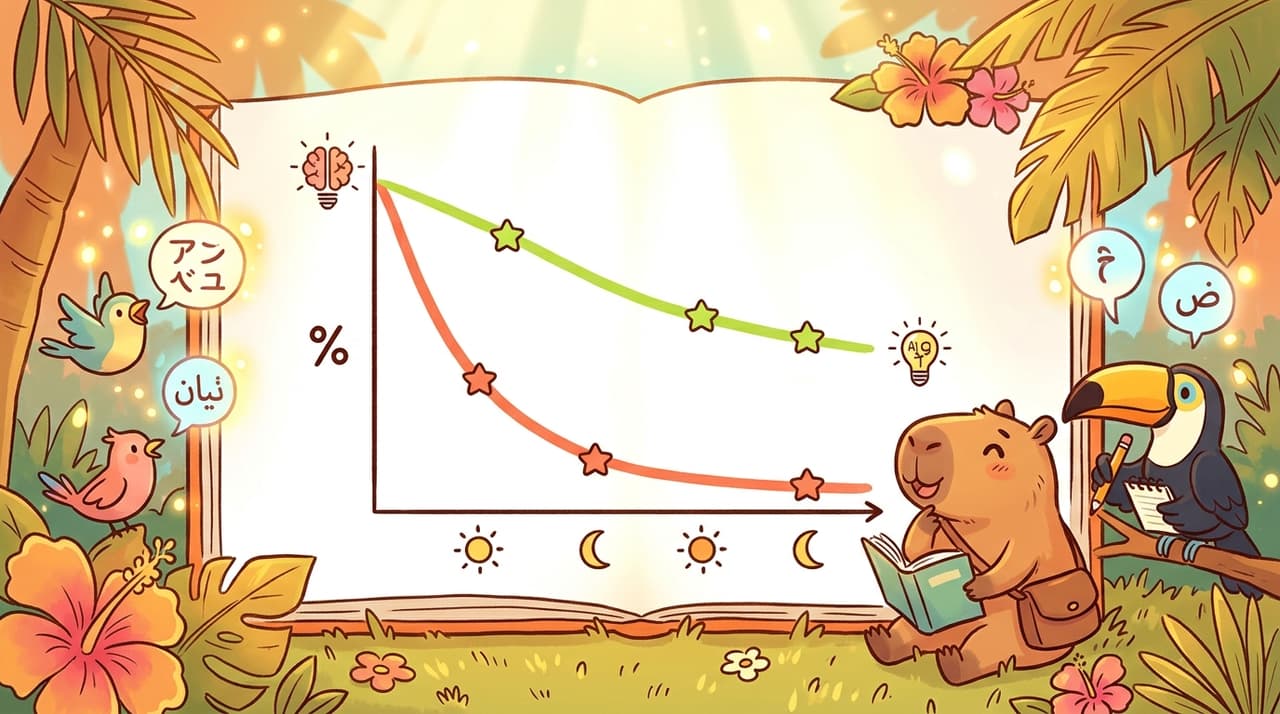
A landmark 2008 study by Karpicke and Roediger in Science put it in stark terms. Students who practiced retrieving information remembered 80% of material after a week. Students who simply re-read the same material? 36%.
That's not a marginal difference. It's more than double the retention.
And the thing that keeps surprising researchers is how universal this is. It doesn't matter if you're memorizing vocabulary, anatomy terms, legal concepts, or historical dates. Forcing your brain to produce the answer, rather than just recognize it, strengthens the memory trace in a fundamentally different way.
The mechanism isn't fully settled, but the leading theory is straightforward: retrieval creates new and stronger pathways to the memory. Every time you successfully pull a word out of your head, you're not just checking that it's there. You're actively reinforcing the route to it. Re-reading doesn't do this. It creates a feeling of familiarity, which your brain happily confuses with actual knowledge.
The fluency illusion: why passive review feels so good
Here's what bugs me about passive review: it's seductive precisely because it's easy. Psychologists call this the "fluency illusion." When you see a Portuguese word and its English translation side by side, your brain processes that pairing smoothly. That smoothness feels like learning. You think, "Ah yes, madrugada means early morning hours, I definitely know that."
But do you?
Close your eyes. If I asked you right now, what's the Portuguese word for those early hours between roughly midnight and dawn? Could you produce madrugada from nothing?
That gap between recognition and production is where most language learning falls apart. You "know" hundreds of words when you see them, but when you're standing in a bakery in São Paulo trying to ask for something, your brain goes blank. Production requires a different, harder, more effortful kind of memory retrieval. And effortful retrieval is exactly what builds durable memory.
A 2011 study by Kornell, Hays, and Bjork found something that captures this perfectly: students who used passive review predicted they'd perform better on a test than students who used active recall. They were wrong. The active recall group outperformed them significantly. We are genuinely bad at judging what's working.
Typing as forced production
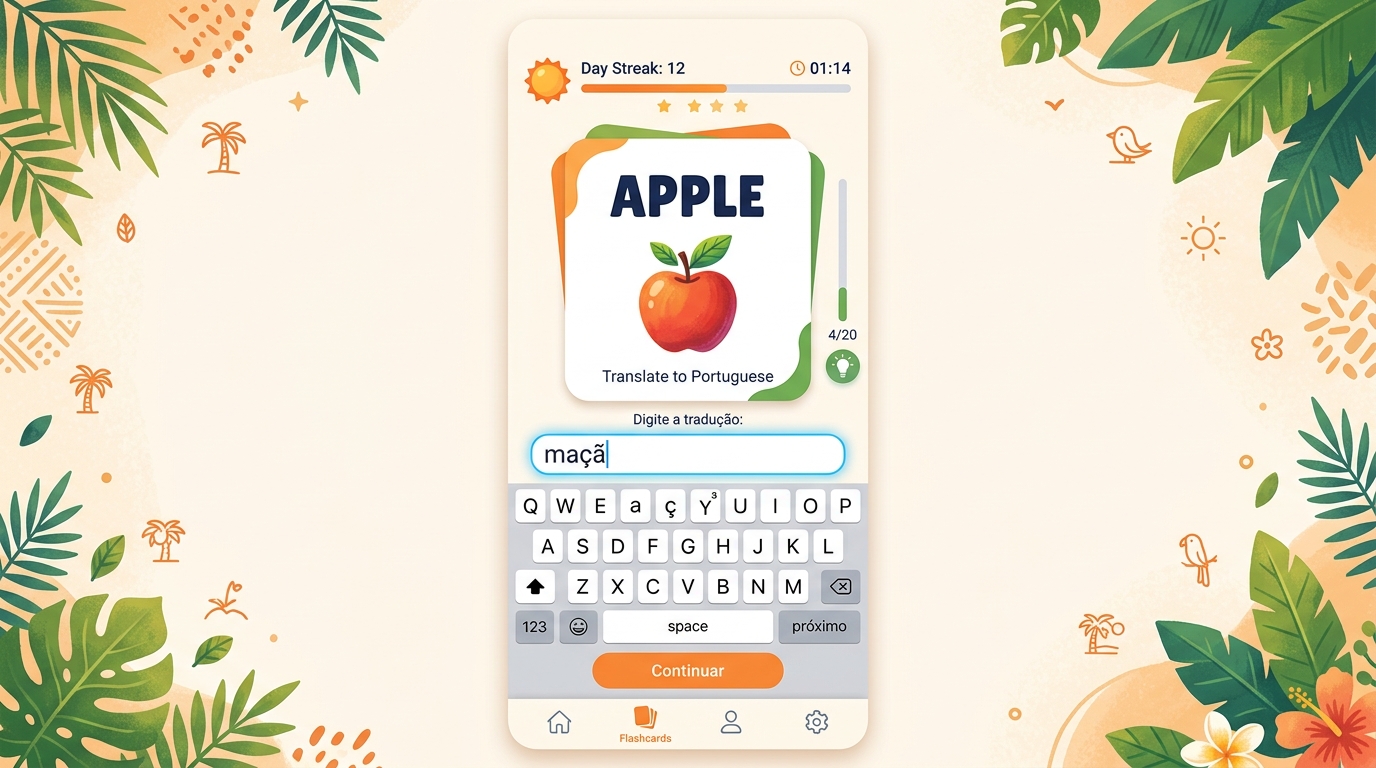
So how does typing fit in? When a flashcard app asks you to type the answer rather than flip a card and self-grade, it's forcing production. You can't fake it. You can't squint at abacaxi and say "oh yeah, pineapple, I knew that" when really you were 60% sure and the card's appearance jogged your memory.
Typing is a commitment. You either know that saudade is the answer or you don't. There's no "kinda knew it" when there's a text field staring at you.
This matters more than people realize. Research on the "judgment of learning" problem shows that self-grading on traditional flashcards is unreliable. People overestimate their knowledge by 20-30% on average, according to a meta-analysis by Rhodes and Tauber (2011) in Memory & Cognition. Every time you generously mark a card as "Good" when you were actually guessing, you're telling the algorithm to show it to you later than it should, and the word slips further away.
Typing removes that entire failure mode.
But doesn't typing take longer?
Yes. A typing-based review session takes 2-3x longer per card than a tap-to-reveal session.
But here's the math that matters: if you remember 80% of typed cards versus 50% of passively reviewed cards, you need far fewer total reviews over time. The cards graduate faster. You spend less time re-learning things you thought you already knew.
A 2015 study by van den Broek et al. in Applied Cognitive Psychology compared typed responses versus recognition-based responses for foreign vocabulary. The typing group needed 40% fewer total review sessions to reach the same level of long-term retention. Less time, not more, when you zoom out past a single study session.
This is the counterintuitive part: the slower method is faster in the long run.
When passive review still makes sense
I don't want to be absolutist about this. There are situations where recognition-based review has its place.
Listening comprehension, for one. When you're training your ear to recognize spoken words, you need exposure, not production. Reading practice is similar. If you're working through a Brazilian news article and encountering words in context, that's not "passive" in the lazy sense. Your brain is doing real work connecting form to meaning in a natural setting.
Early-stage learning benefits from some passive exposure too. When you first encounter a word, seeing it a few times with its translation helps build an initial memory trace before you have anything to retrieve. The shift to active recall should happen quickly though, probably after the first or second exposure.
The problem isn't that passive review exists. The problem is that most people never graduate from it.
Making active recall work in practice
If you're convinced (and the research really is overwhelming on this), here's how to actually implement it.
First, use a flashcard system that requires typed responses rather than self-grading. This is exactly why Decko is built around typing, rather than the traditional flip-and-tap model. The mild friction of typing is the whole point.
Second, combine active recall with spaced repetition. These two techniques are complementary. Spaced repetition tells you when to review. Active recall determines how you review. Together, they're the closest thing to a cheat code that learning science has found.
Third, embrace the difficulty. When you're staring at a blank text field trying to remember how to conjugate fazer in the preterite and your brain hurts a little? That's the desirable difficulty that Bjork and Bjork (2011) write about. That struggle is the learning happening in real time. The moment it feels easy is the moment you should worry you're not actually learning.
The uncomfortable bottom line
I keep coming back to that Karpicke and Roediger number. 80% versus 36%.
Most language learners I talk to are doing some version of passive review. They scroll through word lists. They flip digital flashcards and tap "Easy" a little too generously. They watch Portuguese TV (which is great for other reasons, but won't build your productive vocabulary on its own).
If you change one thing about how you study, make it this: stop recognizing and start producing. Type the answer. Write it. Say it out loud. Do whatever forces you to pull the word from your memory rather than letting your eyes confirm it was there all along.
Your brain will resist. It prefers the easy path. That's exactly why the hard path works.
Ready to put this into practice? Decko uses spaced repetition and conjugation drilling to make vocabulary stick. Start learning Brazilian Portuguese with flashcards that actually work.
Try Decko Free