How to remember Portuguese gender (o vs a) without memorizing rules
Struggling with Portuguese masculine and feminine nouns? These practical memory tricks go beyond the textbook rules.
Every Portuguese learner hits the same wall. You learn that o gato (the cat) is masculine and a casa (the house) is feminine, and you think: okay, I just need to memorize which is which for every single noun in the language.
That's thousands of nouns. Your brain politely declines.
Portuguese gender isn't the random lottery it feels like. There are real patterns, and once you see them, you stop memorizing and start predicting. I won't pretend every noun plays by the rules. But most do, and the ones that don't? There are tricks for those too.
The endings that do the heavy lifting
Let's start with the good news. Portuguese is remarkably consistent about gender when it comes to word endings. Not perfectly consistent, but consistent enough to be genuinely useful.
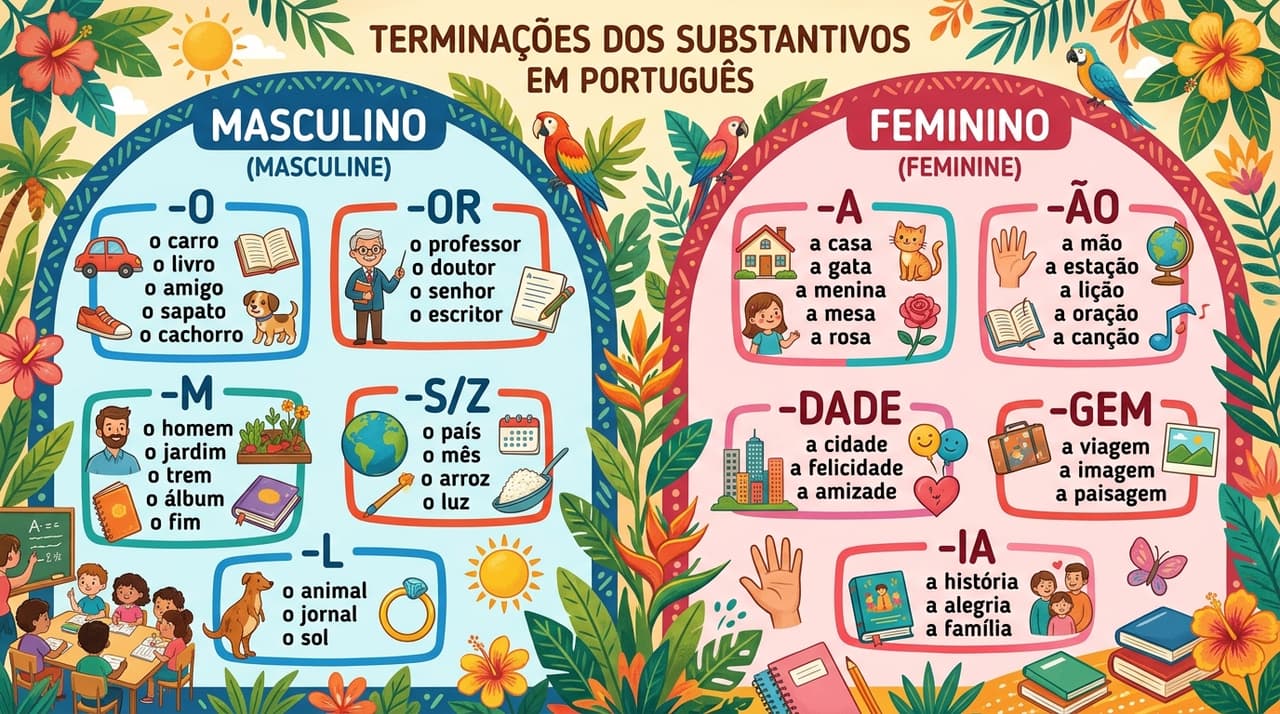
Most nouns ending in -o are masculine. Most nouns ending in -a are feminine. You already knew that. But here's where it gets more interesting.
Masculine endings you can bet on:
| Ending | Examples | Translation |
|---|---|---|
| -o | o livro, o carro | the book, the car |
| -or | o amor, o calor | love, heat |
| -mente | (this one's actually an adverb, skip it) | |
| -l | o papel, o animal | paper, the animal |
| -r | o lugar, o mar | the place, the sea |
Feminine endings that almost never betray you:
| Ending | Examples | Translation |
|---|---|---|
| -a | a mesa, a porta | the table, the door |
| -ção | a informação, a situação | information, the situation |
| -dade | a cidade, a felicidade | the city, happiness |
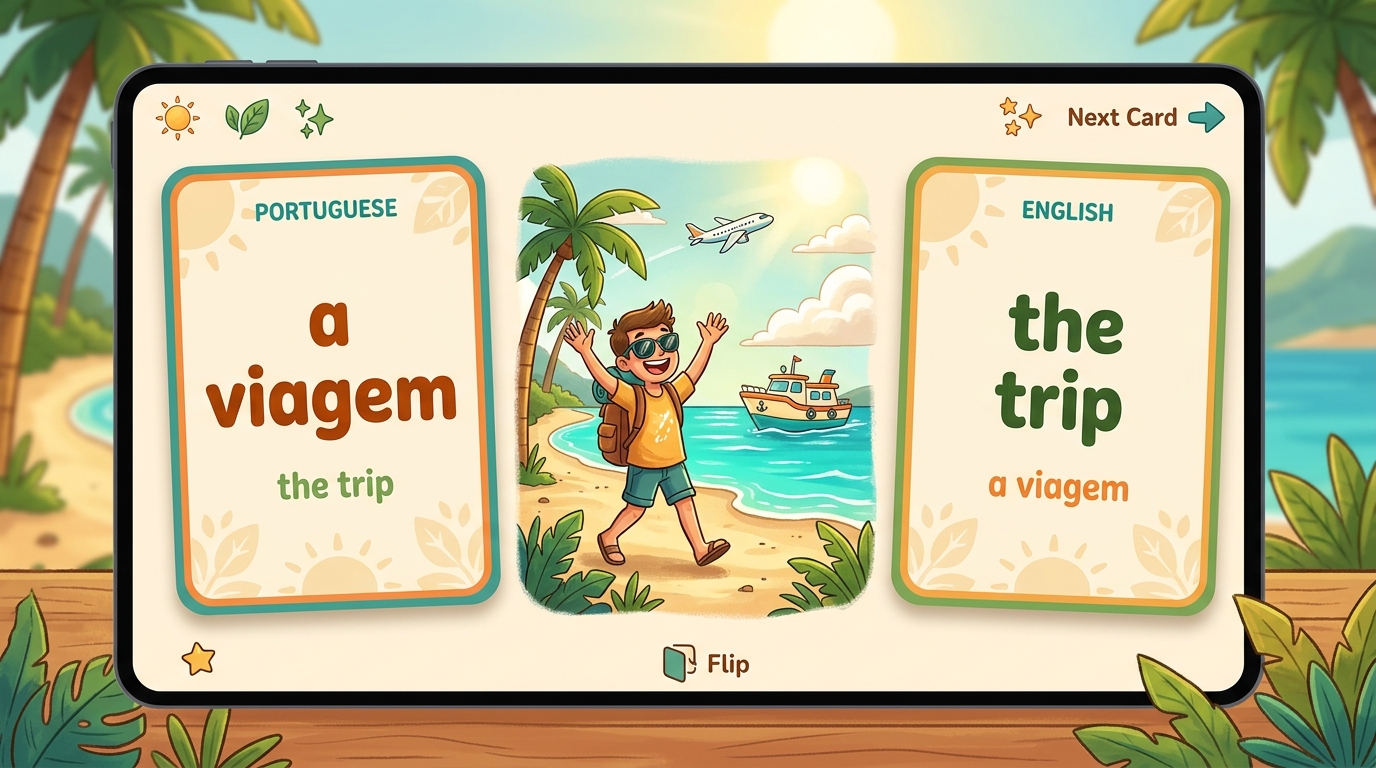
| -gem | a viagem, a mensagem | the trip, the message |
| -ência/-ância | a diferença, a importância | the difference, importance |
That -ção ending alone covers hundreds of Portuguese words. Every single one is feminine. No exceptions. Same with -dade and -gem. Internalize just these three patterns and you've eliminated a huge chunk of guesswork.
The troublemakers
Now for the nouns that love to cause problems.
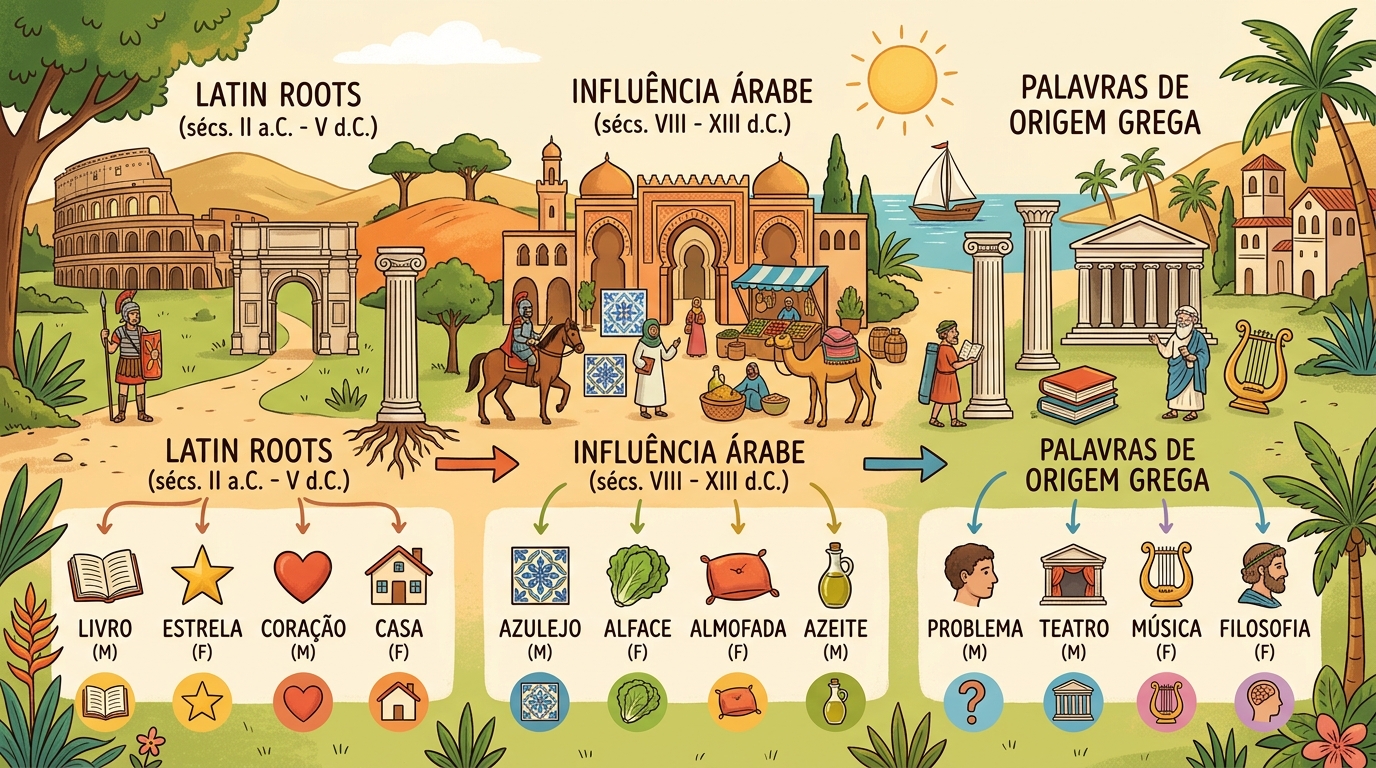
O dia (the day) ends in -a but is masculine. It's probably the most commonly cited exception in Portuguese, and honestly, you just have to learn it. Same with o mapa (the map), o problema (the problem), o sistema (the system), and o cinema (the cinema). Notice something? Several of these come from Greek, where -ma endings were neuter. Portuguese absorbed them as masculine.
Then there's a tribo (the tribe) and a foto (the photo), which end in -o but are feminine. Foto is feminine because it's short for fotografia. Same logic applies to a moto (from motocicleta).
I keep a mental "weird list" of about 15 nouns. That's it. Fifteen exceptions I drilled specifically because they kept tripping me up. Everything else follows the patterns closely enough.
Stop learning nouns naked
This is the single most effective habit change I can recommend: never learn a noun without its article.
Don't put "casa" in your flashcard. Put "a casa." Don't memorize "livro." Memorize "o livro." Every time.
This sounds almost too simple, but there's real science behind it. When you learn a word with its article, your brain encodes the gender as part of the word itself, not as a separate fact attached to it. It's the difference between knowing that your friend's birthday is March 12th because you memorized it from a list, versus knowing it because you've always associated them with that date. One is fragile. The other sticks.
A 2006 study by Bordag and Pechmann in the journal Bilingualism: Language and Cognition found that L2 learners who practiced nouns with determiners showed significantly better gender accuracy than those who learned bare nouns and tried to apply rules later. The article-first group wasn't faster at reciting rules. They just... knew.
If you're using Decko to build your vocabulary, every Portuguese card already pairs the noun with its article. That's deliberate. The repetition bakes gender into muscle memory so you don't have to consciously think about it mid-conversation.
The color trick (weird but it works)
Here's a technique that feels silly until you realize how well it works.
Pick two colors. Blue for masculine, red for feminine (or whatever pairing feels natural to you). When you encounter a new noun, briefly visualize the object in that color. O sol (the sun)? Picture a blue sun. A lua (the moon)? Red moon.
You're essentially giving your visual memory system a job. And visual memory is absurdly powerful compared to rote memorization. You won't need to do this forever. After a few weeks of practice, the gender starts feeling automatic for words you've visualized. Then you can drop the color crutch.
Some people prefer spatial placement instead: imagine masculine nouns on your left, feminine on your right. Same principle, different sensory channel. Experiment and see what clicks for your brain.
When you guess, guess smart
You're in a conversation. A noun comes up that you haven't studied. You need to pick o or a right now. What do you do?
First: check the ending. Apply the patterns above. That'll get you the right answer maybe 80% of the time.
Second: if it's a word for a person, the gender usually matches the person's actual gender. O professor (male teacher), a professora (female teacher). This seems obvious, but in the panic of live conversation, obvious things need stating.
Third: if you truly have no idea, just pick one and keep talking. Brazilians will understand you perfectly even if you get the gender wrong. I've heard fluent non-native speakers occasionally slip on gender after years of living in Brazil. It's not a communication breakdown. It's a minor rough edge.
The goal isn't perfection on day one. It's building pattern recognition over time so the right article feels wrong when you pick the wrong one.
The patterns behind the patterns
Something that helped me was realizing that Portuguese gender isn't arbitrary, it's just old. The masculine/feminine assignments trace back through Latin, and sometimes through Arabic (Portuguese absorbed around a thousand Arabic words during the Moorish period). When a aldeia (the village) is feminine, it's because the Arabic source word carried that gender centuries ago.
You don't need to study etymology to learn Portuguese. But knowing that there is a reason, even a historical one, makes the whole system feel less like chaos.
Building the instinct
Gender accuracy in Portuguese isn't about memorizing a giant table. It's a pattern recognition skill, and like any skill, it improves with the right kind of practice.
Learn nouns with their articles. Always. Spaced repetition will handle the long-term retention. The ending patterns will cover most of what you encounter. And for the handful of weird exceptions, a short list and some active recall practice will get them locked in faster than you'd expect.
After a few months, you won't be thinking about rules at all. You'll just hear someone say o problema and it'll sound right. That's the instinct. And it's closer than you think.
Ready to put this into practice? Decko uses spaced repetition and conjugation drilling to make vocabulary stick. Start learning Brazilian Portuguese with flashcards that actually work.
Try Decko Free