Por vs para: a practical guide that finally sticks
Por vs para in Portuguese confuses every learner. Here's a practical breakdown with real Brazilian examples that will actually stick in your head.
If you've spent any time learning Portuguese, you've probably stared at a sentence wondering whether to use por or para and just guessed. You're in good company. These two prepositions cause more second-guessing than almost anything else in the language, and Spanish speakers don't get a free pass either, the rules don't map perfectly between the two languages.
Nobody tells you this upfront: native Brazilians aren't running through a mental checklist when they pick one. They feel it. Our job is to get to that same feeling, and the fastest way is through patterns you can actually remember, not abstract rules about "cause vs purpose."
Let's fix this.
The one-sentence version
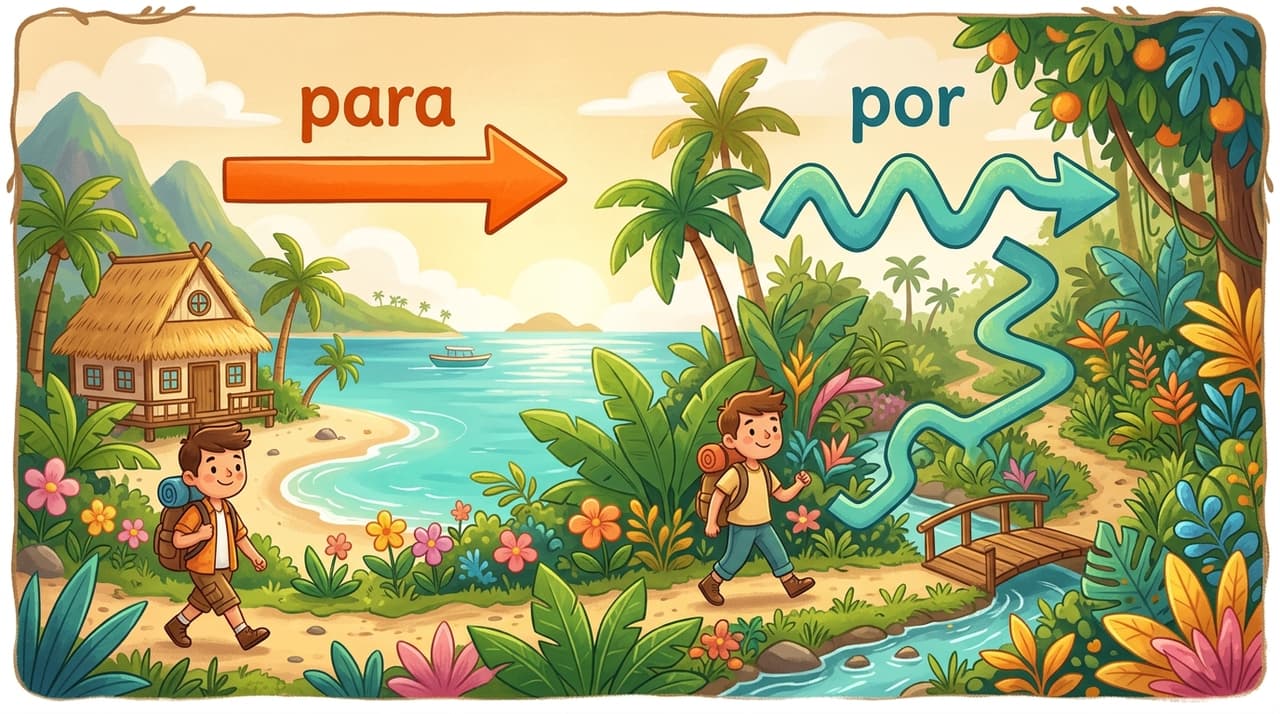
Para points forward. Por points through, around, or because of.
That's the intuition. Para is about destination, recipient, deadline, goal. Por is about the path you took, the reason something happened, the duration you spent, the rate you paid.
If you only remember one thing from this article, remember the arrow. Para = →. Por = the messy stuff in between.
Para: the destination preposition
Use para when there's an endpoint. A place you're going, a person receiving something, a moment in the future, a reason something exists.
- Vou para São Paulo. (I'm going to São Paulo.) Destination.
- Esse presente é para você. (This gift is for you.) Recipient.
- Preciso terminar para sexta. (I need to finish by Friday.) Deadline.
- Estudo português para morar no Brasil. (I'm studying Portuguese in order to live in Brazil.) Purpose.
- Esse copo é para água. (This glass is for water.) Intended use.
Notice how every example has something pointing forward. A goal, a target, a future state. If you can rephrase the English with "in order to" or "intended for," you almost certainly want para.
Quick Brazilian note: in spoken Portuguese, para often gets crushed down to pra. Vou pra praia. (I'm going to the beach.) It's not slang exactly, it's just how people talk. Write para, say pra.
Por: the messy middle preposition
Por is harder because it does more jobs. But they all share a flavor: cause, path, exchange, duration. The thing happening through something else.
- Passei pelo parque. (I went through the park.) Path. Note: por + o contracts to pelo.
- Obrigado por tudo. (Thanks for everything.) Cause or reason.
- Comprei por dez reais. (I bought it for ten reais.) Exchange.
- Estudei por duas horas. (I studied for two hours.) Duration.
- Foi escrito por ela. (It was written by her.) Agent of a passive sentence.
- Trocaram meu pedido por outro. (They swapped my order for another.) Substitution.
The contractions matter. People forget them constantly, which is frustrating because they're not optional. Por + o = pelo, por + a = pela, por + os = pelos, por + as = pelas. Andei pela cidade. Not por a cidade. If you say it the wrong way, Brazilians will understand you, but it sounds off the way "I goed to store" sounds off in English.
The pairs that will burn the rules into your brain
This is the trick that finally made it click for me. Compare these sentences side by side and feel the difference.
| Portuguese | English | Why |
|---|---|---|
| Trabalho para essa empresa. | I work for that company (as my employer). | Destination of effort |
| Trabalho por essa empresa. | I work on behalf of that company (representing it). | Cause/reason |
| Fiz isso para você. | I did this for you (as a gift). | Recipient |
| Fiz isso por você. | I did this because of you (you're the reason). | Cause |
| Saiu para o Rio. | She left for Rio (heading there). | Destination |
| Saiu pelo Rio. | She left through Rio (passing through). | Path |
Read those out loud a few times. The pattern is genuinely there once you stop trying to translate word by word.
A CTA, but a relevant one
This is exactly the kind of grammar distinction that disappears from your brain three days after you learn it. You read an article like this, nod along, then blank in a real conversation. The fix isn't more reading, it's spaced repetition with the actual sentence pairs above. Decko is built for this: drop these contrasting examples into a deck, and the app schedules them so you see them right when you're about to forget. By the third or fourth review, por and para stop being a coin flip.
Fixed expressions you just have to memorize
Some phrases lock in one preposition no matter what the rule says. These are worth drilling as units, don't try to derive them.
With por: por favor (please), por exemplo (for example), por enquanto (for now), por isso (that's why), por acaso (by chance), por fim (finally).
With para: para sempre (forever), para que? (what for?), estar para + infinitive (to be about to).
Don't overthink these. Treat them like vocabulary, not grammar. I wasted probably two weeks trying to "understand" why por favor uses por before I just accepted it and moved on.
The mistake almost every English speaker makes
English uses "for" for both purpose and duration, and that's the trap. "I studied for two hours" and "I studied for the test" use the same preposition in English, but Portuguese splits them.
- Estudei por duas horas. (Duration → por)
- Estudei para a prova. (Goal → para)
If you can substitute "during" without breaking the meaning, use por. If you can substitute "in order to" or "toward," use para. This single test catches maybe 70% of the cases where English speakers go wrong.
If grammar pairs like this are your weak spot in general, the trick of comparing sentences side by side also works wonders for ser vs estar and for choosing between preterite and imperfect. Same principle every time: don't memorize rules in isolation, memorize the contrast.
What to do this week
Pick five sentences from your life, things you actually want to say, and write each one with por and para side by side. Force yourself to feel why one is wrong. "This coffee is for me" → para mim. "Thanks for the coffee" → pelo café. The more you create personal examples, the faster the intuition shows up.
And when you mess it up in conversation, which you will, nobody will care. Brazilians are remarkably forgiving about prepositions. Get the verb right and they'll fill in the rest.
Ready to put this into practice? Decko uses spaced repetition and conjugation drilling to make vocabulary stick. Start learning Brazilian Portuguese with flashcards that actually work.
Try Decko Free