The spacing effect: why cramming fails and distributed practice wins
The spacing effect is one of the most replicated findings in cognitive science. Here's what it means for your language learning and how to use it.
I keep coming back to one finding in cognitive psychology because it's both incredibly well-replicated and almost universally ignored by students: studying the same material in shorter sessions spread over time produces dramatically better long-term retention than studying it all at once. This is the spacing effect, and Hermann Ebbinghaus first described it in 1885. We've been confirming it ever since. And most of us still cram.
If you've ever spent four hours on Sunday hammering through a vocabulary list and then watched half of it evaporate by Wednesday, you've experienced the cost of ignoring it.
What the research actually shows
In 2006, Cepeda and colleagues ran a meta-analysis of 317 experiments on the spacing effect. The pattern was clear: distributed practice beat massed practice in 259 of them. Not by a little. A 2008 follow-up study by the same lab tested over 1,300 participants learning trivia facts and found that the optimal gap between study sessions depends on how long you want to remember something. Want to remember it for a week? Space your reviews about a day apart. Want to remember it for a year? Space them about three to four weeks apart.
That's the part most people miss. Spacing isn't just "study a bit each day instead of all at once." The gaps themselves carry information about how your memory is being built.
Why does it work?
There are a few competing explanations. They're all partly right, I think.
The encoding variability account says that each time you study in a different context (different mood, time of day, location, mental state), you attach the memory to more retrieval cues. More cues, more ways back to the memory later.
The study-phase retrieval account is more interesting to me. When you encounter a word for the second time after a gap, your brain has to partially reconstruct it from memory. That reconstruction is itself a learning event. The harder the reconstruction (within reason), the stronger the resulting trace. This is sometimes called "desirable difficulty," a term Robert Bjork coined in the 1990s.
The consolidation account points to sleep. Memories get reorganized and stabilized during sleep, and spacing your sessions across multiple days lets multiple consolidation cycles do their work on the same material.
Whatever the precise mechanism, the point is simple: short sessions, spread out, with sleep in between, beat long sessions every time.
Why cramming feels like it works
Here's the trap. Cramming feels effective in the moment. You re-read a list of irregular verbs ten times in a row and by the tenth time you're fluent. You feel like you know them. You probably do, briefly.
This is what cognitive psychologists call the illusion of competence. Fluency in the moment of study gets mistaken for durable learning. The two are almost unrelated. Studies by Karpicke and Roediger have shown that students consistently predict they'll remember crammed material better than spaced material, and they're consistently, badly wrong.
So cramming gets reinforced because it makes the immediate test easier (and there's usually an immediate test), and the long-term cost shows up weeks later when you've forgotten everything and blame yourself rather than the method.
What this means for vocabulary
Language learning is essentially a long-term memory problem. You're not trying to know 2,000 words for Friday's quiz. You're trying to know them in three years, on a phone call, when you can't pause to think.
That means spacing isn't optional. It's the entire game.
A few practical implications:
Twenty minutes a day beats two hours on Saturday. Not by a small margin. The 2008 Cepeda data suggests that consolidating the same study time into a single session can reduce long-term retention by 50% or more compared to spreading it out.
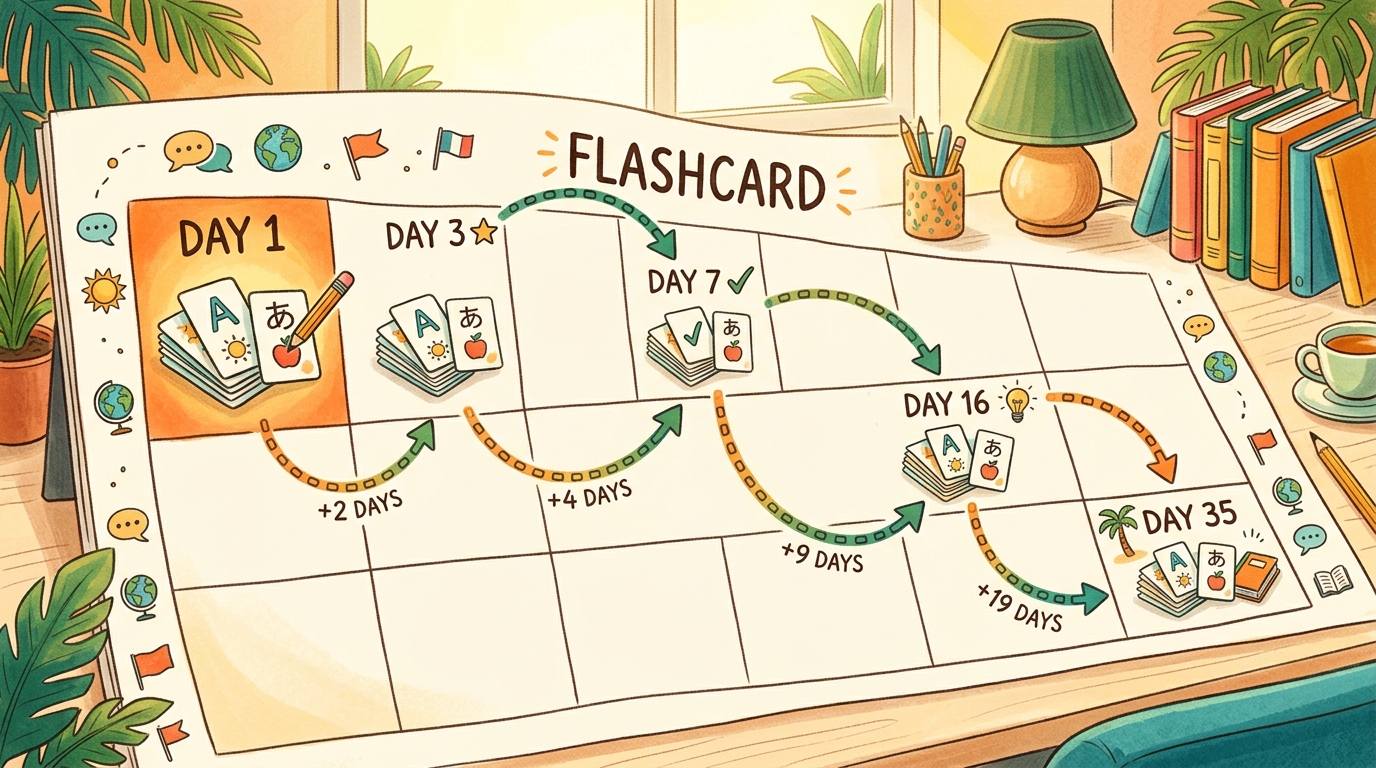
The gap should grow over time. After you learn a word, review it the next day. Then a few days later. Then a week. Then a month. This is the core insight behind every spaced repetition system, from paper Leitner boxes to modern algorithms like FSRS. If you want to understand how the algorithm makes these scheduling decisions, I wrote about how FSRS works separately.
Don't restudy something you just got right. Counterintuitive, but immediate restudy adds almost nothing. The forgetting has to start happening before the next review does its work.
Sign up for Decko and you'll get scheduled reviews that handle the math for you. The whole point of a spaced repetition app is that you don't have to track which words need review when. The algorithm does it, and the science behind that algorithm goes back to Ebbinghaus.
The interaction with forgetting
There's a related point that took me a while to internalize. The spacing effect works because of forgetting, not in spite of it. If you never let yourself forget anything, you never get the strengthening benefit of partial retrieval. This is why apps that show you cards too often actually hurt your long-term learning, even though they feel more reassuring.
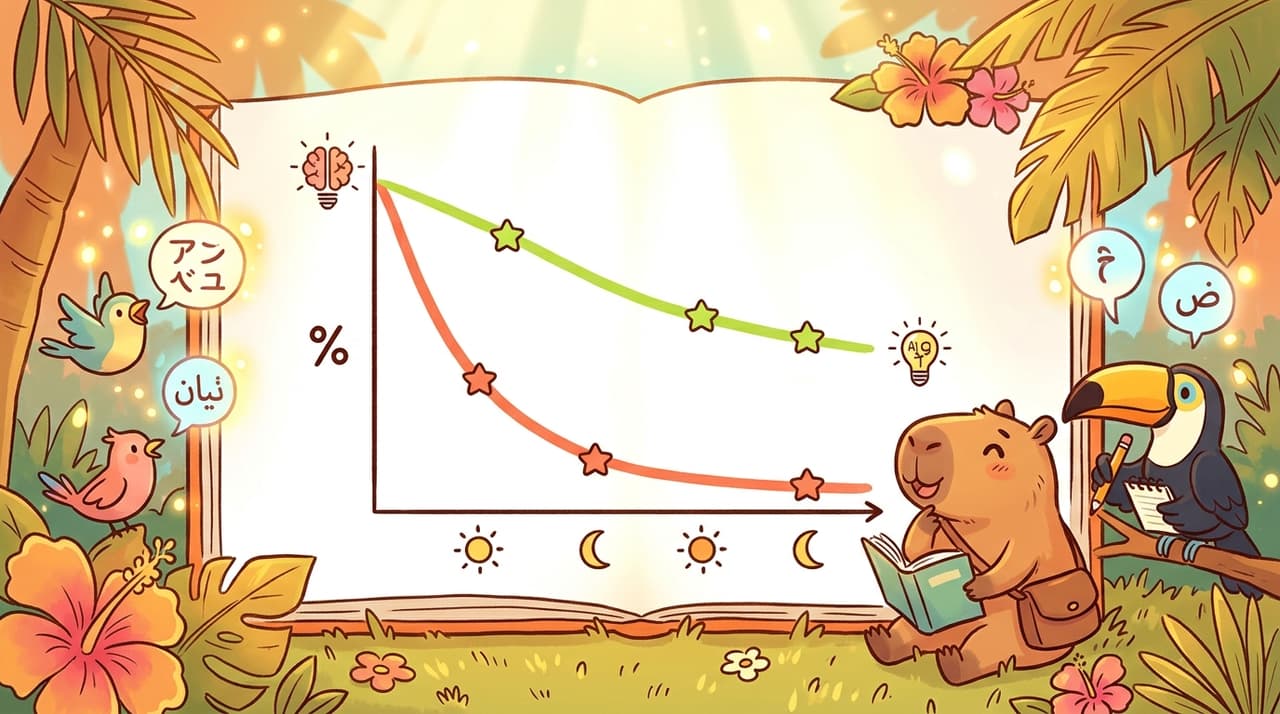
The forgetting curve and the spacing effect are two sides of the same coin. Forgetting is a feature of how memory works, and spaced review uses it strategically.
A small experiment you can run
If you don't believe me, try this. Pick 20 new words on Monday. Study 10 of them for 30 minutes in one sitting. Study the other 10 in three 10-minute sessions spread across Monday, Tuesday, and Wednesday.
Test yourself on all 20 the following Monday. Don't peek before then.
I've never met someone who ran this experiment honestly and didn't end up converting. The gap between the two groups is usually embarrassing.
That's the spacing effect. It won't go viral, but it happens to be one of the most reliable findings in the history of cognitive psychology. And it can change how much of a language you actually retain a year from now.
Ready to put this into practice? Decko uses spaced repetition and conjugation drilling to make vocabulary stick. Start learning Brazilian Portuguese with flashcards that actually work.
Try Decko Free