How FSRS works and why it beats the old flashcard algorithms
FSRS is the algorithm quietly replacing SM-2 in modern flashcard apps. Here's what it actually does differently and why your reviews feel smarter.
If you've used flashcards for more than a few weeks, you've probably noticed something annoying. Some cards keep coming back too often. You know them cold, but the app keeps shoving them in your face. Other cards vanish for months and reappear when you've completely forgotten them. The algorithm feels dumb, because in a real sense it is.
That algorithm is almost certainly SM-2, designed by Piotr Wozniak in 1987. It powered the original SuperMemo, then Anki, then most of the spaced repetition apps that followed. It's been the default for nearly four decades. And it's finally being replaced.
The replacement is called FSRS, short for Free Spaced Repetition Scheduler. It was developed by Jarrett Ye starting around 2022, became an official option in Anki in 2023, and is now the recommended scheduler there. If you're learning Portuguese, Spanish, or anything else with flashcards, understanding the difference matters. It's the gap between an algorithm that guesses and one that actually models how your memory works.
What SM-2 was doing (and where it broke)
SM-2 has a simple core idea. Each card has an "ease factor" that goes up when you get it right and down when you get it wrong. The interval until the next review is roughly the previous interval multiplied by that ease factor. Easy cards get longer and longer gaps. Hard cards bounce back quickly.
This works. It's better than reviewing everything every day, by a huge margin. But it has problems that anyone who's used Anki for years can list from memory:
Ease hell. Cards you've failed a few times get their ease factor crushed permanently. Even after you learn them, they keep showing up too often, forever.
No real model of forgetting. SM-2 doesn't predict how likely you are to remember a card. It just adjusts intervals based on past performance, with no explicit target.
Same treatment for every learner. A card you've reviewed 20 times and a card you've reviewed twice are scheduled with the same logic. Your personal forgetting patterns don't enter the picture.
The result is a scheduler that's reasonable on average but wrong in specific, frustrating ways for almost every user.
What FSRS does differently
FSRS is built on a three-component model of memory called DSR: Difficulty, Stability, and Retrievability. The math gets involved, but the ideas are clean.
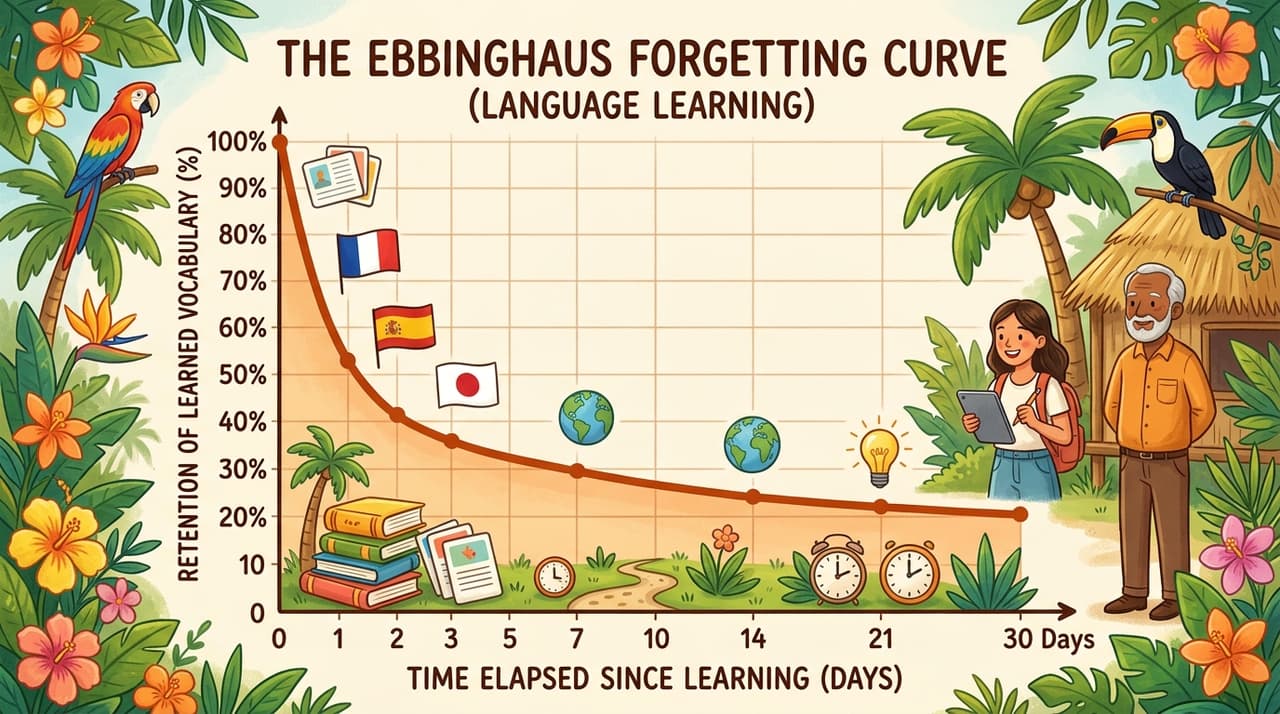
Retrievability is the probability that you'll recall a card right now. It decays over time following a forgetting curve, the same one Hermann Ebbinghaus first sketched out in 1885 and that modern memory research keeps confirming. If you want the longer story on that curve and why it dictates everything about review scheduling, I wrote about it here.
Stability is how slowly that curve decays. A high-stability card forgets slowly. A low-stability card drops off fast. Every successful review increases stability, and FSRS calculates by how much.
Difficulty is how hard the card is for you, specifically. Some cards are just stickier than others, and FSRS tracks this per card.
The scheduler then asks a different question than SM-2 ever did: given this card's current stability and difficulty, when will retrievability drop to my target level? You set the target, usually around 90%. FSRS schedules the review to land right when you're predicted to be on the edge of forgetting.
That's the key shift. SM-2 reacts to your past answers. FSRS predicts your future memory state and schedules accordingly.
Why this matters in practice
A few things change when you switch.
Reviews feel more appropriate. Cards you know well stretch out faster, sometimes dramatically, because FSRS recognizes high stability and trusts it. Cards you genuinely struggle with come back at intervals that match your actual forgetting, not at intervals punished by a damaged ease factor.
The workload smooths out. SM-2 has a tendency to clump reviews because intervals all multiply by similar factors. FSRS spreads reviews more evenly because it's targeting a probability, not chaining multiplications.
You can tune the retention target. Want to remember 95% of your Portuguese vocabulary instead of 90%? Set it. You'll do more reviews, but FSRS handles the math. SM-2 had no equivalent control.
The biggest study comparing them, run on anonymized Anki data from tens of thousands of users, found FSRS reduced workload by roughly 20 to 30% for the same retention level, or boosted retention noticeably for the same workload. Those numbers vary by user, but the direction is consistent.
The catch with any algorithm
FSRS is better. It's also not magic.
The same fundamentals still apply: you have to actually do the reviews, the cards have to be well-made, and you need to recall actively rather than just stare at the answer. If your cards are walls of text or you're flipping them passively, no scheduler will save you. That's a separate problem I dug into here.
FSRS also needs data to work well. The first few weeks with a new deck, it's running on default parameters. After you've reviewed a few hundred cards, it can fit those parameters to your actual memory, and the scheduling gets sharper. The longer you use it, the better it gets at predicting you specifically.
Why we built Decko on FSRS
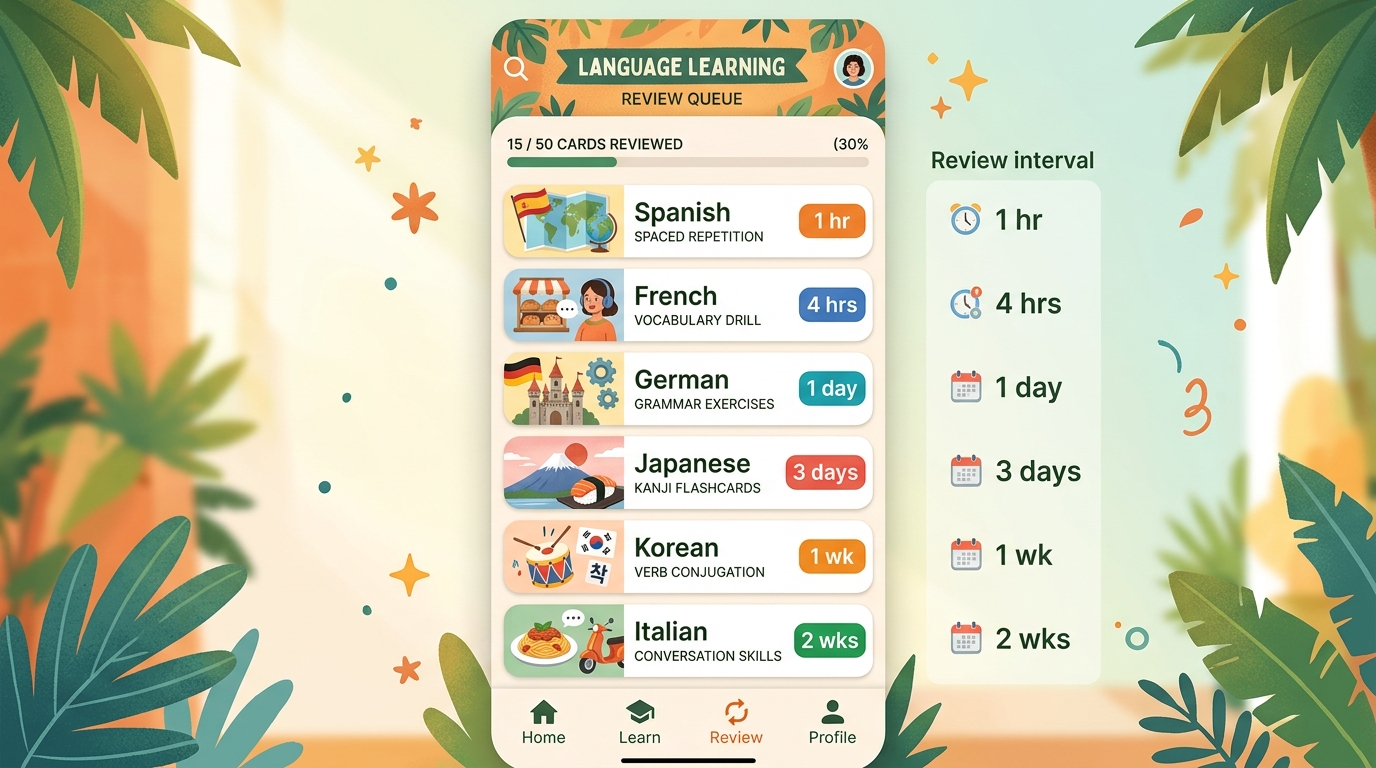
When we started building Decko, sticking with SM-2 felt like shipping a 2024 app with a 1987 engine. The research was clear, the open-source implementations were solid, and there was no good reason to give learners a worse algorithm than what was already available. So Decko runs on FSRS by default. Your Portuguese and Spanish reviews are scheduled by a model that's actually trying to predict when you'll forget, not one that's guessing based on rules of thumb from the Reagan era.
If you want to try a flashcard app built around modern memory science, you can sign up here and start a deck in a couple of minutes.
What to do with this
If you're already using Anki, switch to FSRS in the settings. It's a one-click change in recent versions, and you can let it optimize parameters once you have enough review history.
If you're using an older app that's still on SM-2 with no FSRS option, that's a real reason to consider switching.
And if you've been frustrated with flashcards in the past, blaming yourself for cards that wouldn't stick or workloads that felt punishing? It's worth knowing that some of that was the algorithm. Not all of it. But more than you probably thought.
Ready to put this into practice? Decko uses spaced repetition and conjugation drilling to make vocabulary stick. Start learning Brazilian Portuguese with flashcards that actually work.
Try Decko Free