The testing effect: why quizzing yourself beats rereading every time
Rereading feels productive but barely moves the needle. Here's why retrieval practice is the single best-studied technique in learning science.
There's a study from 2006 that I think about constantly. Roediger and Karpicke gave students at Washington University a passage to learn. One group reread it four times. Another group read it once and then took three recall tests. Five minutes later, the rereaders did better on a final test. They felt more confident too. They were sure their method was working.
Then the researchers tested everyone again a week later.
The rereaders had collapsed to about 40% recall. The testing group held on at around 61%. Same time spent. Same material. Roughly 50% more retention from a method the students themselves rated as harder and less effective.
This is the testing effect, and it's one of the most replicated findings in cognitive psychology. If you're learning a language and you're still mostly rereading vocab lists, watching grammar videos, or going through textbook chapters, you're working against decades of evidence.
What's actually happening in your brain
When you reread something, your brain has a shortcut available: recognition. The words look familiar, you nod along, and a feeling of "yeah, I know this" gets triggered. Cognitive scientists call this fluency, and it's a terrible proxy for actual learning. Familiarity is not memory.
When you try to retrieve something, your brain has to do real work. It searches, fails partially, reconstructs, succeeds or doesn't. That effort is the point. Each retrieval attempt strengthens the neural pathways involved, and importantly, it strengthens them in a way that makes future retrieval easier. Henry Roediger calls this the "retrieval-based learning" framework, and Jeffrey Karpicke has spent his career showing it beats almost everything else we've tried.
There's a clean mechanism behind it. Retrieval acts as a memory modifier. Bjork's research at UCLA on "desirable difficulties" found that the harder a retrieval feels (within reason, you have to actually succeed sometimes), the more durable the resulting memory. Easy practice produces fragile knowledge. Effortful practice? That produces knowledge that survives.
Why this matters specifically for language learning
Languages are basically a giant retrieval problem. You're not trying to recognize words on a page. You're trying to produce them, in real time, while a Brazilian uncle asks you about your job at a churrasco. Recognition vocabulary ("oh yeah, I've seen aproveitar before") is wildly easier than production vocabulary ("the word for 'take advantage of' is... uh...").
A 2014 meta-analysis by Adesope, Trevisan, and Sundararajan looked at 118 studies on the testing effect and found a mean effect size of 0.50. In education research, that's enormous. The effect was strongest for tasks requiring delayed recall, which is exactly what speaking a language is.
The practical implication: every minute you spend rereading a vocabulary list is a minute you could have spent forcing your brain to retrieve those words from scratch. The first method feels productive. The second one actually is.
What good retrieval practice looks like
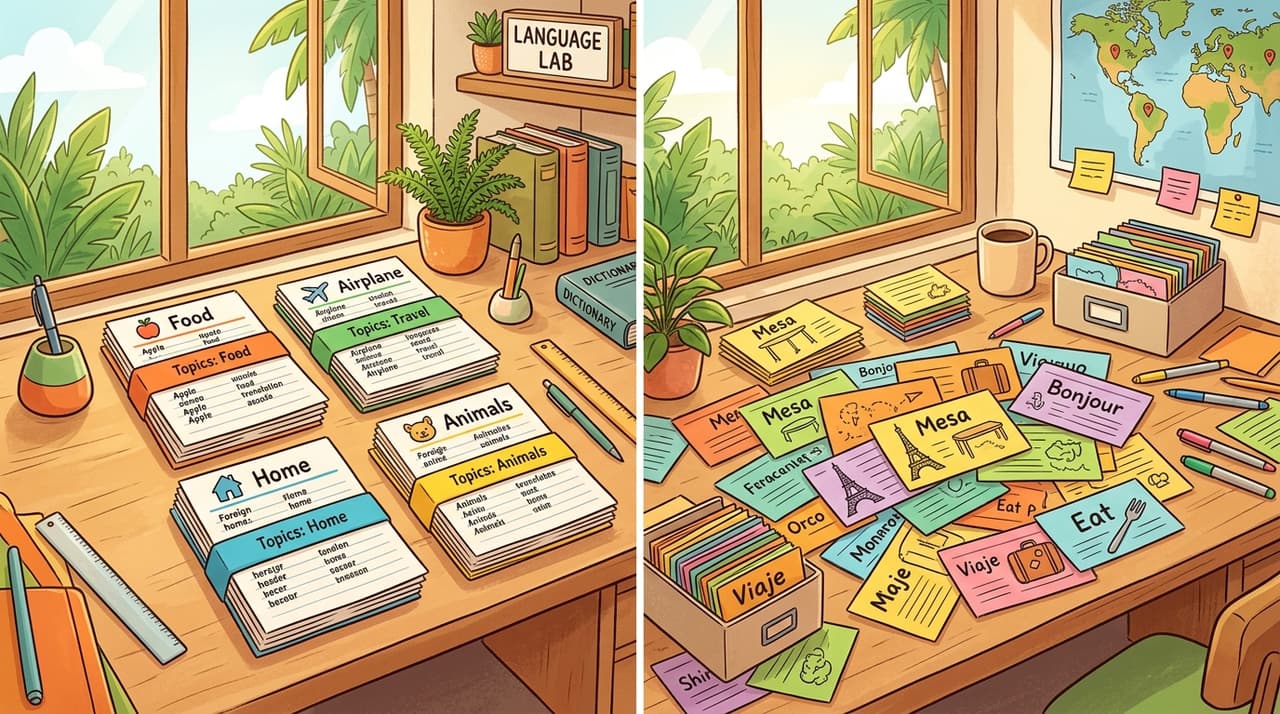
Flashcards are the obvious application, but not all flashcards are equal. A card that shows you "saudade" with the translation underneath isn't testing you. It's just rereading with extra steps. Real retrieval requires a gap, a moment where you have to produce the answer before you see it.
A few principles from the research:
Production beats recognition. Cards that ask you to produce the target language word from an English prompt are harder and more effective than the reverse direction. Both have value, but if you only do one, do production.
Free recall beats multiple choice. Typing or saying the answer forces full retrieval. Picking from options leans on recognition.
Spacing multiplies the effect. Cepeda et al. (2008) showed that spacing your retrieval attempts across days produces dramatically better long-term retention than cramming them into one session. The testing effect and the spacing effect stack.
Some failure is good. If you're getting 100% on your reviews, your cards are too easy and you're not learning much. The sweet spot is somewhere around 80-85% success.
This is why a well-designed spaced repetition system is essentially testing-effect-as-a-service. It schedules retrievals at the moments when they're hardest but still possible, which is where the strongest memory gains happen. This is also why FSRS-based scheduling outperforms older algorithms. It gets the difficulty calibration closer to that ideal zone.
Decko is built around this principle: every review is a real retrieval attempt, scheduled at the point where your brain has to actually work to find the answer. No passive rereading dressed up as studying.
The uncomfortable part
Here's what bugs me about the testing effect: it doesn't feel good. Roediger and Karpicke's students consistently rated the rereading method as more effective even when they performed worse on it. We trust the warm glow of familiarity over the friction of retrieval. It's a metacognitive illusion that takes deliberate effort to override.
Which means studying effectively requires you to actively distrust your own sense of "this is working." If your study session feels smooth and confident, that's a warning sign. If it feels effortful and slightly frustrating? You're probably doing it right.

How to actually apply this
If you want to translate the testing effect into a study routine, a few changes go a long way:
Replace rereading with self-quizzing. After reading a passage, close the book and try to summarize it. After learning new vocabulary, cover the translations and produce them from memory.
When you make flashcards, write them so the prompt forces retrieval, not recognition. A picture, a sentence with a blank, an English cue. Anything that doesn't just show you the answer.
Get comfortable with not knowing. Failed retrievals aren't wasted effort. As long as you see the answer afterward, the failed attempt itself produces learning. This is called the "pretesting effect" and it's wild: even being tested on material you haven't studied yet improves how well you learn it later.
Space your sessions. Twenty minutes of retrieval every day beats two hours once a week, by a lot.
The overall move is simple to describe and surprisingly hard to do: stop putting information into your brain and start pulling it out. That's where memory actually gets built. Everything else is just practice feeling like you're learning.
Ready to put this into practice? Decko uses spaced repetition and conjugation drilling to make vocabulary stick. Start learning Brazilian Portuguese with flashcards that actually work.
Try Decko Free