Ser vs Estar: The Explanation That Actually Makes It Click
Finally understand ser vs estar in Portuguese. A clear, science-backed guide with real Brazilian examples that makes the difference stick.
Ser vs. Estar in Portuguese: The Real Rule
If you've studied Portuguese for more than a day, someone has probably told you: "ser is for permanent things, estar is for temporary things." It's the most common explanation out there. It's also wrong. Or at least, it's incomplete enough to get you into trouble fast.
The permanent/temporary rule fails in real sentences. Ele está morto (He is dead). That's pretty permanent, right? But it uses estar. Ela é jovem (She is young). Youth is temporary, yet it takes ser. So what's actually going on?
A Better Framework: Essence vs State
Linguists who study second language acquisition have moved toward a more useful distinction. A 2011 study by Geeslin and Guijarro-Fuentes published in Studies in Second Language Acquisition found that learners taught to think in terms of inherent characteristics vs conditions/states outperformed those who relied on the permanent/temporary shortcut.
Here's the reframe:
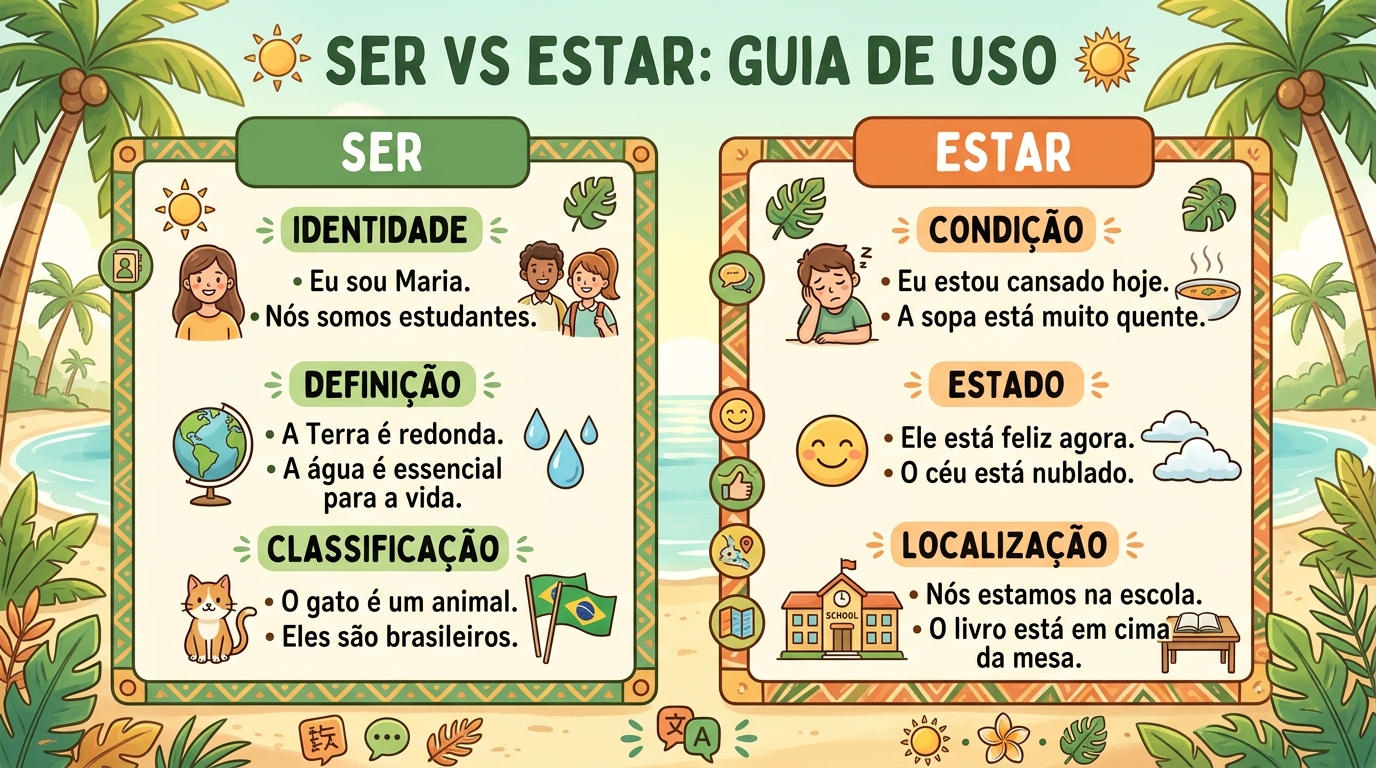
- Ser describes what something is (its identity, its nature, its classification)
- Estar describes how something is (its condition, its state, its current situation)
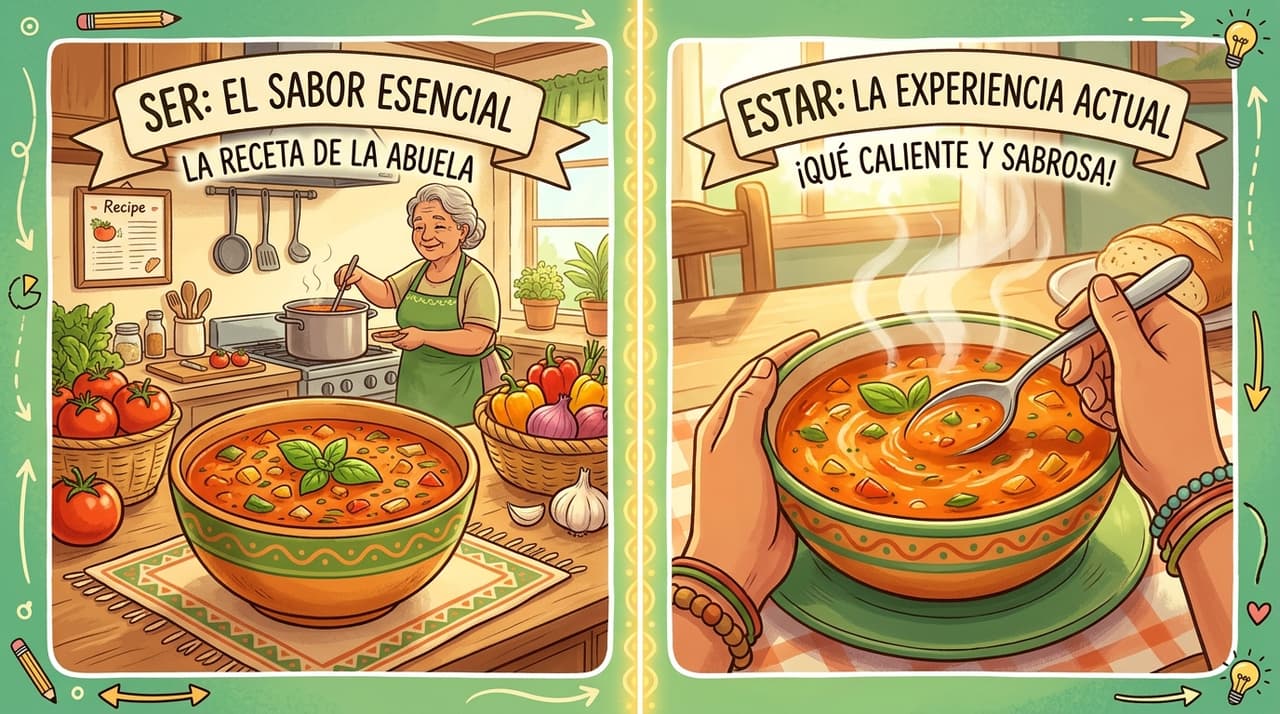
This reflects how native Brazilian Portuguese speakers actually use these verbs. When you say A sopa é boa (The soup is good), you're talking about the recipe itself, the soup as a concept. When you say A sopa está boa (The soup tastes good right now), you're talking about this particular bowl in front of you.
Same adjective. Different verb. Completely different meaning.
The Core Uses of Ser
Ser answers the question: What is it? Think of it as the verb of definition.
| Use | Example | Translation |
|---|---|---|
| Identity | Eu sou a Maria. | I'm Maria. |
| Profession | Ele é professor. | He's a teacher. |
| Origin | Nós somos do Brasil. | We're from Brazil. |
| Material | A mesa é de madeira. | The table is made of wood. |
| Time/Date | São três horas. | It's three o'clock. |
| Characteristics | O café é forte. | The coffee is strong by nature. |
| Possession | O livro é meu. | The book is mine. |
Some of these are technically temporary. Being a teacher isn't forever. But ser works because you're classifying, defining, saying what category something belongs to. Your profession is part of your social identity, not a passing condition.
The Core Uses of Estar
Estar answers the question: How is it? It's the verb of condition.
| Use | Example | Translation |
|---|---|---|
| Emotion | Estou feliz. | I'm happy right now. |
| Physical state | Ela está doente. | She's sick. |
| Location | O banco está na esquina. | The bank is on the corner. |
| Weather (felt) | Está frio hoje. | It's cold today. |
| Result of change | A porta está aberta. | The door is open. |
| Progressive tense | Ele está estudando. | He's studying. |
Location is the one that trips people up conceptually. The bank on the corner isn't going anywhere. But Portuguese treats location as a state, a "where it finds itself" situation, not a definition of what it is.
The Adjective Test: Where It Gets Interesting
Many adjectives can take either ser or estar, and the verb you choose changes the meaning.
| With SER | Meaning | With ESTAR | Meaning |
|---|---|---|---|
| Ele é magro. | He's thin naturally. | Ele está magro. | He's looking thin, lost weight. |
| Ela é bonita. | She's beautiful as a trait. | Ela está bonita. | She looks beautiful today. |
| O João é chato. | João is boring, annoying by nature. | O João está chato. | João is being annoying lately. |
| A fruta é verde. | The fruit is green in color. | A fruta está verde. | The fruit is unripe. |
The last example is revealing. The same word, verde, means "green" (a characteristic) with ser and "unripe" (a state) with estar. The verb carries the distinction.
A 2017 study by Woolsey in Hispania found that presenting learners with these minimal pairs (same adjective, different verb) was significantly more effective for building intuition than drilling isolated sentences. Your brain picks up the contrast faster when it sees both options side by side.
Spaced repetition handles this well. Seeing ser bonita and estar bonita in separate flashcard sessions, with enough spacing to challenge your recall, builds the neural pathways that make the choice automatic.
Four Tricky Cases (and How to Think About Them)
1. "Estar morto" (to be dead) Death is permanent, but it's a state you entered. You weren't always dead. Estar marks the result of a change.
2. "Ser jovem" (to be young) Youth is temporary, but it's a characteristic that defines someone at this stage of life. You're classifying them.
3. "Ser casado" vs "Estar casado" (to be married) Both appear in Brazil. Ser casado treats marriage as part of your identity (like marital status on a form). Estar casado treats it as a current life state. Many Brazilians use them interchangeably, but there's a subtle difference in framing.
4. "A festa é no sábado" (The party is on Saturday) Didn't we say location uses estar? Events are the exception. When you're saying where or when an event takes place (not where an object sits), you use ser. A festa é no restaurante (The party is at the restaurant). Think of it as defining the event, not locating an object.
A Mnemonic That Actually Works
Forget acronyms. Research on mnemonic devices in language learning (Nation, 2001, Learning Vocabulary in Another Language) shows that mental imagery outperforms abstract rules. So try this:
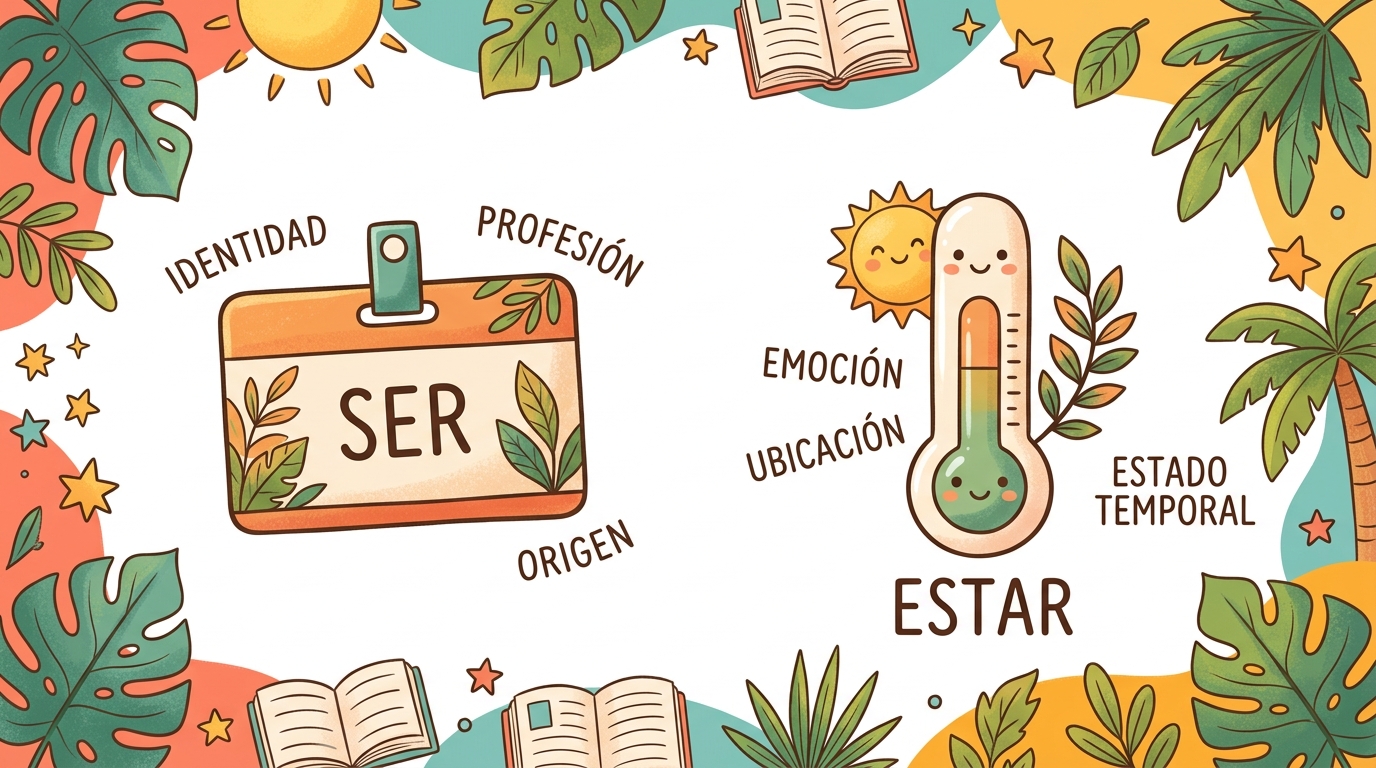
Picture ser as a name tag. It tells you what something is. You'd write your name, your nationality, your profession on a name tag. These are definitions.
Picture estar as a thermometer. It reads the current condition. Temperature, mood, health, where you happen to be right now. These are readings that change.
Name tag vs thermometer. That's it.
How to Practice This
Passive understanding won't work. A 2019 meta-analysis by Kang, Gollan, and Pashler in Psychological Bulletin confirmed that retrieval practice (actively recalling information) beats re-reading or re-listening by a wide margin.
Here's a practical drill. Take five adjectives you already know (bonito, triste, alto, frio, rico) and write two sentences for each, one with ser and one with estar. Then say the English meaning out loud. If you can clearly articulate the difference each time, you've got it.
You might also notice that some common mistakes in Portuguese come from applying English logic to ser/estar. English only has "to be," so your brain defaults to a single concept. The trick is building a second mental category, and that takes repetition.
The permanent/temporary rule was a starting point. Now you have something better. Essence vs state. Name tag vs thermometer. Same adjective, different verb, different meaning. Practice the pairs, trust the pattern, and give your brain time to make it automatic.
Ready to put this into practice? Decko uses spaced repetition and conjugation drilling to make vocabulary stick. Start learning Brazilian Portuguese with flashcards that actually work.
Try Decko Free