Portuguese reflexive verbs: why Brazilians 'sit themselves' and 'call themselves'
Reflexive verbs in Brazilian Portuguese aren't as scary as they look. Here's how they actually work, with the patterns Brazilians really use.
The first time I heard a Brazilian say eu me chamo João, I translated it literally in my head: "I call myself João." Weird. Why does João need to call himself anything? He already knows his name.
That's the thing about reflexive verbs in Portuguese. The literal translation makes them sound bizarre, but the logic underneath is actually pretty simple once you stop fighting it. And once you see the pattern, you'll start noticing reflexives everywhere, including in places where English just shrugs and uses a regular verb.
What a reflexive verb actually is
A reflexive verb is one where the subject and the object are the same person. You do something to yourself. Eu me lavo literally means "I wash myself." The pronoun me points back to eu. Subject and object, same person.
English does this too, just less often. "I hurt myself." "She taught herself guitar." The structure is identical to Portuguese. The difference is that Portuguese uses this construction in a lot more situations, including some where English would never bother.
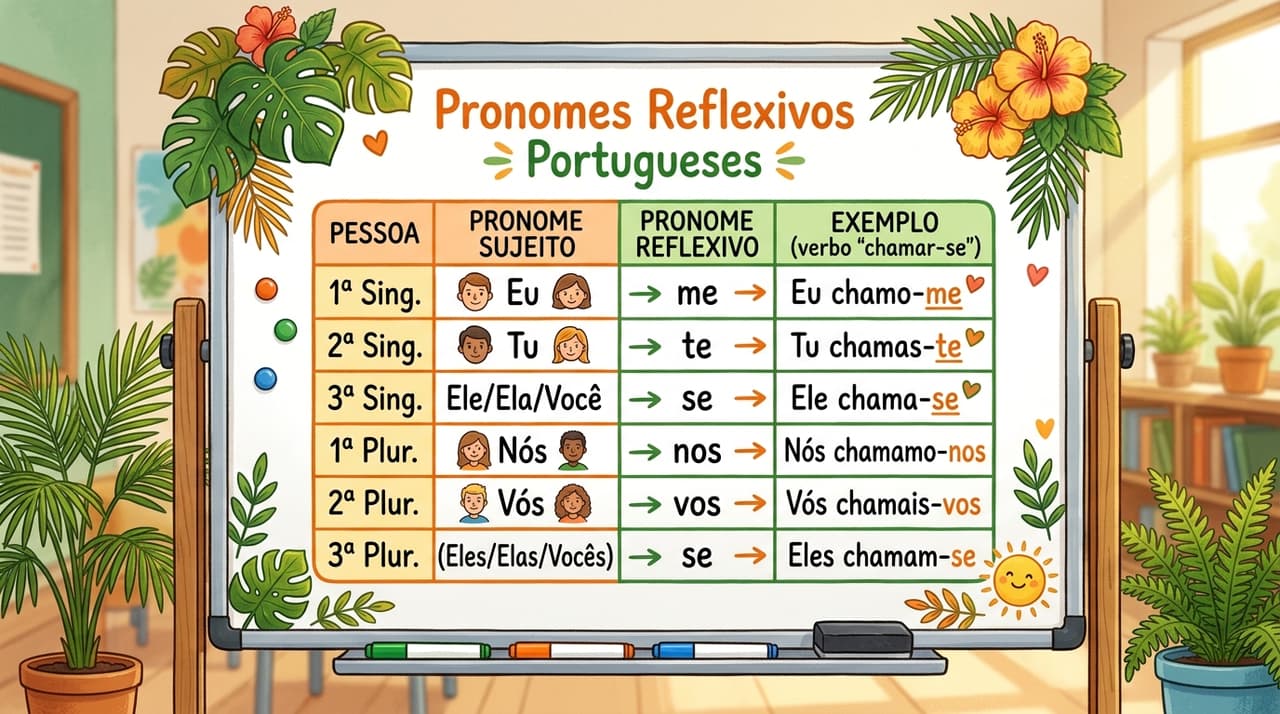
Here are the reflexive pronouns you need:
| Subject | Reflexive pronoun |
|---|---|
| eu | me |
| você / ele / ela | se |
| nós | nos |
| vocês / eles / elas | se |
That's it. Four forms. (Yes, tu exists with te, but in most of Brazil you'll use você with se, so I'm keeping this practical.)
Where reflexives show up in daily Brazilian speech
Let's start with the verbs you'll hear constantly.
Chamar-se (to be called / named). Eu me chamo Ana. My name is Ana. Brazilians use this all the time when introducing themselves, alongside the simpler meu nome é Ana. Both work.
Sentar-se (to sit down). Senta aqui! Sit here! In casual speech, Brazilians often drop the reflexive pronoun and just say senta instead of sente-se, but the verb is technically reflexive. The idea is that you're seating yourself.
Levantar-se (to get up). Eu me levanto às sete. I get up at seven. Again, you're literally "raising yourself."
Lembrar-se (to remember). Você se lembra dele? Do you remember him? Though honestly, Brazilians often just say Você lembra dele? without the se, which is technically not standard but extremely common.
Esquecer-se (to forget). Same story as lembrar. The reflexive version is more formal; eu esqueci is what you'll actually hear.
Vestir-se (to get dressed). Ela se veste rápido. She gets dressed quickly. Compare to ela veste o filho, where she's dressing her son (no reflexive, because the object is someone else).
That last contrast is the whole game. Same verb, different meaning depending on whether you're doing it to yourself or to someone else.
The placement problem (this is where it gets weird)
Where does the pronoun go? Brazilian Portuguese has its own habits here, and they don't match what your textbook probably tells you.
In formal written Portuguese, the rule is that the pronoun usually goes after the verb, attached with a hyphen: chamo-me João. You'll see this in newspapers and literature.
In spoken Brazilian Portuguese, the pronoun almost always comes before the verb: eu me chamo João. This sounds natural and is what you should imitate.
In negative sentences, the pronoun goes before the verb in both registers: eu não me lembro (I don't remember).
There are more detailed rules about pronoun placement (called próclise, ênclise, and mesóclise if you want to look it up), but for spoken Brazilian Portuguese, you can mostly just put the pronoun before the verb and be fine.
Reflexives that don't feel reflexive in English
This is where learners get tripped up. Some Portuguese verbs are reflexive even though the English equivalent isn't.
Casar-se (to get married). Ela se casou ano passado. She got married last year. In English, "married" isn't reflexive. In Portuguese, you're marrying yourself off, sort of. I know. It's strange at first.
Mudar-se (to move, as in move house). Nos mudamos para São Paulo. We moved to São Paulo. Without the reflexive, mudar means to change something else, like mudar de ideia (to change your mind).
Sentir-se (to feel, as in feel a certain way). Eu me sinto cansado. I feel tired. Without the reflexive, sentir means to sense or feel something external, like sentir o vento (to feel the wind).
The pattern: when the action loops back to affect the subject themselves, Portuguese marks it explicitly. English just trusts context to handle it.

The reciprocal trick
Reflexive pronouns also do double duty as reciprocal pronouns. Same form, slightly different meaning.
Eles se amam can mean "they love themselves" or "they love each other," depending on context. Brazilians figure it out from what's being talked about. If you want to be unambiguous, you can add um ao outro (one another): eles se amam um ao outro.
Other common reciprocals: nós nos conhecemos (we know each other / we met), eles se beijaram (they kissed each other), vocês se viram? (did you see each other?).
How to actually learn this stuff
Reading about reflexive verbs is one thing. Getting them to come out of your mouth at the right moment is another.
The trick is repeated exposure to real sentences, in context, until the pattern feels automatic. This is exactly the kind of thing spaced repetition handles well, because you need lots of small encounters spread over time, not one big study session.
Decko lets you build flashcards around specific verbs and their reflexive uses, so you see me lembro, se lembra, nos lembramos in varied sentences until they stop sounding strange. That contextual variety matters more than memorizing conjugation tables.
A quick sanity check
Here are some sentences to test yourself with:
I forgot. (Hint: most Brazilians drop the reflexive here.)
They got married in Rio.
We're moving next month.
She feels happy today.
Sit down, please.
How'd you do? Here's what they should look like: Eu esqueci. Eles se casaram no Rio. Nós nos mudamos mês que vem (or A gente se muda mês que vem in casual speech). Ela se sente feliz hoje. Senta, por favor (informal) or Sente-se, por favor (formal).
If you got most of those, you're already past the hardest part. Reflexive verbs feel weird for about two weeks, and then they don't. The pronouns start sliding into the right spot without you thinking about it, and you stop translating eu me chamo as "I call myself." You just hear it as "my name is," which is what it always meant.
Ready to put this into practice? Decko uses spaced repetition and conjugation drilling to make vocabulary stick. Start learning Brazilian Portuguese with flashcards that actually work.
Try Decko Free