The future in Brazilian Portuguese (hint: it's not futuro do presente)
Textbooks teach futuro do presente, but Brazilians rarely use it in speech. Here's how to actually talk about the future in Portuguese.
Open any Portuguese textbook to the chapter on the future tense and you'll get a neat conjugation table. Eu falarei, tu falarás, ele falará... Beautiful. Tidy. Almost completely useless for talking to actual Brazilians.
Here's the thing nobody tells you upfront: Brazilians barely use the futuro do presente in conversation. You can spend months learning farei, comerei, sairei and then arrive in São Paulo to discover everyone is saying vou fazer, vou comer, vou sair. The fancy textbook future is alive in writing, in news, in formal speeches. In everyday speech? It mostly sleeps.
Let me show you what Brazilians actually do.
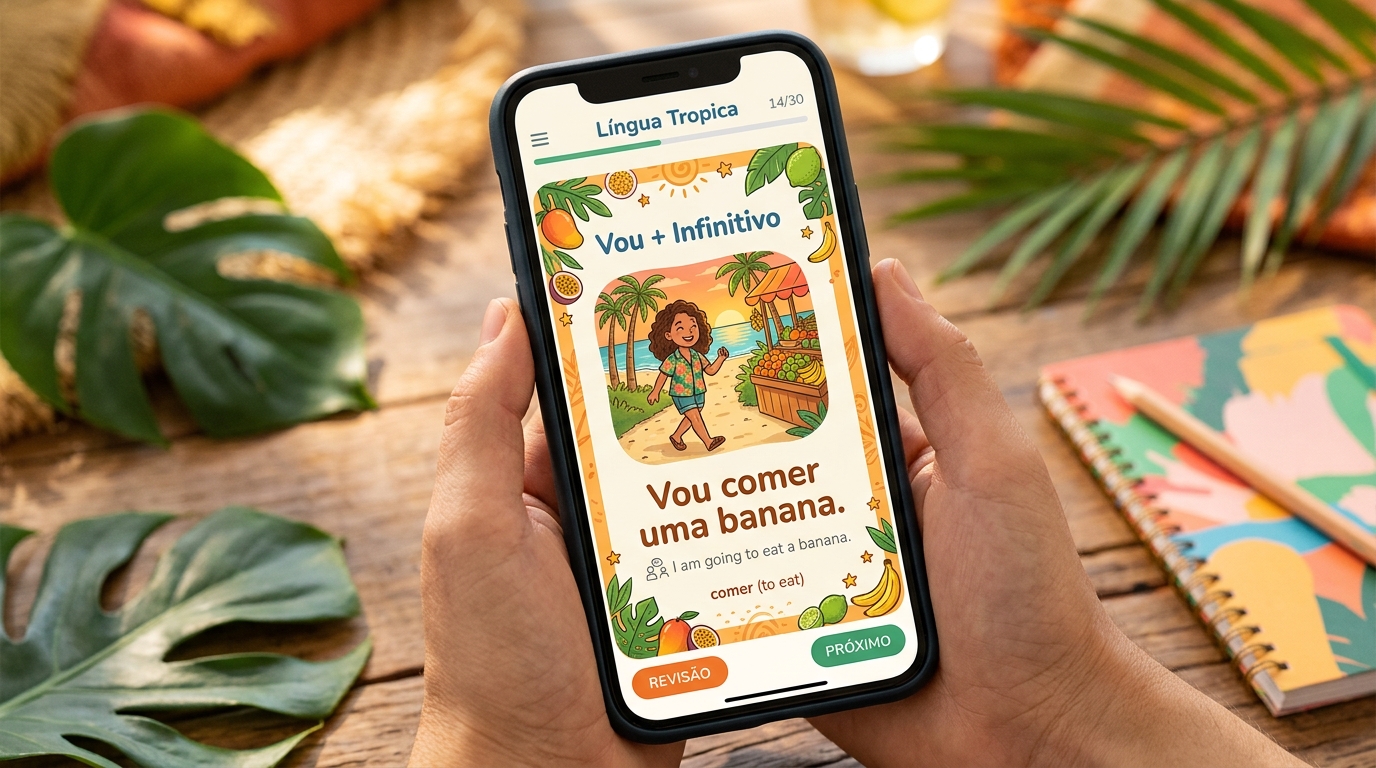
The future that everyone uses: ir + infinitive
This is the workhorse. Conjugate ir (to go) in the present, slap an infinitive on the end, done.
- Eu vou estudar amanhã. (I'm going to study tomorrow.)
- Ela vai chegar tarde. (She's going to arrive late.)
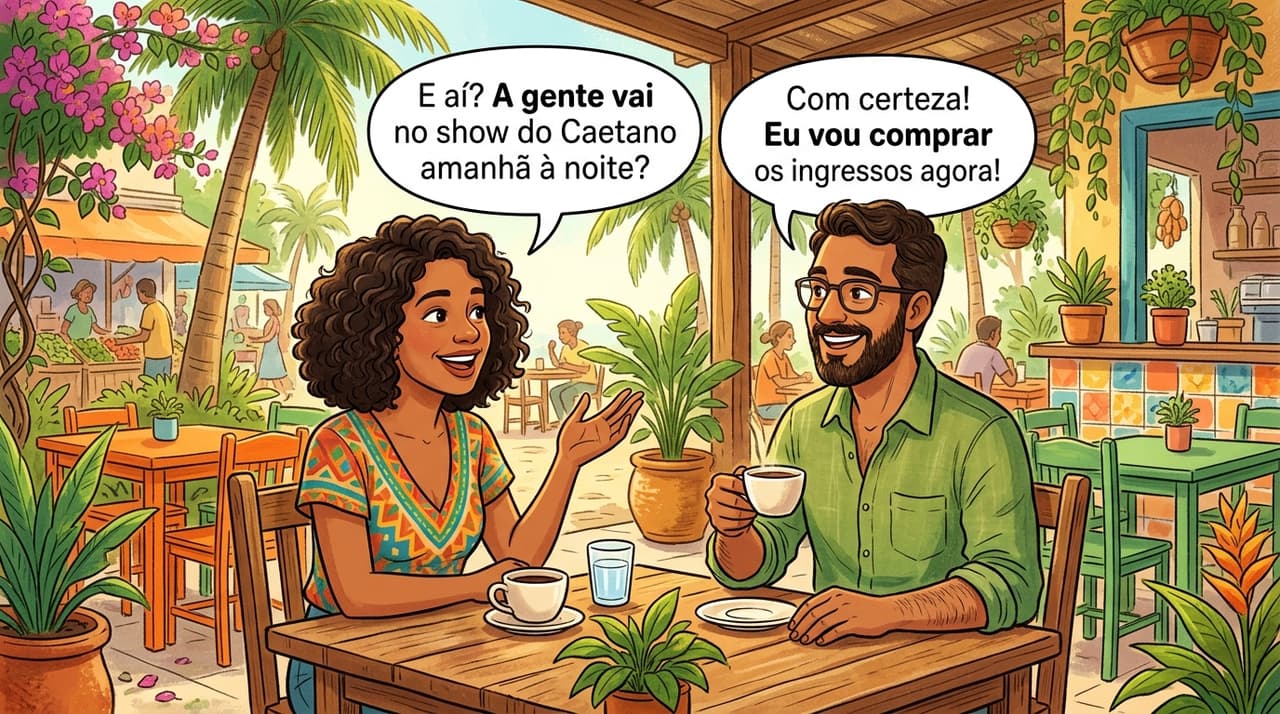
- A gente vai sair mais cedo. (We're going to leave earlier.)
- Eles vão entender, relaxa. (They'll understand, relax.)
If you learn nothing else from this article, learn this pattern. It covers maybe 90% of future situations in spoken Brazilian Portuguese. It's the same construction English uses with "going to," which makes it weirdly intuitive for English speakers.
And notice a gente vai instead of nós vamos. In casual speech, a gente (literally "the people," meaning "we") is everywhere, and it takes the third person singular. Mixing this in will make you sound dramatically more natural.
The future that pretends to be the future: the present tense
This one trips people up because it feels wrong. Brazilians constantly use the present tense to talk about the future, especially when there's a time marker in the sentence.
- Amanhã eu trabalho até tarde. (Tomorrow I'm working late.)
- Semana que vem ela viaja. (Next week she's traveling.)
- A festa começa às nove. (The party starts at nine.)
- Te ligo depois. (I'll call you later.)
That last one is gold. Te ligo depois is technically present tense (ligo = I call), but it clearly means "I'll call you later." You'll hear te mando o link (I'll send you the link), a gente se vê (we'll see each other), te falo amanhã (I'll tell you tomorrow). Brazilians do this constantly with verbs like ligar, mandar, falar, ver.
If the future is clear from context, the present tense just... handles it. No conjugation gymnastics required.
So when does the textbook future actually show up?
Futuro do presente isn't dead. It's just selective about where it appears. You'll find it in:
Writing and formal contexts. News headlines, contracts, academic writing, official announcements. O presidente anunciará as medidas amanhã. (The president will announce the measures tomorrow.)
Predictions and hypotheticals with a slightly dramatic flavor. Você se arrependerá. (You will regret it.) Said with a raised eyebrow, ideally.
Polite or softened statements. Eu diria que sim. (I'd say yes.) This is actually the futuro do pretérito (the conditional), which Brazilians do use, especially for politeness: Você poderia me ajudar? (Could you help me?)
Set expressions. Seremos eternos. Veremos. These have a ring to them that vamos ser and vamos ver don't quite match.
The pattern: the more formal, written, or rhetorical the situation, the more likely the textbook future shows up. The more casual and conversational, the more vou + infinitivo and present tense take over.
A practical breakdown
Here's what you'll actually use in different situations:
Casual plan: ir + infinitive. Vou comprar pão.
Scheduled event: Present tense. O filme começa às 8.
Promise or quick commitment: Present tense. Te ligo amanhã.
News, formal writing: Futuro do presente. O ministro viajará amanhã.
Politeness or hypothetical: Futuro do pretérito (conditional). Eu gostaria de um café.
Dramatic prediction: Futuro do presente. Você verá.
This isn't a rigid rulebook. Brazilians switch between these constantly, sometimes within the same sentence. But if you internalize that ir + infinitive is your default, you're already speaking like a local.
How to actually get this into your head
Grammar tables won't do it. What works is hearing the patterns enough times that they feel natural, then producing them yourself under a little pressure. This is where active recall makes a real difference, the kind where you have to generate the answer instead of just recognizing it.
Decko lets you build flashcards with full example sentences, not just isolated verbs. You can drill vou + infinitive patterns with real Brazilian contexts and have the spacing algorithm bring them back right when you're about to forget. Way more useful than staring at a conjugation chart for the fifteenth time.
A few sentences to steal
These are the kind of phrases that, once they're automatic, make you sound like you've actually been here a while:
- Vou ver e te falo. (I'll check and let you know.)
- A gente se fala depois. (We'll talk later.)
- Te mando por WhatsApp. (I'll send it to you on WhatsApp.)
- Vai dar certo. (It'll work out.)
- Vamos ver no que vai dar. (Let's see how it goes.)
- Daqui a pouco eu vou. (I'll go in a bit.)
Notice none of them use futuro do presente. None. And they cover most of what you'd want to say about things that haven't happened yet.
If you've already wrestled with preterite vs imperfect, you know that Portuguese tenses often have a textbook version and a spoken version that diverge. The future is the most extreme example of this. Embrace vou, sprinkle in present tense for scheduled stuff, and save the textbook future for when you want to sound dramatic or write a formal email. That's the actual rule.
And if someone tells you você se arrependerá de não ter aprendido futuro do presente, just smile. They're being theatrical on purpose. That's the whole point.
Ready to put this into practice? Decko uses spaced repetition and conjugation drilling to make vocabulary stick. Start learning Brazilian Portuguese with flashcards that actually work.
Try Decko Free