How to form questions in Portuguese (it's simpler than you think)
Forming questions in Brazilian Portuguese is way easier than English. Here's how Brazilians actually ask things, with examples you can use today.
Here's something nobody tells beginners: forming questions in Portuguese is one of the few things that's genuinely easier than in English.
Think about what English makes you do. You want to ask if someone speaks Portuguese? You can't just say "You speak Portuguese?" (well, you can, but it sounds weird in writing). You have to summon the auxiliary verb do, flip the word order, and produce "Do you speak Portuguese?" That little do exists for one reason: making questions. It's grammatical scaffolding English speakers don't even notice they're using.
Portuguese skips all of that. You just raise your voice at the end.
The trick: intonation does the work
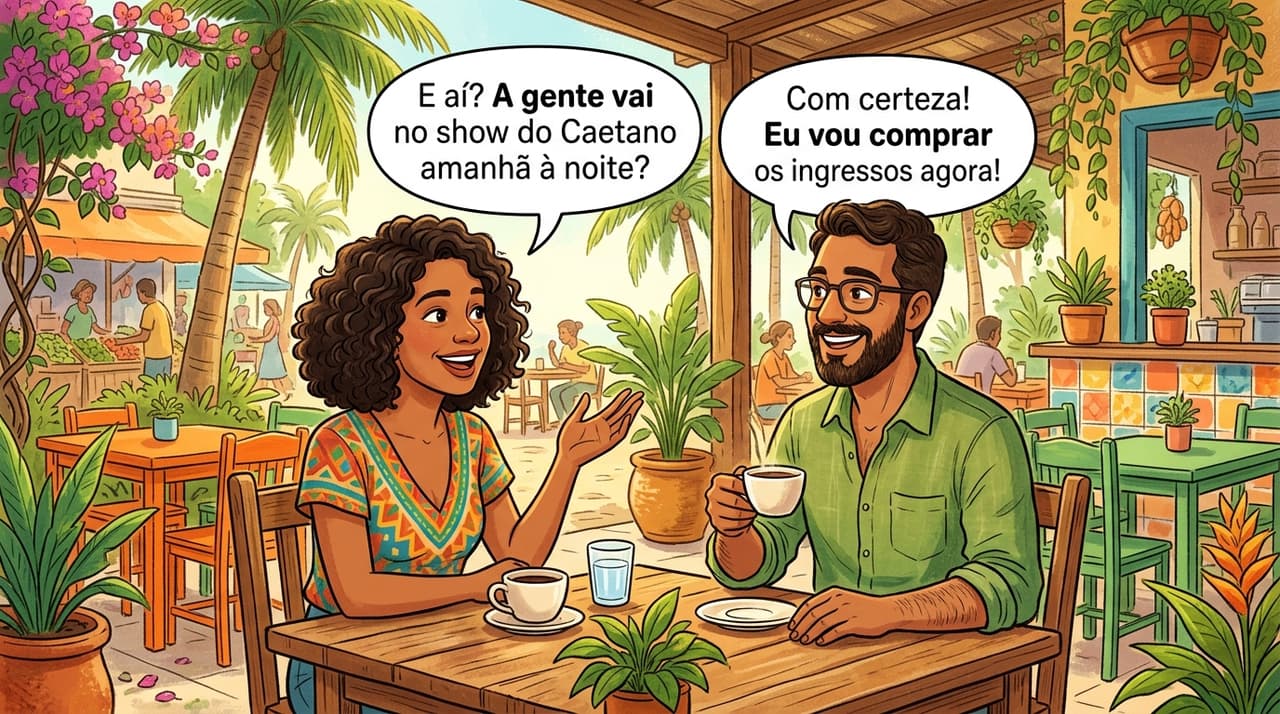
In Brazilian Portuguese, the most common way to turn a statement into a question is to keep the exact same word order and let your voice rise at the end.
- Você fala português. (You speak Portuguese.)
- Você fala português? (Do you speak Portuguese?)
Same words. Same order. The only difference is the question mark in writing and the rising tone in speech. That's it. That's the rule.
More examples:
- Ela mora aqui? (Does she live here?)
- Vocês querem café? (Do you all want coffee?)
- Ele chegou ontem? (Did he arrive yesterday?)
Notice how clean this is. No auxiliary verbs. No word-order gymnastics. The verb stays put, the subject stays put, you just curl your voice upward at the end like you're a little surprised about what you're saying.
You can usually drop the subject too
Portuguese is what linguists call a pro-drop language, which means the verb ending already tells you who's doing the action. So Você fala português? often becomes just Fala português? in casual conversation. The verb form fala implies você.
This is one of those things that sounds wrong to English speakers at first. You want the subject pronoun in there. But Brazilians drop subjects constantly, especially in questions where context makes it obvious who you're talking about.
- Tá com fome? (Are you hungry? Literally: "Are with hunger?")
- Mora longe? (Do you live far away?)
- Quer mais? (Want more?)
If you've spent any time around Brazilians, you've heard these. They're everywhere.
Question words (the wh- words)
When you need to ask what, where, when, why, or how, Portuguese uses question words that go at the beginning, just like English. Here are the main ones:
| Portuguese | English | Example |
|---|---|---|
| O que | What | O que você quer? (What do you want?) |
| Quem | Who | Quem chegou? (Who arrived?) |
| Onde | Where | Onde ela mora? (Where does she live?) |
| Quando | When | Quando você chega? (When do you arrive?) |
| Por que | Why | Por que você está triste? (Why are you sad?) |
| Como | How | Como funciona? (How does it work?) |
| Qual | Which | Qual é o seu nome? (What's your name?) |
| Quanto | How much/many | Quanto custa? (How much does it cost?) |
Notice again: no auxiliary verb shows up. Onde ela mora? is literally "Where she lives?" Word for word. The English version forces you to insert does out of thin air. Portuguese doesn't bother.
The little word que that confuses everyone
One thing trips up beginners constantly: the difference between o que and que and qual.
- O que asks about a thing in general. O que é isso? (What is this?)
- Qual asks you to pick from options. Qual é o seu nome? (What's your name? Literally "Which is your name?" because you're picking from all possible names)
- Que by itself can mean "what" in some fixed expressions and tends to appear before nouns. Que horas são? (What time is it?), Que dia é hoje? (What day is today?)
If you're stuck, o que is the safer default for "what." Brazilians will understand you either way.
This is exactly the kind of fiddly distinction that benefits from spaced repetition rather than rule memorization. You learn the patterns by seeing them in context, over and over, until qual é o seu nome feels obvious and o que é seu nome sounds wrong. Try Decko free if you want something that spaces these patterns out automatically.
The "né?" trick
Brazilians love turning statements into questions with one tiny syllable: né? It's short for não é? and means roughly "right?" or "isn't it?"
- Tá frio hoje, né? (It's cold today, right?)
- Você é americano, né? (You're American, right?)
- Ela é simpática, né? (She's nice, isn't she?)
If you only learn one question-forming trick from this article, make it né? You'll sound ten times more natural the moment you start using it. It's the conversational glue that holds Brazilian small talk together. Honestly, I've seen beginners get way more mileage out of né than out of memorizing verb conjugation tables.
Tag questions and confirmation
Besides né, Brazilians use a few other tags to ask for confirmation:
- ...certo? (right?)
- ...não é? (isn't it? The full version of né)
- ...né mesmo? (isn't it really?)
- ...sabia? (did you know?)
These show up at the end of statements, doing the same job as English "you know?" or "right?" Useful when you want to invite the other person into the conversation instead of just declaring things at them.
What about formal writing?
Everything above is how Brazilians actually talk. In formal written Portuguese, you'll see the same patterns, though without the dropped subjects and the né tags. A news headline might read O presidente falou sobre a economia? with the same simple structure. The grammar doesn't change much between registers, just the vocabulary and the casual shortcuts.
Compare this to the ser vs estar distinction, which actually requires some thinking. Or the casual slang Brazilians use, which takes real exposure to learn. Questions? Questions are the easy part.
Try it out
Next time you want to ask a Brazilian something, resist the urge to translate the English structure word for word. Don't reach for an auxiliary verb. Just take the statement form, raise your voice at the end, and you're done.
Você gosta de café?
Tá tudo bem?
Fala inglês?
That's the whole grammar lesson. The hard part isn't the rule, it's trusting that it's really this simple.
Ready to put this into practice? Decko uses spaced repetition and conjugation drilling to make vocabulary stick. Start learning Brazilian Portuguese with flashcards that actually work.
Try Decko Free