
Brazilian slang you won't find in textbooks (but hear every day)
The Brazilian slang words and expressions you'll actually hear on the street, in messages, and at the bar but never in your textbook.
Textbook Portuguese will get you understood. It won't get you in on the joke.
I remember the first time someone in São Paulo told me a story and ended with "aí ele deu PT." I nodded like I knew what that meant. I did not know what that meant. My textbook had taught me how to ask for the bathroom in a formal restaurant and how to conjugate the pluperfect subjunctive, but it had skipped the part where someone passes out drunk at a churrasco.
This is the gap. Brazilian Portuguese as spoken by actual Brazilians is full of slang that ranges from mildly informal to so casual it would make your professor wince. Here's a working set you'll hear constantly, with notes on when it's safe to use them and when you should just recognize them and smile.
The everyday fillers
These are the words that grease conversation. They don't mean much on their own, but Brazilians sprinkle them everywhere.
Tipo (like). Functions exactly like the English "like" as a filler. "Ele é tipo meu melhor amigo" (He's like my best friend). Overuse it and you sound 17, but everyone uses it.
Tipo assim (like, so). The deluxe version of tipo. Buys you time while you think.
Sei lá (I dunno / who knows). Literally "I know there." Brazilians use it constantly to mean "beats me" or "whatever."
Beleza? (cool? / all good?). A greeting, a check-in, an agreement. "Vamos às 8, beleza?" — "Beleza." Done.
Massa (cool / awesome). More common in the Northeast but spreading. "Que massa!" (How cool!)
Maneiro (cool). Rio's version of massa. Same job, different accent.
Words for people
Cara (dude / guy). The universal word for "guy" but also used like "man" as you'd say it to a friend. "Cara, você não vai acreditar." (Dude, you won't believe this.)
Mano (bro). São Paulo loves this one.
Mina (girl/chick). The female counterpart, though mina specifically means a young woman, often with a flirty edge.
Galera (the crew / everyone). "A galera tá lá" (Everyone's there). Useful, friendly, totally safe.
Véi or véio (old man, but used like "bro"). Tricky one. Sounds weird coming from a non-native speaker until you've really got the rhythm down. Recognize it, hold off on using it.
Parça (short for parceiro, partner/buddy). Affectionate, masculine, used between male friends.
Reactions and exclamations
Nossa! (Wow!). Short for Nossa Senhora (Our Lady). The single most useful exclamation in Brazilian Portuguese. Surprise, shock, delight, horror — nossa covers all of it.
Caraca! (Whoa!). Stronger than nossa, milder than the swear words it's politely substituting for.
Eita! (Whoa! / Oof!). Northeastern in origin, now everywhere. Great for reacting to mild disasters.
Que saco! (What a drag!). Literally "what a bag" but means "how annoying." Saco shows up in tons of expressions about annoyance.
Pô (short for poxa, itself a softened swear). Expresses disappointment, mild frustration, or just emphasis. "Pô, cara, sério?" (Come on, dude, seriously?)
The ones that confused me for months
Dar um jeito (to find a way / work it out). Brazilians dar um jeito in everything. There's always a way. This is so culturally loaded it could be its own article.
Rolar (to happen / go down). "O que rolou ontem?" (What went down yesterday?) Literally "to roll." You'll hear it constantly.
Pegar has like fifteen meanings, but slang-wise: ficar com alguém or pegar alguém means to hook up with someone (kissing, usually, not necessarily more). Context matters a lot.
Dar PT (to pass out / black out, usually from drinking). PT stands for perda total (total loss). "Ele deu PT na festa."
Zoar (to mess with / tease). "Tô zoando" = "I'm just messing with you." Critical for not taking yourself too seriously around Brazilians, who tease constantly as a sign of affection.
Mó (short for maior, biggest). Used as an intensifier. "Mó legal" (super cool), "mó chato" (super annoying).
Learning slang like this is where flashcards earn their keep. You're not going to absorb 40 informal expressions from one article, no matter how engaging I try to be. You need to bump into them, forget them, see them again, and gradually have them stick. Spaced repetition is built for exactly this kind of vocabulary load — high-frequency words that don't have clean English equivalents. Try building a deck of these in Decko and add new slang as you hear it in songs, shows, or conversations.
A note on register
Here's the thing nobody tells you: slang has registers within registers. Beleza and legal are safe in almost any informal context, including with your boss if your workplace is chill. Mano, véi, parça are for friends only and sound strange from non-natives until your accent is solid. Anything involving pegar in the romantic sense is fine with friends and a disaster at a job interview.
When in doubt, recognize first and produce later. Hearing slang and understanding it makes you fluent. Trying to use slang you haven't fully internalized makes you sound like a tourist who watched too much Brazilian YouTube. Both are fine stages to be in. Just know which one you're at.
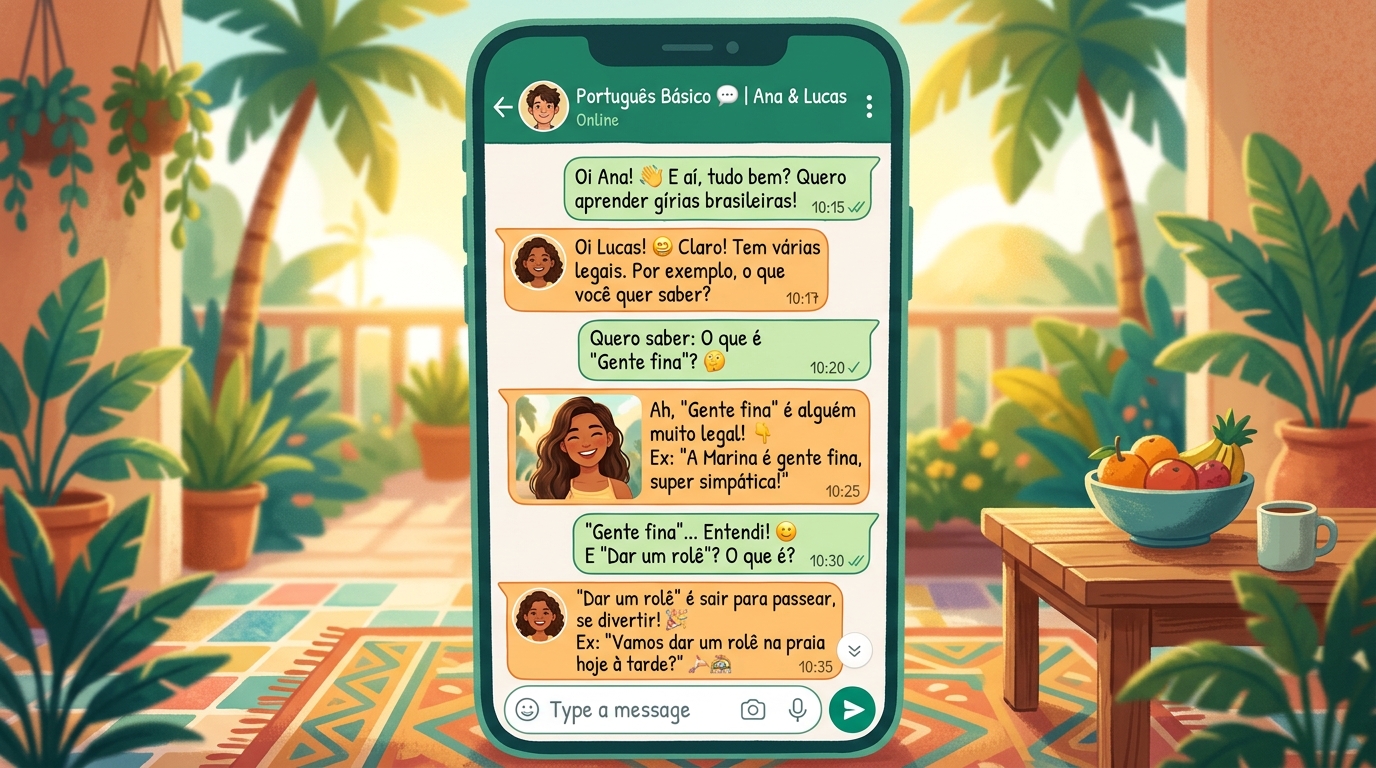
How to actually pick this up
Reading lists like this one gets you started. Hearing the words in the wild is what makes them stick, which means Brazilian content. Not the polished language-teaching stuff. The messy real stuff.
Brazilian YouTubers who vlog (not the language-teaching ones) for natural speech. Funk and rap lyrics, which are slang-dense. Shows like Sintonia or 3% on Netflix with Portuguese subtitles. Twitch streams in Portuguese if you're a gamer.
Write down anything you hear three times and don't understand. That's your slang shortlist. Add them to your flashcards with the context you heard them in, not a clean dictionary definition. Slang lives in context. Strip it out and it dies.
And if you mess up and use mano with someone's grandmother, she'll laugh and tell the story for years. That's Brazilian.
Ready to put this into practice? Decko uses spaced repetition and conjugation drilling to make vocabulary stick. Start learning Brazilian Portuguese with flashcards that actually work.
Try Decko FreeRelated Articles

How to talk about feelings in Portuguese (without sounding like a textbook)
5 min read

The Portuguese connectors that make you sound fluent (even when you're not)
6 min read

Portuguese Diminutives (-inho/-inha): Why Brazilians Make Everything Tiny and Adorable
6 min read