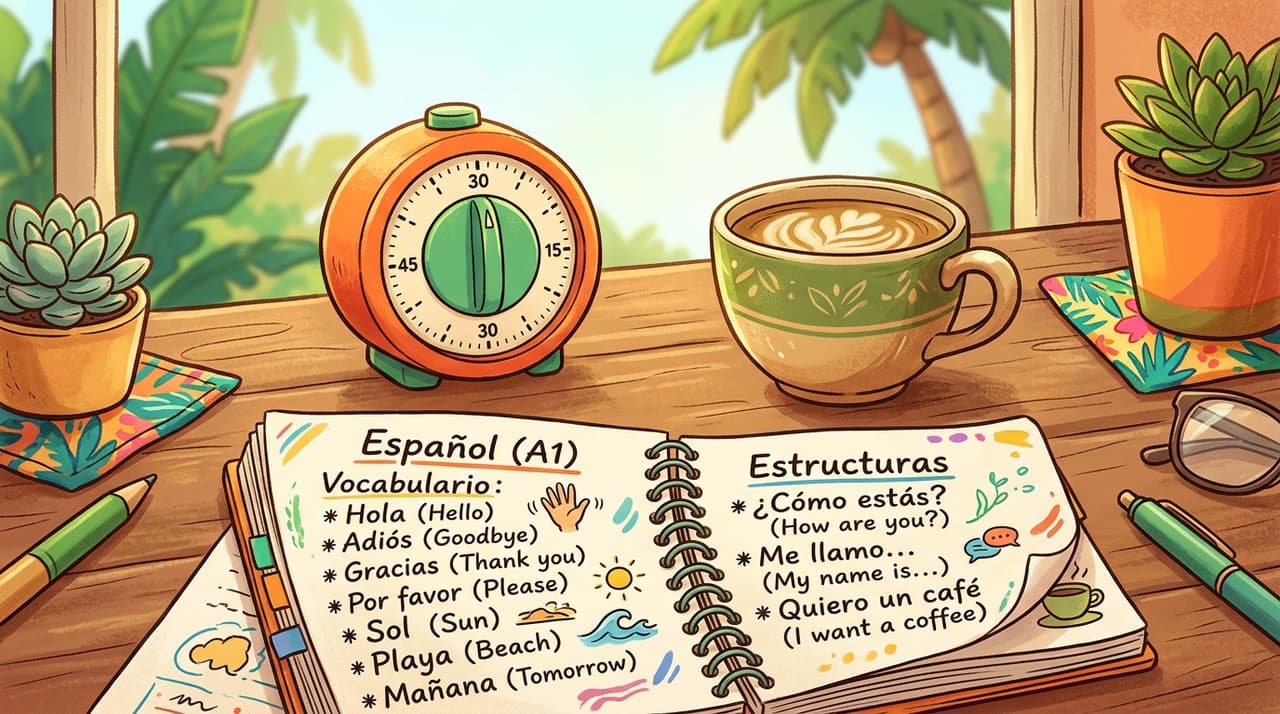
How to study a language in 15 minutes a day and actually make progress
Fifteen minutes a day sounds too short to matter. The research says otherwise, if you spend those minutes the right way.
I used to believe you needed at least an hour a day to learn a language properly. Anything less felt like a joke, like showing up to the gym for two pushups and calling it a workout.
That belief cost me about three years of stop-and-start progress. I'd commit to an hour, keep it up for two weeks, miss a day, feel guilty, quit for four months, then start again with a fresh hour-a-day plan. Rinse, repeat, achieve nothing.
The learners I know who actually got fluent didn't study more than me. They studied more consistently, in smaller doses. And there's real science behind why 15 focused minutes can beat 90 unfocused ones.
Why short sessions punch above their weight
Memory research keeps pointing at the same thing: how often you revisit material matters more than how long you sit with it. This is the spacing effect, first documented by Hermann Ebbinghaus in the 1880s and confirmed roughly a thousand times since. A 2006 meta-analysis by Cepeda and colleagues looked at 317 experiments and found spaced practice beat massed practice in nearly every one, with the effect getting larger the longer you wanted to remember something.
Translation: if your goal is to still know a word next month, seven short sessions across a week will crush one long session on Sunday.
There's also the attention piece. Your brain's ability to focus intently drops off a cliff after about 20 to 25 minutes for most people. That last stretch of a long study session? You're mostly just moving your eyes across the page. I've written about why cramming fails so predictably, and the short version is that your brain treats a marathon session as one event, not many.
Fifteen minutes, done daily, gives you seven separate encoding events per week. One two-hour session on Saturday gives you one.
What to actually do in those 15 minutes
Here's where most "study less, learn more" advice falls apart. People hear "15 minutes a day" and interpret it as "scroll Duolingo on the toilet." That's not studying, that's tapping.
The 15 minutes has to be active. You need to be pulling information out of your head, not letting it wash over you. If you finish a session without at least a few moments of "wait, what was that word again," you weren't really studying.
Here's a rough split that works well:
| Minutes | Activity | Why |
|---|---|---|
| 0-8 | Flashcard review (due cards only) | Retrieval practice on things your brain is about to forget |
| 8-12 | Read or listen to something slightly hard | Exposure to words in context |
| 12-15 | Write two or three sentences using new words | Production forces deeper processing |
The first block is non-negotiable. This is where spaced repetition earns its keep, catching words right before they fade. The second block is where language stops feeling like a math problem, a paragraph from a news article, a scene from a show with subtitles, a song lyric you actually want to understand. The third block is the one people skip, and it's the one that turns passive knowledge into stuff you can say out loud.
The consistency problem (which is really the whole problem)
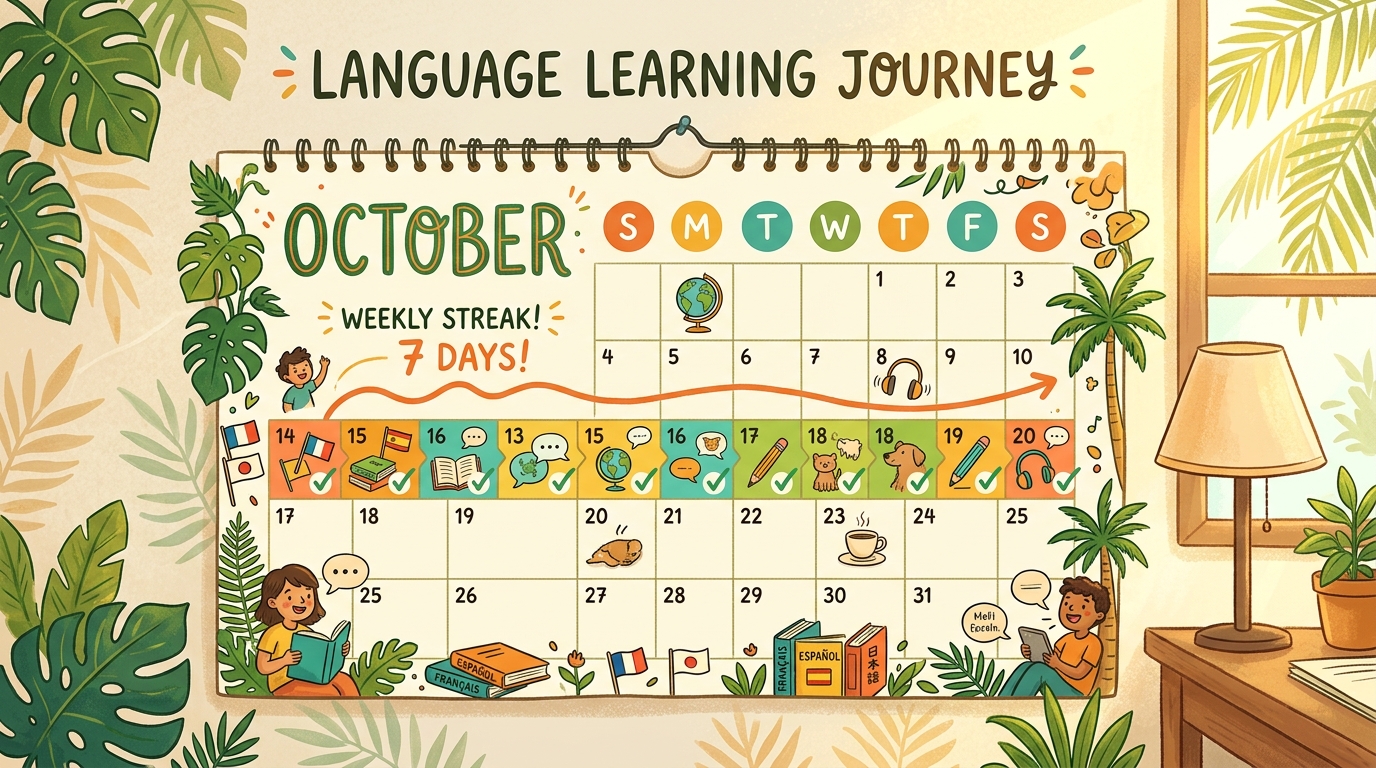
Fifteen minutes a day sounds easy on paper. In practice, most people can't string together seven days in a row.
A few things that helped me:
Anchor the habit to something you already do. Coffee, commute, brushing your teeth, whatever. I do my reviews with my first coffee. If I try to fit them in "sometime today," they don't happen.
Lower the bar on bad days. If you're exhausted and 15 minutes feels impossible, do five. Do one card. The point is keeping the chain alive, because the day you skip is the day the whole thing quietly ends. I've watched myself do this. I've watched everyone I know do this. The reason most people quit flashcards isn't the flashcards, it's the all-or-nothing mindset.
Don't design a routine for your ideal self. Design one for your worst Tuesday.
Where a good app actually helps
This is exactly the problem Decko is built for. The FSRS algorithm schedules cards so your 15 minutes always land on the words you're actually about to forget, not the ones you know cold. You don't waste a single second reviewing "obrigado" for the four hundredth time. If you have eight minutes, do eight minutes, the queue is always sorted by what matters most right now.
What 15 minutes a day actually gets you
Let's do some math, because I find this genuinely motivating.
15 minutes a day, five days a week (giving yourself weekends off), for one year, is roughly 65 hours of active, focused study. Research on vocabulary acquisition suggests learners can pick up around 8 to 12 new words per hour of well-structured spaced review. Conservatively, that's 500+ new words in a year, on top of whatever grammar and listening you're doing in those sessions.
500 words gets you past survival Portuguese or Spanish and well into conversational territory. The most common 1,000 words in a language cover about 80% of everyday speech.
The uncomfortable truth
The reason most people don't make progress with a language isn't that they lack talent or time. It's that they oscillate between doing too much and doing nothing.
Fifteen minutes a day feels almost embarrassingly small. That's the point. It's small enough to keep doing when you're tired, stressed, traveling, or sick. It's small enough that missing it feels stupid. And it compounds in a way that a heroic weekend session simply doesn't.
I'd rather study 15 minutes a day for two years than two hours a day for two weeks. One of those actually gets you somewhere. Guess which.
Ready to put this into practice? Decko uses spaced repetition and conjugation drilling to make vocabulary stick. Start learning Brazilian Portuguese with flashcards that actually work.
Try Decko Free