
Brazilian football vocabulary: the language of the beautiful game
Learn the Portuguese words and phrases Brazilians actually use to talk about football, from stadium chants to TV commentary slang.
If you spend any time in Brazil, you'll figure out fast that football isn't a hobby. It's a national vocabulary engine. People argue about it on the bus, at the barbecue, in line at the bakery. Your Uber driver will have opinions. Your dentist will have opinions. And almost none of the words they use will match what your Portuguese textbook taught you about sports.
So let's fix that. Here's the football Portuguese that'll actually let you follow a conversation, a TV broadcast, or a screaming match in a bar in Vila Madalena.
Start with the basics (but the real basics)
The sport is futebol. A match is uma partida or, more commonly in everyday speech, um jogo. The field is o campo, the ball is a bola, and a goal is um gol (not golo, that's the European Portuguese version).
A team is um time in Brazil. Spanish speakers and European Portuguese speakers say equipe or equipa, and you'll hear equipe sometimes too, especially in formal contexts. But in a bar? It's time. Always time. "Qual é o seu time?" (What's your team?) is a question you will be asked. Have an answer ready, even if it's a lie.
The positions, the players, the moves
Here's where it gets fun, because Brazilian Portuguese has specific words for almost everything happening on the field.
| Portuguese | English |
|---|---|
| goleiro | goalkeeper |
| zagueiro | defender (center back) |
| lateral | fullback |
| volante | defensive midfielder |
| meia | midfielder |
| atacante | forward |
| ponta | winger |
| craque | star player, ace |
| reserva | bench player |
| técnico | coach |
| juiz or árbitro | referee |
| bandeirinha | linesman (literally "little flag") |
That last one gets me every time. Bandeirinha, "little flag guy." I love that they named a referee position after his accessory. Brazilian Portuguese loves a diminutive, which is a whole rabbit hole worth going down on its own, but we're here for football.
For actions on the field, you'll hear:
- chutar — to shoot/kick
- driblar — to dribble past someone
- passar — to pass
- cabecear — to head the ball
- marcar — to mark a player, or to score (context tells you which)
- defender — to save (for a goalkeeper)
- furar — literally "to pierce," used when a defender completely misses the ball
- roubar a bola — to steal the ball
The slang that makes you sound like you watch the games
This is the part textbooks won't help with. When something amazing happens, you'll hear:
Que golaço! — What a great goal! (gol + the augmentative -aço makes it bigger and better)
Pintura! — Literally "painting." Used when a goal or play is so beautiful it's art.
Frango! — Literally "chicken." This is what you yell when the goalkeeper lets in an embarrassingly easy goal. "O goleiro tomou um frango" means the keeper let in a soft one. Nobody knows exactly why a chicken, and that's part of its charm.
Carrinho — A sliding tackle. Literally "little cart."
Chapéu — "Hat." When a player lifts the ball over an opponent's head and runs around them. Pure humiliation. Beautiful to watch.
Caneta or janelinha — A nutmeg. Putting the ball between an opponent's legs. Caneta means pen, janelinha means little window. Both work, use whichever one you remember.
Pendurado — Literally "hanging." A player who's one yellow card away from suspension.
Pipoqueiro — Someone who chokes in big moments. Literally "popcorn maker," because they pop and disappear when it counts.
Learning vocabulary this specific is exactly the kind of thing that doesn't stick from a single reading. You need to see frango used in three different contexts before it lodges in your brain. This is where a flashcard system that schedules reviews based on how well you actually remember each word pays off. Decko uses FSRS to space out review of vocabulary like this so you're not constantly relearning the same words you forgot last week.
Talking about teams without starting a fight
Brazil has serious rivalries. Flamengo vs Fluminense in Rio. Corinthians vs Palmeiras in São Paulo. Grêmio vs Internacional in Porto Alegre. These aren't friendly rivalries. People take this personally.
A few useful words:
- torcedor — fan
- torcida — the fanbase, collectively, or the crowd at a game
- torcida organizada — organized supporter group (sometimes rough, often loud)
- rival — rival
- clássico — a derby, a match between traditional rivals
- camisa — the jersey, and by extension, the shirt as a symbol of loyalty
"Eu sou Flamengo" or "eu torço pro Corinthians" are how you declare allegiance. Torcer por means to root for. Don't say "eu gosto do Flamengo," that sounds like you mildly enjoy them. You don't enjoy your team. You suffer with them. There's a difference.
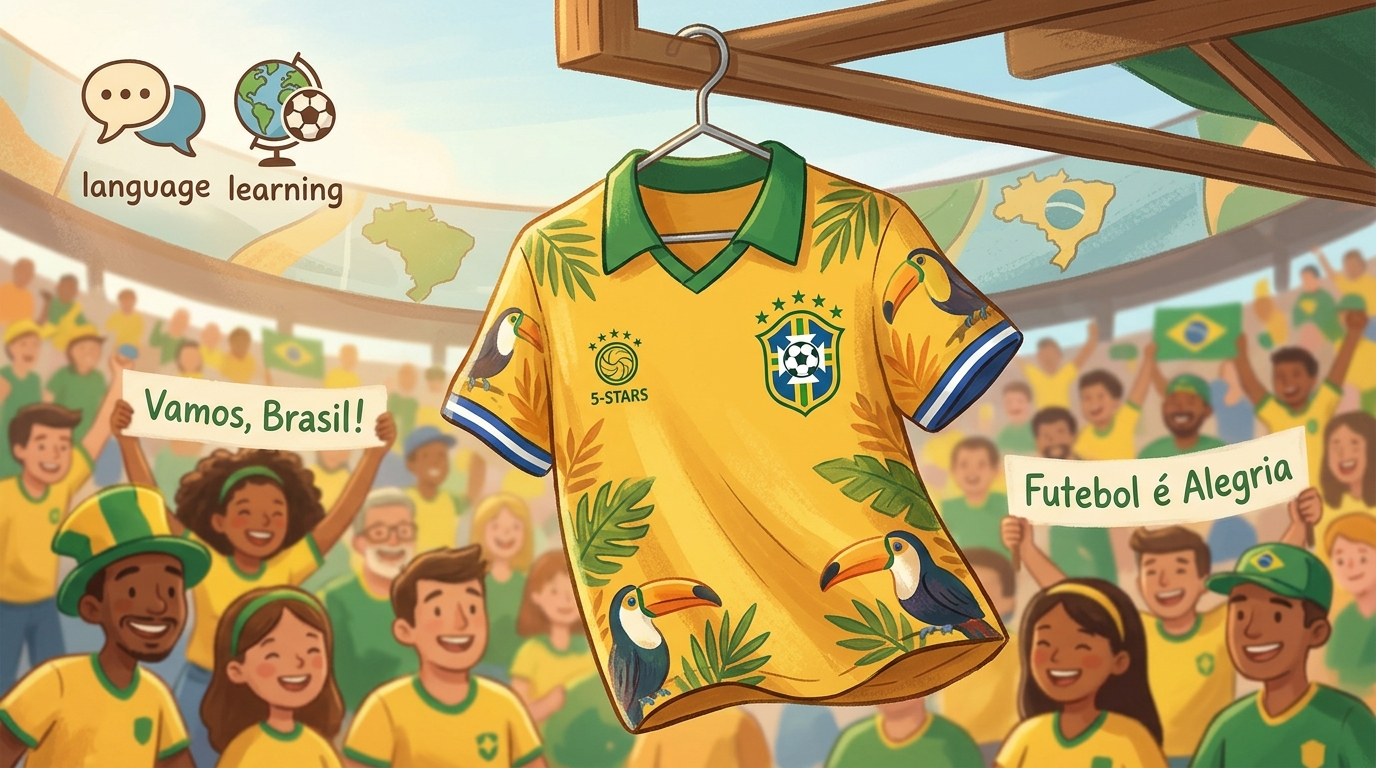
TV commentary phrases worth knowing
If you watch a game on Brazilian TV, the announcer will yell things at you. Some greatest hits:
"Gooooooool!" — You know this one. They hold it for an uncomfortably long time.
"Tá na rede!" — "It's in the net!"
"Tirou tinta da trave" — "It took paint off the post." Used when a shot barely misses.
"Mandou pra galera" — "He sent it to the crowd." A shot that goes way over the bar.
"De primeira" — A one-touch shot or pass, hit on the first contact.
Getting comfortable with this vocabulary also means getting comfortable with how Brazilians actually speak, which is messier, faster, and more idiomatic than what you study in a course. The same patterns of contraction and slang show up in everyday spoken Portuguese, and the more you absorb in one context, the easier the next one gets.
Why bother with all this?
Because football is one of the easiest ways into a real conversation with a Brazilian. Ask someone about their team and you've unlocked twenty minutes of monologue, complete with hand gestures and at least one strong opinion about a coach who should be fired. You don't even need to follow the sport. You just need to know enough words to keep the conversation going.
And if you're traveling to Brazil during a big match — World Cup, Copa do Brasil final, a Flamengo vs Fluminense clássico — you'll be surrounded by this language for hours. Knowing what pintura and frango mean turns a confusing wall of noise into something you can actually follow. Then participate in.
Grab ten words from this list that feel useful. Stick them in your review deck. Watch a game, listen for them, add more as they come up. By your third match in a Brazilian bar, you'll be yelling along with everyone else.
Ready to put this into practice? Decko uses spaced repetition and conjugation drilling to make vocabulary stick. Start learning Brazilian Portuguese with flashcards that actually work.
Try Decko FreeRelated Articles
Why Brazilian Carnival isn't just a party (and the words you need to survive it)
6 min read
Street food Portuguese: what to actually order at a Brazilian feira
6 min read

Brazilian coffee culture: from cafezinho to specialty brewing (and the words you need to know)
6 min read