Brazilian coffee culture: from cafezinho to specialty brewing (and the words you need to know)
Explore Brazilian coffee culture from the humble cafezinho to specialty brewing, plus the Portuguese vocabulary you need to order like a local.
The first thing you notice about coffee in Brazil isn't the taste. It's the size.
If you walk into a padaria (bakery) in São Paulo and ask for a coffee, you'll get a tiny cup, maybe 50ml, of something intensely sweet and very, very strong. This is the cafezinho, and it's less a beverage than a social institution. Refusing one is borderline rude. Accepting one means you belong, even if just for a moment.
I find it kind of funny that Brazil, the world's largest coffee producer for over 150 years, has spent most of that time exporting the good stuff and drinking what was left over. That's changing fast, and the vocabulary is changing with it. But let's start with the basics.
The cafezinho: Brazil's real national drink
Forget caipirinhas. The cafezinho (little coffee) is what actually runs Brazil. The word comes from café + the diminutive -inho, and the smallness is the point. It's served everywhere: offices, shops, people's homes, gas stations, dental offices. Especially dental offices, for some reason.
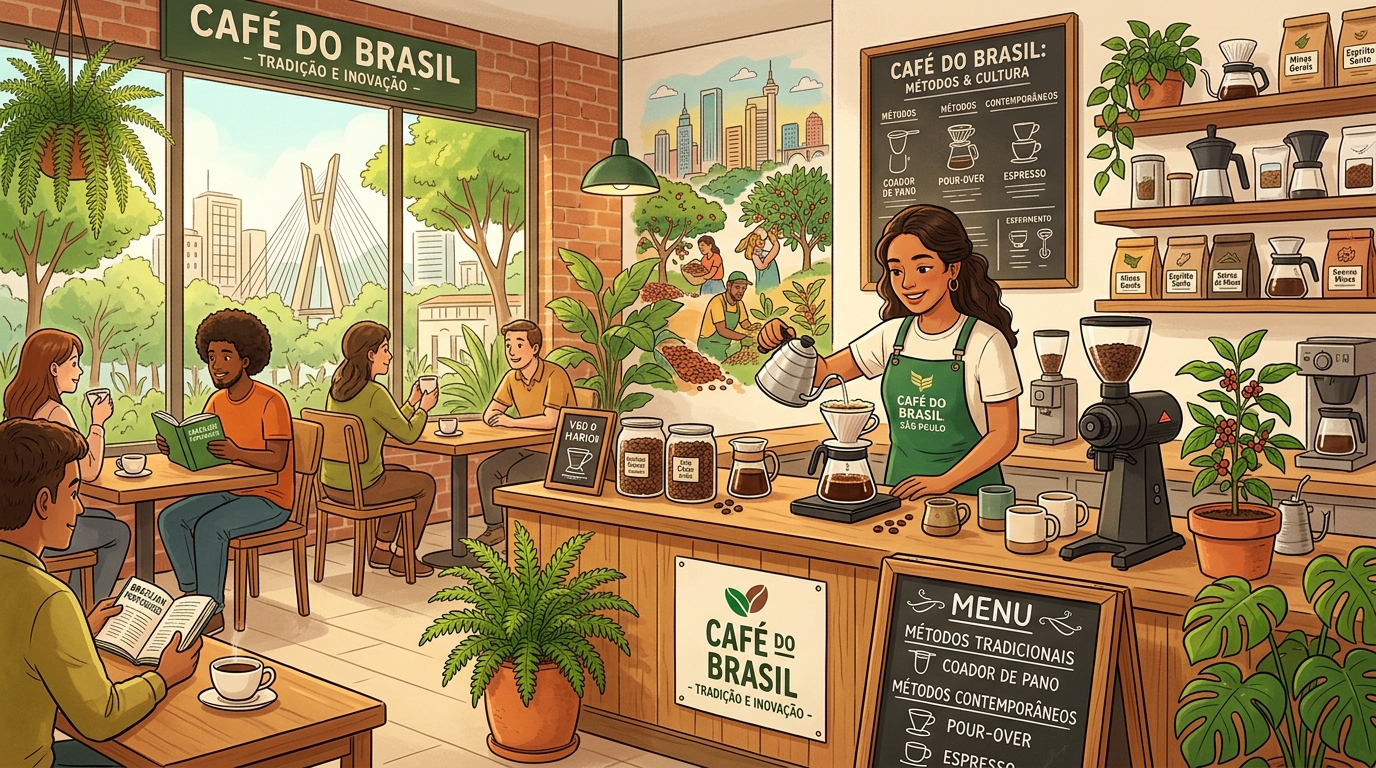
Traditionally, cafezinho is brewed using a coador de pano, a cloth filter that looks like a tiny fabric sock stretched over a wire frame. The ground coffee goes in, hot water pours through, and the result drips into a pot. Sugar is usually added during brewing, not after, which means it's woven into the coffee itself. Asking for it without sugar (sem açúcar) will get you a surprised look in many places, though it's becoming more common.
Here's what you need to know to order:
| Portuguese | English |
|---|---|
| um cafezinho | a small black coffee (the default) |
| café preto | black coffee |
| café com leite | coffee with milk |
| café sem açúcar | coffee without sugar |
| café adoçado | sweetened coffee |
| um pingado | coffee with a splash of milk |
| média | a larger coffee with milk (São Paulo term) |
The pingado is one of my favorites. The word literally means "dripped" because you're just dripping a little milk into the coffee. Different cities have different names for the same drink, which is a whole thing I'll get to.
The specialty coffee wave
Here's what happened over the past decade or so: Brazilians started keeping their best beans for themselves.
Brazil produces roughly a third of the world's coffee. For generations, the finest single-origin beans went straight to export markets in Europe, Japan, and the US. Meanwhile, Brazilians drank café comercial, a commodity blend that was often over-roasted to hide inconsistencies. The sugar in cafezinho wasn't just tradition. It was partly compensation.
Now there's an entire café especial (specialty coffee) scene, especially in cities like São Paulo, Belo Horizonte, and Curitiba. Minas Gerais state alone produces about half of Brazil's coffee, and some of those farms are now selling directly to local roasters. You'll see words on menus that would feel at home in Brooklyn or Melbourne:
| Portuguese | English |
|---|---|
| café especial | specialty coffee |
| grãos | beans |
| torrefação | roastery |
| moído na hora | freshly ground |
| coado | pour-over / filtered |
| prensa francesa | French press |
| extração | extraction |
| café gelado | iced coffee |
| grão arábica | arabica bean |
| acidez | acidity |
| encorpado | full-bodied |
The word coado is worth pausing on. It comes from the verb coar (to strain/filter) and connects directly back to that cloth filter, the coador. Even fancy third-wave shops in São Paulo will sometimes use the cloth filter method, rebranding it as artisanal. Which, honestly, it always was.
Regional differences that'll trip you up
Brazil is continent-sized, and coffee vocabulary shifts depending on where you are. A few examples that caught me off guard:
In São Paulo, a média is a large coffee with milk, essentially a latte. Walk into a bakery in Rio and ask for a média and you might get blank stares, because there it's just a café com leite grande. In parts of Minas Gerais, people offer coffee so constantly that they have a verb for the ritual of pausing to drink coffee with visitors: cafeinar. I'm not sure this is in any dictionary, but it's absolutely in use.
Then there's the cultural weight behind the offer itself. When someone says "Vamos tomar um café?" (Shall we grab a coffee?), they're often not really talking about coffee. Like "let's get a drink" in English, it's an invitation to spend time together, catch up, talk. The unspoken social rules around accepting and offering coffee are real. In many homes and offices, refusing a cafezinho reads as cold or distant.
If you're learning Portuguese and want to lock in this vocabulary before a trip, Decko's spaced repetition system is built for exactly this kind of practical, situation-specific word learning. Knowing pingado at the right moment will earn you a genuine smile.
Useful phrases for the coffee shop
Beyond just ordering, here are some phrases that'll come up:
| Portuguese | English |
|---|---|
| Tem café? | Do you have coffee? / Is there coffee? |
| Aceita um café? | Would you like a coffee? (when offered) |
| Pode ser sem açúcar? | Can it be without sugar? |
| Tá forte demais | It's too strong |
| Que café bom! | What great coffee! |
| Onde posso tomar um bom café aqui perto? | Where can I get good coffee nearby? |
| Quanto custa o café? | How much is the coffee? |
That last one: you'll be pleasantly surprised. A cafezinho at a padaria typically costs between R$2 and R$5 (roughly $0.40 to $1 USD). Even at specialty shops, you'll rarely pay more than R$15 for a pour-over. Coming from the US or Europe, Brazilian coffee prices feel almost suspiciously low.
What this all comes down to
Coffee in Brazil is a social act first and a caffeinated drink second. The quality varies wildly. The tiny cup at a gas station on the BR-101 highway might be bitter and over-sugared, and the single-origin V60 at a specialty shop in Pinheiros might be genuinely world-class. But both of them are doing the same job: creating a moment of connection.

So when someone offers you a cafezinho, say "Aceito, sim" (Yes, I'll take it). Even if you don't love the taste. The coffee itself was never really the point.
Ready to put this into practice? Decko uses spaced repetition and conjugation drilling to make vocabulary stick. Start learning Brazilian Portuguese with flashcards that actually work.
Try Decko Free