Why Brazilian Carnival isn't just a party (and the words you need to survive it)
Carnival is bigger, weirder, and more organized than tourists expect. Here's what's actually happening, plus the Portuguese you'll need on the ground.
The first time I went to Carnival in Recife, I made a rookie mistake. I thought I was going to a party. A big one, sure, but still a party, the way you'd think about New Year's Eve or Halloween. That framing was completely wrong.
Carnival is closer to a national mood shift. For roughly a week, the country runs on different rules. Businesses close or open weird hours. Whole neighborhoods become pedestrian zones. People you've never met will grab your hand and pull you into a dancing line, and that's not creepy, it's just Tuesday. If you show up expecting a nightclub with better costumes, you'll miss what's actually going on.
So let's talk about what Carnival really is, and the Portuguese you'll want in your pocket when you get there.
It's not one festival, it's dozens
The biggest thing tourists get wrong: they assume Rio is Carnival. Rio has a Carnival, a spectacular one, but so does Salvador, Recife, Olinda, São Paulo, Ouro Preto, and hundreds of smaller cities. Each has its own flavor, music, and rhythm.
In Rio, the headline event is the desfile das escolas de samba (samba school parade) at the Sambódromo. This is the televised, choreographed, judged competition you've probably seen clips of. It's incredible, and it's also more like the Super Bowl than a street party. You buy tickets. You sit. You watch.
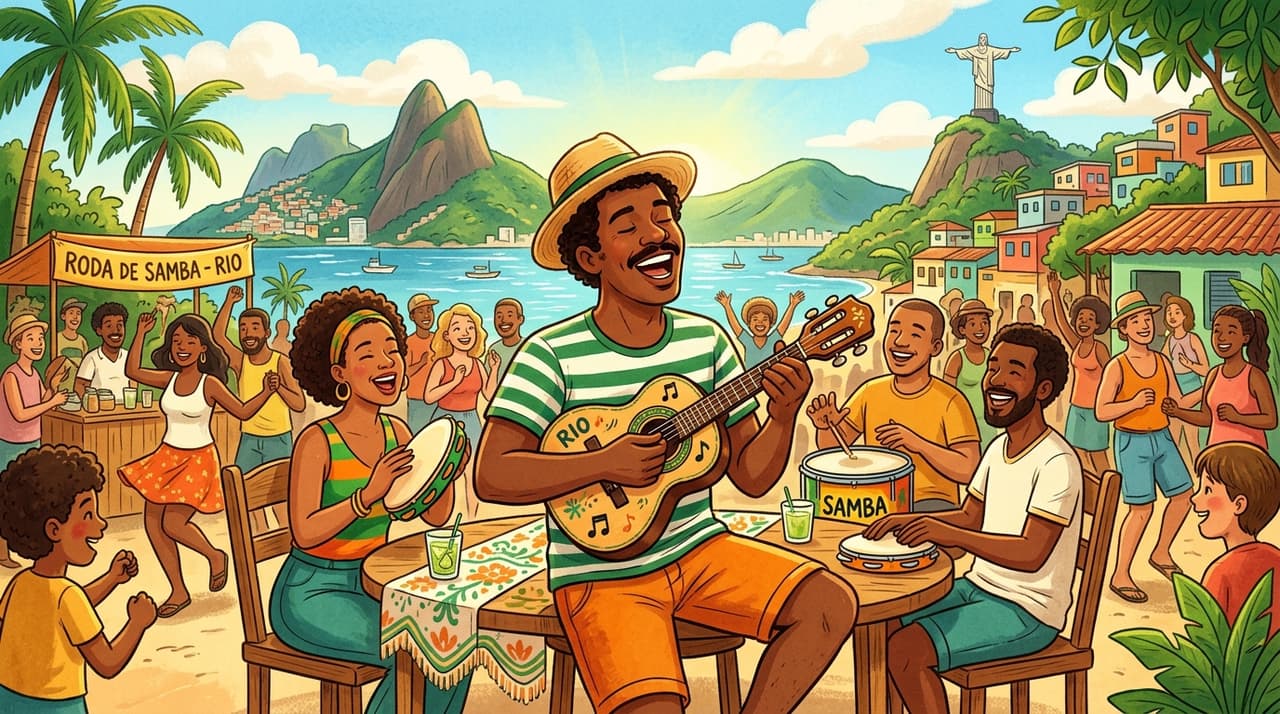
The street party is a separate thing, called a bloco. A bloco is a moving crowd that follows a band or a truck through the streets, dancing, singing, drinking. Rio has hundreds of blocos, and they're free. Salvador has trios elétricos, which are massive sound trucks with bands playing on top, followed by thousands of people. Recife and Olinda lean into frevo (a fast, acrobatic style) and giant puppets called bonecos gigantes.
If someone in Brazil asks you where you're going for Carnival, they're asking which city. The answer matters.
The vocabulary you'll hear on the street
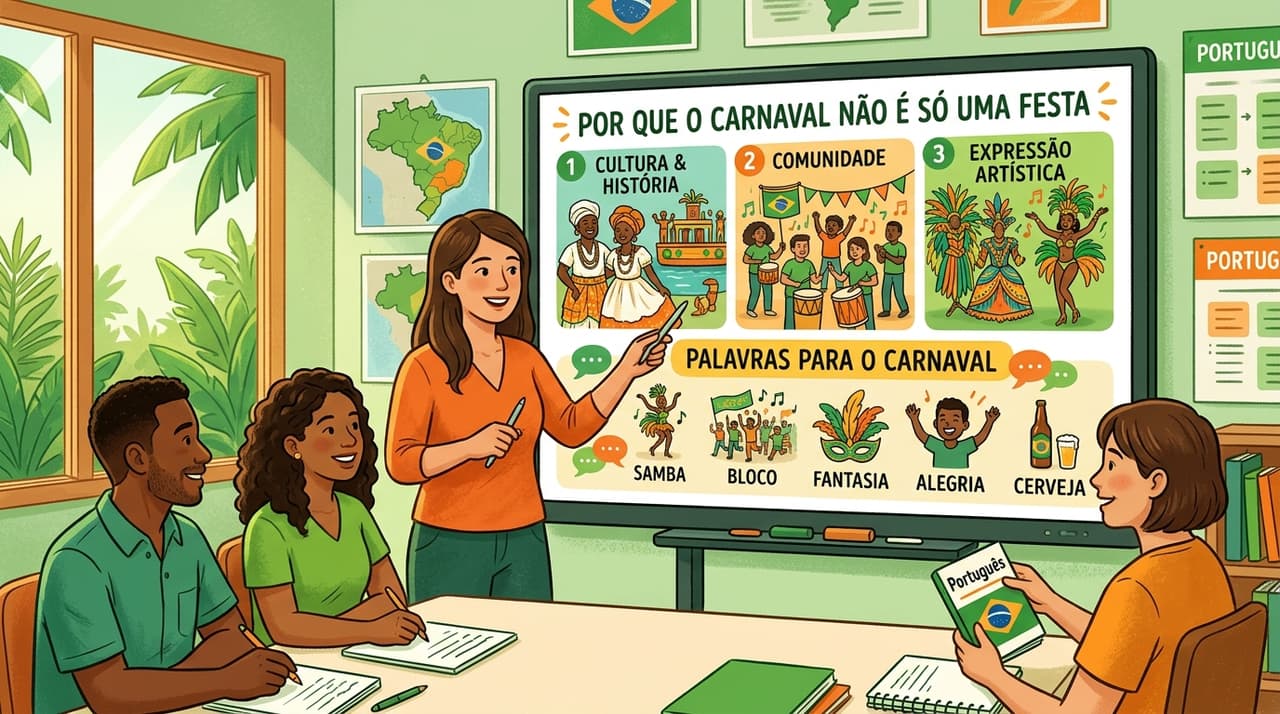
Here's the practical stuff. These aren't textbook words, they're what you'll hear shouted, sung, and posted on flyers.
| Portuguese | English | Context |
|---|---|---|
| bloco | street party group | "Qual bloco você vai?" |
| foliões | Carnival revelers | On the news, in signs |
| fantasia | costume | "Cadê sua fantasia?" |
| abadá | official bloco t-shirt/pass | Salvador especially |
| pipoca | crowd outside the roped section | Also means popcorn |
| trio elétrico | sound truck with band | Salvador core vocabulary |
| sambódromo | samba parade stadium | Rio and São Paulo |
| enredo | parade theme/story | Each school picks one |
| ala | section of a samba school | "Ala das baianas" is famous |
| marchinha | old-school Carnival song | Sing-along tunes everyone knows |
| esquenta | pre-party warm-up | Before the bloco leaves |
| ressaca | hangover | You'll need this word |
Pipoca literally means popcorn, but during Carnival in Salvador it refers to the free crowd dancing outside the roped-off area that paying abadá-wearers get. Being na pipoca is cheaper, more chaotic, and honestly more fun if you can handle the crush.
Fantasia is a false friend worth flagging. It doesn't mean fantasy here, it means costume. If someone says "não esqueci a fantasia," they didn't forget an imaginary thing, they remembered their outfit.
The phrases that'll save you
A few sentences worth drilling before you go:
- "Que horas o bloco sai?" — What time does the bloco start? (Literally "leaves.")
- "Onde é a concentração?" — Where's the meeting point?
- "Tem banheiro por aqui?" — Is there a bathroom around here? (Spoiler: usually no. Plan accordingly.)
- "Não, obrigado/obrigada" — No, thank you. You'll say this a lot to vendors selling beer, water, glitter, and mystery cocktails.
- "Posso tirar uma foto com você?" — Can I take a photo with you? Costumed foliões usually love this.
And one cultural note: kissing culture at Carnival is real and open, but it's also consent-based. If someone leans in and you're not into it, a friendly "não, valeu" (no, thanks) is completely normal and won't cause offense. If you want to read more about the unspoken social rules Brazilians navigate constantly, I wrote about that here.
Why the music matters more than you think
Each regional Carnival has its own soundtrack, and knowing what you're hearing changes the whole experience. Rio's blocos mix samba and marchinhas. Salvador runs on axé and pagodão. Recife is frevo territory, with maracatu weaving in and out. Olinda blends all of it.
If you learn even three or four sing-along marchinhas before you go, something magical happens: strangers realize you know the words, and suddenly you're not a tourist watching a party, you're part of it. "Cidade Maravilhosa," "Mamãe Eu Quero," and "Ó Abre Alas" are the classics. Look them up. I go deeper into how different Brazilian genres teach you different Portuguese in this post on music and vocabulary.
The learning-Portuguese angle
Here's what I wish someone had told me: Carnival is one of the best possible immersion environments, but only if you've done the vocabulary work in advance. In the moment, everything moves too fast to look things up. You need the words already loaded.
This is exactly the kind of situation spaced repetition is built for. Load up 30-40 Carnival-specific words two or three weeks before you travel, review them daily, and by the time you land they'll be automatic. Try Decko free and build a deck for your trip. It takes about ten minutes a day and it's the difference between nodding politely when someone asks "vai pro bloco do Galo?" and actually saying "vou sim, te vejo lá."
Timing matters more than you'd think
Carnival officially runs from the Friday before Ash Wednesday through Fat Tuesday, but in practice it starts earlier. Pré-Carnaval blocos happen for weeks beforehand, especially in Rio and Salvador. If you can't travel during the official dates, the pré-Carnaval blocos in late January and early February give you 80% of the experience with 40% of the crowds.
And whatever city you pick, wear comfortable shoes. Not cute shoes. Comfortable ones. You'll walk more in one day than you walked all last month. Ask me how I know.
Boa folia.
Ready to put this into practice? Decko uses spaced repetition and conjugation drilling to make vocabulary stick. Start learning Brazilian Portuguese with flashcards that actually work.
Try Decko Free