Street food Portuguese: what to actually order at a Brazilian feira
A practical guide to ordering at a Brazilian feira, with the Portuguese words, phrases, and food terms that vendors actually use.
The first time I went to a feira in São Paulo, I pointed at things and grunted. The vendor was patient. He was also, I realized later, charging me about double what everyone else was paying. Not because he was a crook, but because tourists who can't say what they want get the tourist price. That's just how it works.
A feira (open-air street market) is one of the best places to practice Portuguese in Brazil. Vendors expect quick exchanges, the vocabulary repeats, and people are in a good mood because they're surrounded by mangoes. If you can handle five minutes at a feira stall, you can handle most everyday situations in Portuguese.
Here's what you actually need to know.
What a feira even is
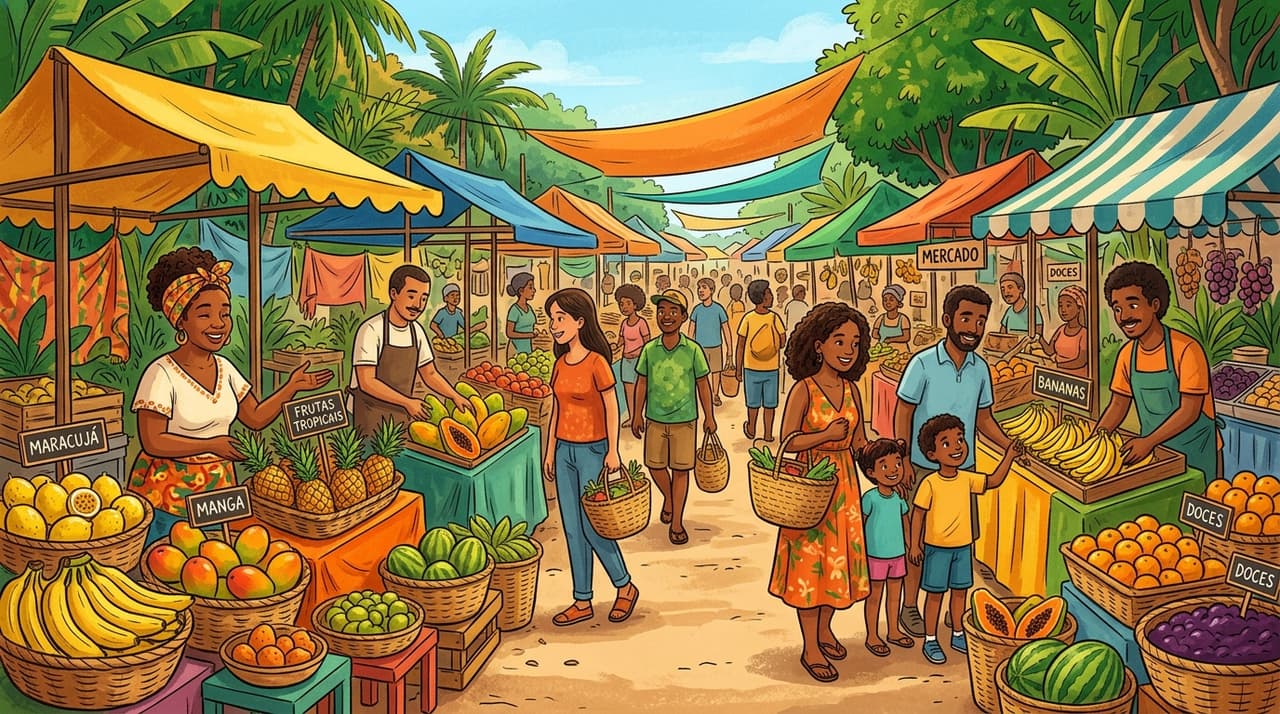
Feiras pop up once a week in most Brazilian neighborhoods. They're not farmers markets in the curated, expensive sense. They're loud, cheap, full of regular people doing their weekly shopping, and they sell fruit, vegetables, fish, meat, herbs, cheese, and street food cooked right there on the spot.
The street food part is what most foreigners come for, and rightly so. A pastel and a copo de caldo de cana (cup of sugarcane juice) on a Saturday morning is one of those small Brazilian rituals that makes you feel like you're finally inside the country instead of looking at it.
The phrases that do 80% of the work
You don't need elaborate sentences. Vendors are working fast, and they appreciate when you're efficient too. These are the phrases I use constantly:
- Oi, tudo bem? Hi, how's it going. Always start with this. Skipping the greeting is rude in Brazil in a way it isn't in some other places.
- Quanto é? / Quanto custa? How much is it?
- Me vê um/uma... Can I get a... (literally "see me a"). This is the workhorse phrase. Me vê um pastel de queijo—get me a cheese pastel.
- Pode ser. That works / sounds good.
- Tá bom. Okay / fine.
- É pra viagem. It's to go. (Useful, though most feira food is eaten standing up right there.)
- Obrigado (if you're male) / Obrigada (if you're female). Thank you.
If the vendor asks you something you don't catch, "como?" means "what?" in a polite way. Don't say "o quê?" alone—it can sound a bit blunt.
The actual food: what you're ordering
Let me walk through the stuff you'll actually see, because menus don't exist at a feira. You order by looking at what's frying.
Pastel. A big rectangular fried pastry with filling inside. The fillings come in a predictable lineup:
- pastel de queijo—cheese
- pastel de carne—ground beef
- pastel de frango—chicken
- pastel de palmito—heart of palm
- pastel de camarão—shrimp
- pastel de pizza—yes, pizza-flavored, with mozzarella, tomato, and oregano
You order by saying the filling: me vê um de queijo, por favor. The word pastel is implied.
Caldo de cana. Fresh-pressed sugarcane juice, often with a squeeze of lime or pineapple. Order it as um caldo de cana or just uma cana. It's the traditional pastel pairing. Don't fight tradition.
Tapioca. A crepe made from cassava starch, folded over a sweet or savory filling. Common ones: tapioca de queijo com presunto (cheese and ham), tapioca de coco com leite condensado (coconut with condensed milk).
Caldo. A hot, thick soup. Caldo de feijão (bean) and caldo verde (a Portuguese-style green soup with kale and sausage) are typical.
Espetinho. Small grilled meat skewers. Espetinho de carne, de frango, de queijo coalho (grilled cheese on a stick, which is exactly as good as it sounds).
Buying fruit without getting confused
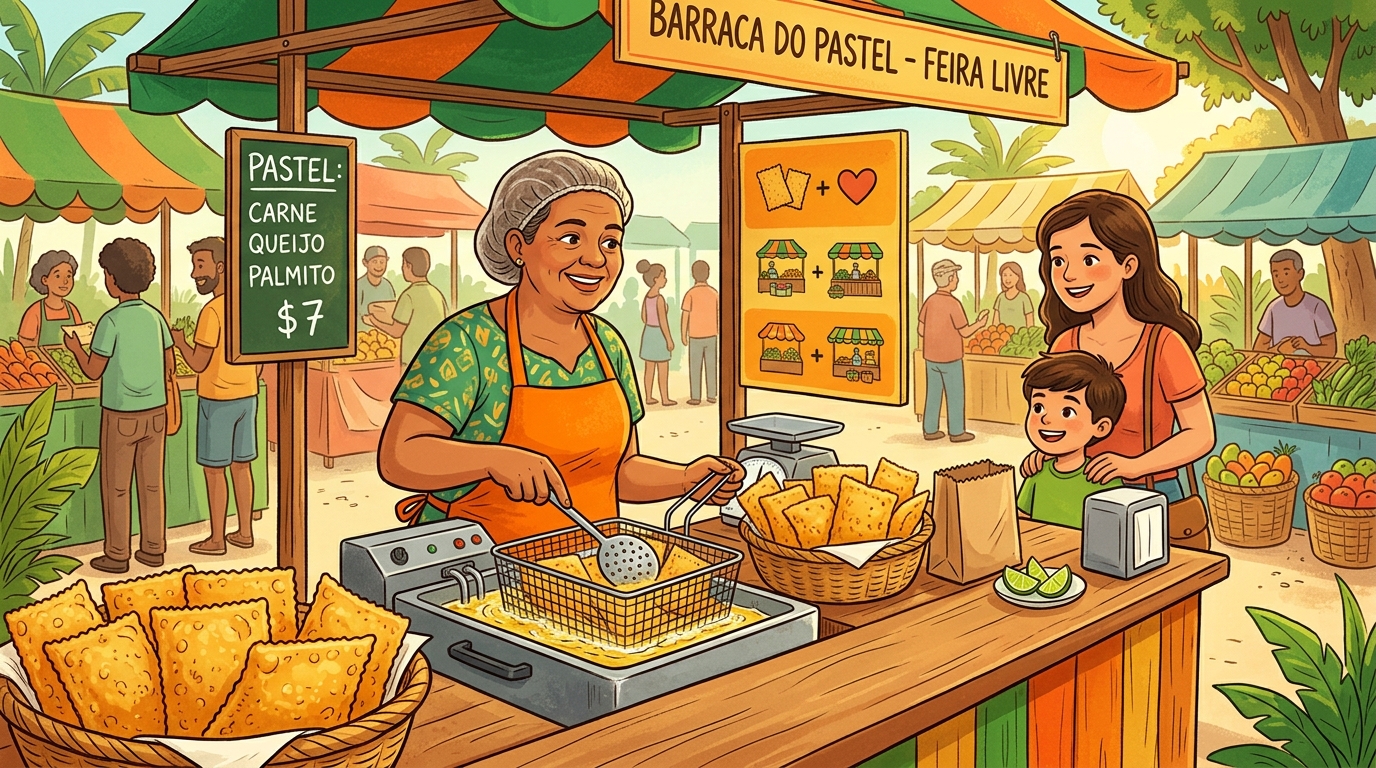
Fruit at a feira is sold by weight (por quilo) or sometimes by the unit (por unidade) or in small piles (o monte—that little pile for a fixed price).
The vendor will usually shout something like "dois reais o monte!"—two reais a pile. You point at the pile you want and say me vê esse. Done.
For weighed fruit, you say how much you want: meio quilo de manga (half a kilo of mango), um quilo de banana (a kilo of banana). If you only want a couple, só duas, por favor works fine.
A few fruit names worth knowing because they don't translate cleanly:
- maracujá—passion fruit
- caju—cashew fruit (the actual fruit, not the nut)
- goiaba—guava
- mamão—papaya. Don't confuse with papai, which means dad. Feiras are full of small embarrassments like this.
- jabuticaba—a small black fruit that grows directly on the trunk of the tree, hard to find outside Brazil
The trick with vocabulary like this? You can't just drill it once and hope it sticks. You need to see these words again three days later, then a week later, then two weeks later—right when your brain's about to forget them. That's spaced repetition. If you want the feira vocab genuinely ready before your trip instead of fumbling through Google Translate at the stall, you can build a feira-specific deck on Decko.
The little cultural stuff that matters
A few things I wish someone had told me:
Vendors will offer you a taste. "Experimenta!" means "try it!" Just take the slice of mango. It's not a sales trick, it's hospitality, and refusing feels weird.
Haggling is mild at a feira. You can ask "faz por dez?" (will you do it for ten?) on bigger purchases, but don't push hard on a two-real bunch of cilantro. People will laugh at you, in a kind way.
At the end of the day, around noon or one, vendors start dropping prices to clear stock. This is called the xepa. If you show up late, you'll hear them shouting deals. The fruit might be slightly bruised but it's basically free.
And bring cash, ideally small bills. Pix (the instant payment app) works at most stalls now, but not all. If you've already gotten comfortable with the basic social rules of interacting with Brazilians, the feira is where you put it all into practice. Greet, chat a little, don't rush, say thank you. The vendor remembers you next week. The price gets better. That's the whole game.
One last phrase
When you're done and walking away with your bag of mangoes and a pastel grease-stained napkin, the vendor will probably say "volte sempre!"—come back always. The right answer is "com certeza" (for sure) or just a smile and a "valeu!" (thanks, casual).
Then eat the pastel before it gets cold. That part doesn't require any Portuguese.
Ready to put this into practice? Decko uses spaced repetition and conjugation drilling to make vocabulary stick. Start learning Brazilian Portuguese with flashcards that actually work.
Try Decko FreeRelated Articles

Brazilian coffee culture: from cafezinho to specialty brewing (and the words you need to know)
6 min read
Why Brazilian Carnival isn't just a party (and the words you need to survive it)
6 min read

Brazilian football vocabulary: the language of the beautiful game
6 min read