
The Portuguese connectors that make you sound fluent (even when you're not)
Master the Portuguese connector words Brazilians actually use in conversation. These small words punch way above their weight in making you sound natural.
Here's something I noticed after spending time with Brazilian friends: the gap between a textbook learner and someone who sounds natural isn't really about vocabulary size. It's about the connective tissue. The little words that glue thoughts together.
You can know 3,000 Portuguese words and still sound robotic if every sentence stands alone like a separate brick. Brazilians don't talk in bricks. They weave. And the threads they weave with are these unglamorous connector words that nobody teaches you properly.
Let me show you the ones that did the most work for me.
The "buying time" connectors
Before we get to the logical connectors, you need the verbal filler that Brazilians actually use. These are what come out of your mouth while your brain catches up.
Tipo (like, sort of) is everywhere. It's the Brazilian equivalent of English "like" as a filler.
- Ele é tipo meu melhor amigo. (He's like my best friend.)
- Foi tipo assim, sabe? (It was like this, you know?)
Sabe? (you know?) is how Brazilians check in with the listener. Drop it at the end of a thought and you instantly sound 30% more native.
Né? is the contraction of não é? and it's the verbal nod of Brazilian Portuguese. You'll hear it constantly.
- Tá frio hoje, né? (It's cold today, right?)
Don't overuse these. But sprinkle them in and your speech stops sounding like a written essay being read aloud.
The connectors that organize your thoughts
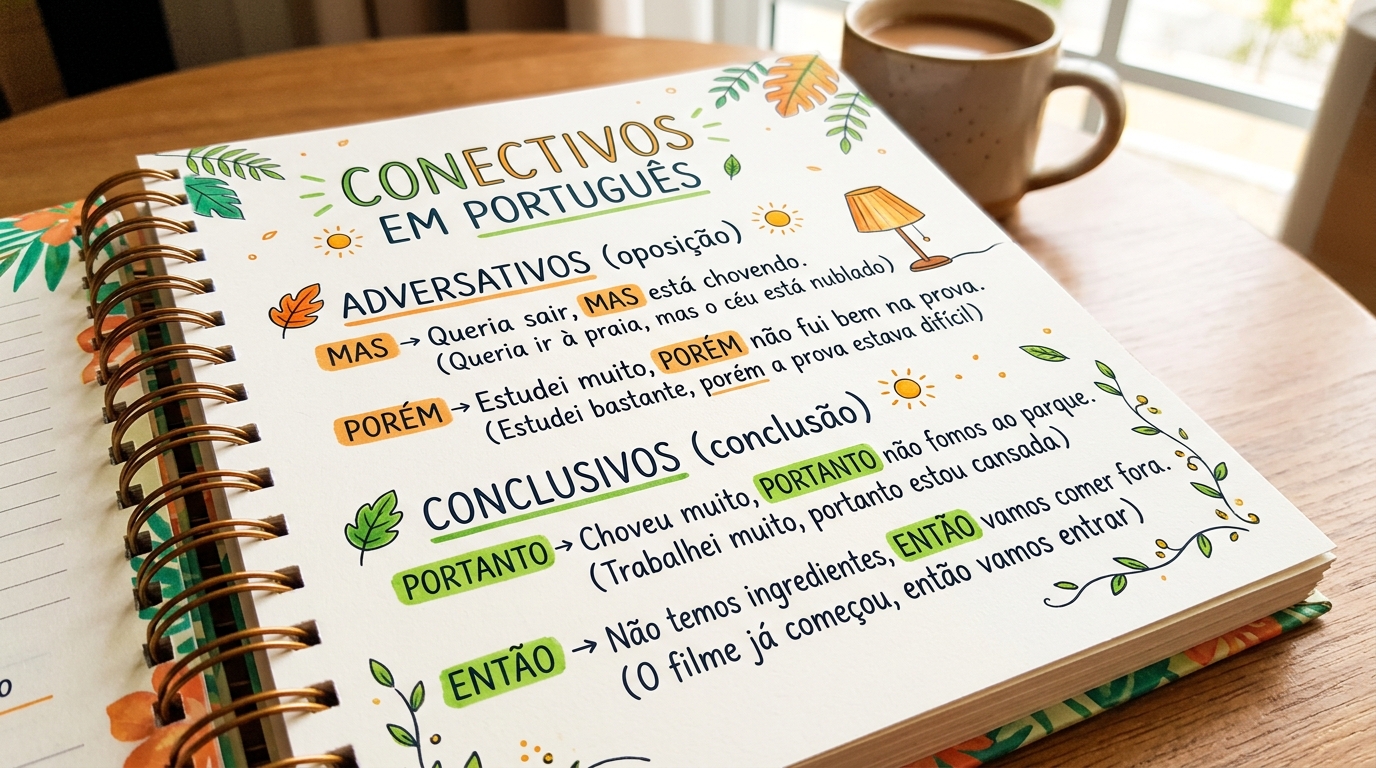
These are the ones that show you can hold a longer thought together. Textbooks usually give you e (and), mas (but), porque (because) and call it a day. Here's what Brazilians actually reach for.
Então (so, then) is the workhorse. It opens explanations, signals conclusions, introduces stories.
- Então, eu cheguei lá e ela não tava. (So I got there and she wasn't there.)
Aí (then, and then) is how Brazilians narrate. It pushes the story forward. If you're telling someone what happened yesterday, aí should appear five times. Seriously, this one alone will carry you through half your conversations.
- Aí eu falei pra ele que não dava. (Then I told him it wasn't going to work.)
Daí is basically the same thing as aí, slightly more emphatic. Use them interchangeably.
Aliás (actually, by the way, in fact) is the one that makes you sound thoughtful. It's for correcting yourself or adding a related thought.
- Ele é brasileiro. Aliás, ele é carioca. (He's Brazilian. Actually, he's from Rio.)
Inclusive (in fact, even, including) is similar but stronger. It introduces something surprising or notable. I didn't appreciate this one until I heard it used in an argument and realized how much punch it adds.
- Eu gosto muito dele, inclusive vou no aniversário dele. (I really like him, in fact I'm going to his birthday.)
The contrast connectors that aren't just "mas"
Mas (but) is fine. It's also the only contrast word most learners ever use, which is why their speech feels flat.
Porém (however) is more formal but very common in writing and slightly elevated speech.
Só que (it's just that) is the conversational gold. Brazilians use this constantly when softening a contradiction. This is probably my favorite on the whole list because it makes disagreeing feel less confrontational.
- Eu queria ir, só que tô cansada. (I wanted to go, it's just that I'm tired.)
No entanto and contudo both mean "however" but lean formal. Save them for written Portuguese or job interviews.
Apesar de (despite) is the one I wish I'd learned earlier. It opens up a whole new way to phrase ideas.
- Apesar do frio, foi divertido. (Despite the cold, it was fun.)
The cause and consequence connectors
Porque (because) is the one everyone knows. Here's what to add to your toolkit.
Já que (since, given that) introduces a reason the listener already knows.
- Já que você tá aqui, vamos almoçar. (Since you're here, let's have lunch.)
Por isso (that's why, because of that) is how you point at a consequence.
- Tava chovendo, por isso não fui. (It was raining, that's why I didn't go.)
Como at the start of a sentence means "since/as," not "how." This trips people up. Still trips me up sometimes, honestly.
- Como tava tarde, fui embora. (Since it was late, I left.)
How to actually learn these
Reading a list like this is the easy part. The hard part is getting these into your active speech, where you grab them without thinking.
Here's the trick that worked for me: don't try to learn them as isolated words. Learn them inside example sentences you can imagine yourself saying. Aí by itself means almost nothing. Aí eu falei que não means a specific thing in a specific moment. Context is everything here.
This is exactly the use case where flashcards earn their keep, if you build them right. One side: a real situation in English. Other side: the Portuguese sentence with the connector doing its job. Review with active recall, not by staring at lists. Staring doesn't work. Trust me, I wasted weeks that way.
Decko handles the spacing automatically, so the connectors you struggle with come back more often than the ones you've nailed. After a few weeks, words like aliás and só que start falling out of your mouth in real conversations.
A small warning about register
Not all of these belong in every situation. Aí and daí are casual. You wouldn't pepper them through a business presentation. No entanto and contudo are the opposite, they'd sound strange at a barbecue with friends.
The fastest way to calibrate is to listen. Watch Brazilian YouTubers, podcasters, interviews. Notice which connectors show up in which contexts. Your ear will sort it out faster than any rule I could write here.
One last thing. Don't try to use all of these at once. Pick three or four for this week, force yourself to actually say them, and let the rest come gradually. Maybe start with então, aí, and só que since those three cover the most ground. Fluency isn't a vocabulary list. It's a set of small habits that eventually stop feeling like habits at all.
Ready to put this into practice? Decko uses spaced repetition and conjugation drilling to make vocabulary stick. Start learning Brazilian Portuguese with flashcards that actually work.
Try Decko FreeRelated Articles

How to talk about feelings in Portuguese (without sounding like a textbook)
5 min read

Brazilian slang you won't find in textbooks (but hear every day)
6 min read

Portuguese Diminutives (-inho/-inha): Why Brazilians Make Everything Tiny and Adorable
6 min read