
How to talk about feelings in Portuguese (without sounding like a textbook)
Move past feliz and triste with the emotional vocabulary Brazilians actually use, from animado to com raiva to that untranslatable saudade.
Here's a problem most Portuguese learners hit around the six-month mark: you can describe what you did yesterday, order food, explain your job, but when someone asks how you're feeling, you reach for feliz or triste and immediately sound like a Duolingo owl. I had this exact moment with a friend in São Paulo who asked how I was doing after a rough week. I said estou triste. She nodded politely. Then her Brazilian friend said tô meio pra baixo, sabe? and everyone immediately understood.
That's the gap. Textbooks give you the dictionary entries. Real Brazilians use a wildly richer emotional vocabulary, and a lot of it doesn't translate cleanly into English.
The happy spectrum (it's not just feliz)
Feliz exists, sure, but Brazilians reserve it for genuinely big, lasting happiness. Wedding day happy. New baby happy. For everyday good moods, you'll hear:
- animado/animada — excited, pumped up. Tô super animada pro show. (I'm so pumped for the concert.)
- contente — content, pleased. Softer than feliz. Fiquei contente com a notícia. (I was pleased with the news.)
- alegre — cheerful, in a good mood. Describes a vibe more than a moment.
- realizado/realizada — fulfilled. Used when something meaningful happens. Me sinto realizado no trabalho novo.
- de bem com a vida — literally "on good terms with life." The Brazilian version of "in a good place right now."
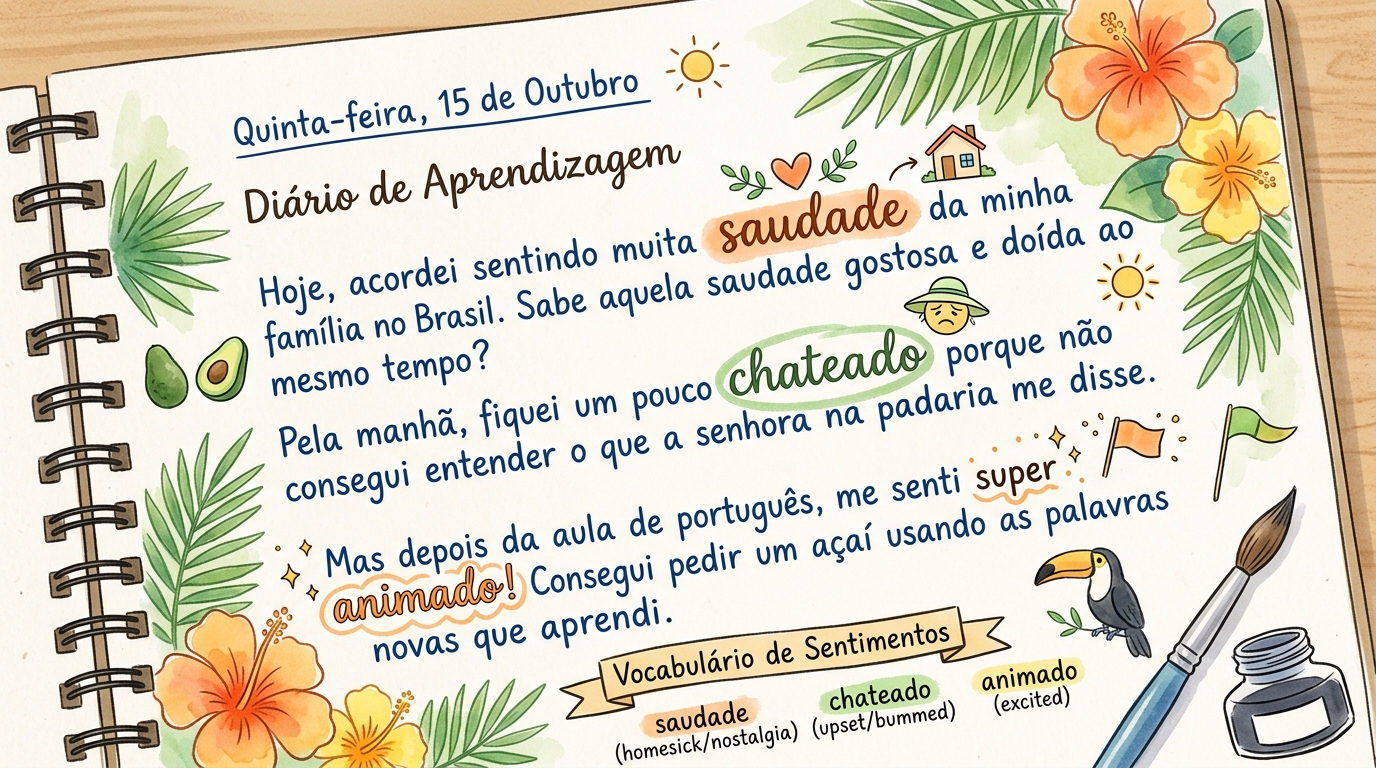
The one I'd push you to actually use is animado. It comes up constantly and it's the natural response to plans, news, weekends, anything mildly exciting.
The sad spectrum (where things get interesting)
Triste works, but it's heavy. For the daily low-grade bad mood, Brazilians have better options:
- chateado/chateada — upset, bothered, annoyed-sad. This is the workhorse. Ele ficou chateado comigo. (He got upset with me.) Use this constantly.
- pra baixo — down, low. Tô meio pra baixo hoje. (I'm a bit down today.) Casual, common, perfect.
- deprê — short for deprimido. Mildly depressed, slangy. Tô deprê.
- mal — just "bad." Tô me sentindo mal. Covers physical and emotional.
- arrasado/arrasada — destroyed, devastated. For when something actually hits hard.
Chateado is the one you'll use most. English speakers overuse triste when chateado is what they actually mean, and you can hear the difference immediately in how Brazilians respond.
Anger, frustration, and the verb you need
Here's where Portuguese diverges from English structurally. You don't say "I'm angry" with ser or estar and an adjective the way you might expect. You usually say estou com raiva (literally "I'm with anger").
- com raiva — angry. Tô com raiva dele. (I'm angry at him.)
- bravo/brava — mad, cross. Minha mãe ficou brava. (My mom got mad.)
- puto/puta — pissed off. Vulgar but extremely common among friends. Handle with care.
- irritado/irritada — irritated. Same as English.
- de saco cheio — fed up. Literally "with a full bag." Tô de saco cheio disso. (I'm fed up with this.)
The estar com + noun pattern shows up everywhere with emotions and physical states: estou com fome (hungry), estou com medo (afraid), estou com vergonha (embarrassed). Worth internalizing as its own grammatical reflex.
Fear, worry, and embarrassment
- com medo — afraid. Tô com medo de voar.
- preocupado/preocupada — worried.
- ansioso/ansiosa — anxious. Brazilians use this a lot, both clinically and casually.
- com vergonha — embarrassed or shy. Fiquei com vergonha. (I got embarrassed.)
- constrangido/constrangida — awkward, uncomfortable in a social way. More specific than com vergonha.
Vergonha is worth pausing on because it covers a wider range than "embarrassment" in English. It can mean shyness, embarrassment, or even shame depending on context. You'll hear it constantly.
If you want this stuff to actually stick instead of evaporating by next Tuesday, you need to see these words in context, repeatedly, over weeks. That's exactly what spaced repetition is built for. Decko lets you build emotion-vocabulary decks with real example sentences, so chateado and animado become as automatic as bom dia.
Saudade and the untranslatables
You knew this was coming. Saudade is the famous one, that bittersweet longing for someone or something absent. Tô com saudade de você (I miss you, more or less) is one of the most-used phrases in Brazil. But there are others worth knowing:
- gostosa/gostoso as a feeling — que gostoso! means something like "how lovely" about a sensation, weather, food, a moment. Different from the (very different) meaning when applied to people.
- dó — a tender pity, almost protective. Tenho dó dele. (I feel for him.)
- carinho — affection, warmth, the feeling of caring. Sinto muito carinho por ela.
- aperto no peito — literally "tightness in the chest." Anxious heaviness, heartache. Brazilians use physical sensations to describe emotions more than English speakers do.
How to actually start using these
Reading a list doesn't put words in your mouth. Here's what works: pick three emotion words from above (I'd suggest animado, chateado, and com saudade) and force yourself to use them this week. Replace every feliz with animado or contente. Replace every triste with chateado or pra baixo. Text a Brazilian friend. Write three sentences in your journal.
The vocabulary that sticks is the vocabulary you've actually said out loud to another human. Everything else is just trivia.
And next time someone asks tudo bem? and you're actually not fine, try tô meio pra baixo, sabe? instead of estou triste. The conversation that follows will be completely different.
Ready to put this into practice? Decko uses spaced repetition and conjugation drilling to make vocabulary stick. Start learning Brazilian Portuguese with flashcards that actually work.
Try Decko FreeRelated Articles

The Portuguese connectors that make you sound fluent (even when you're not)
6 min read

Brazilian slang you won't find in textbooks (but hear every day)
6 min read

Portuguese Diminutives (-inho/-inha): Why Brazilians Make Everything Tiny and Adorable
6 min read