Portuguese body language: the gestures that replace whole sentences
Brazilians say a lot without speaking. Here's how to read and use the gestures that carry as much meaning as the words themselves.
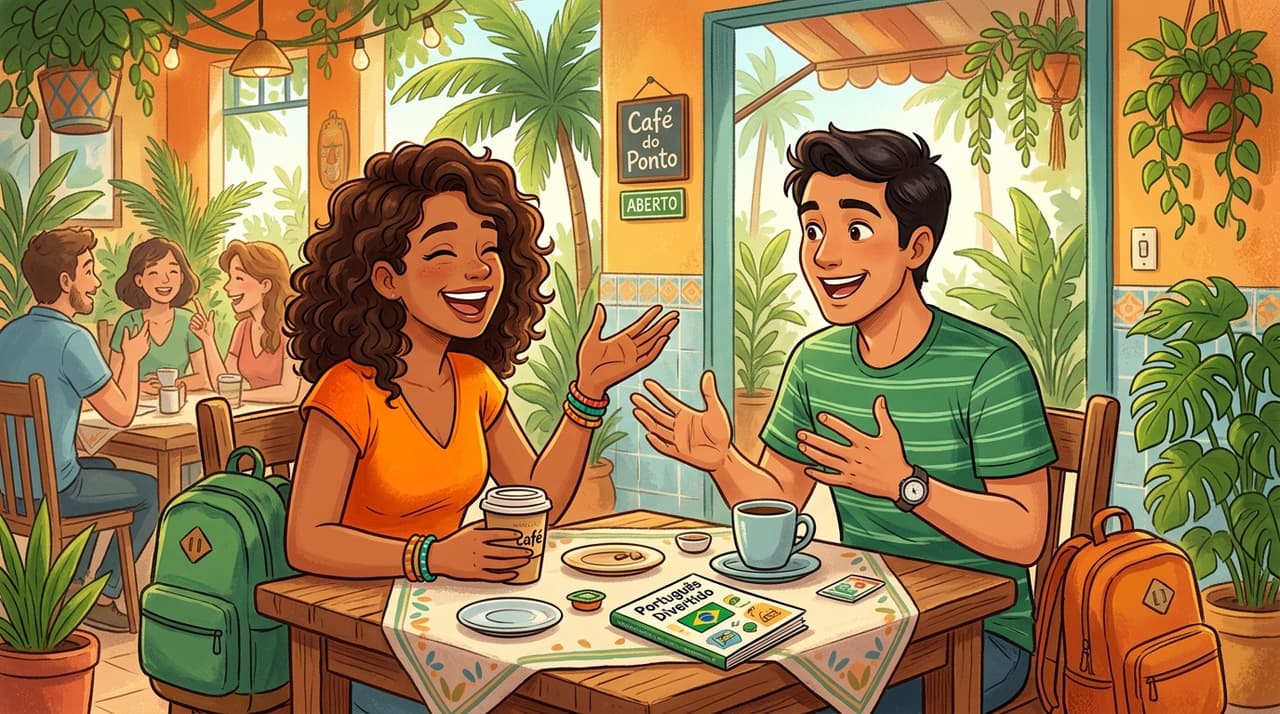
The first time a Brazilian told me a story, I understood maybe 40% of the words. But I understood 100% of the story. That's because half of it was happening with their hands.
This is something no textbook prepares you for. You can memorize a thousand verbs and still miss what a Brazilian is actually saying, because a huge chunk of the meaning lives in gestures. Some of these gestures replace whole phrases. A few of them can even reverse the meaning of what someone just said out loud.
So let's talk about the ones you'll see constantly, what they mean, and which ones you should absolutely avoid trying too early (because a misfired gesture is way more awkward than a mispronounced word).
The thumbs-up is basically a second language
If you take one thing from this article, take this: Brazilians use joia (literally "jewel") and a thumbs-up for almost everything. Yes, okay, thanks, no problem, understood, sounds good, I'm fine, the food is great, you can go ahead. About fifteen other things depending on context.
Someone lets you merge in traffic? Thumbs-up. Waiter asks if the meal is okay? Thumbs-up. Friend asks how you're doing? Thumbs-up with a small nod. You'll see it hundreds of times a day.
The verbal equivalent is tudo bem? / tudo bem! (all good?/all good!), but honestly the gesture often does the whole job by itself.
The finger-flick that means "a lot"
This one took me forever to figure out. Someone shakes their hand loosely at the wrist, letting their fingers flick together, making a soft snapping sound. Means "a lot," "intense," "crazy amount," or "that was wild."
- Tinha muita gente na festa! + hand flick = the party was PACKED
- Tá calor hoje + hand flick = it's not just hot, it's brutal
- Ele come pra caramba + hand flick = this man eats an unreal amount of food
Once you notice it, you can't unnotice it. Brazilians do this constantly to add emphasis without changing any words.
Pulling down the lower eyelid
One finger under the eye, pulling the lower lid down slightly. This means "watch out," "be careful," or "I'm onto you / don't try anything." Playful most of the time, warning occasionally.
A parent might do this to a kid who's about to do something dumb. A friend might do it when you're telling a story that sounds a little too convenient. Pairs well with tô de olho (I've got my eye on you) or esperto, hein? (clever, huh?).
The forehead flick for "forget it"
Quick flick of the fingers off the forehead, moving outward. "I give up." "Forget it." "This is hopeless." "My brain can't handle this right now."
Useful words to pair it with: Deixa pra lá (leave it, forget it), Não dá (no way, can't be done), Cansei (I'm done with this).
Rubbing thumb against fingers: money
Same as in a lot of cultures, but Brazilians use it constantly and often with a raised eyebrow that adds the flavor of "...and it wasn't cheap" or "...if you know what I mean." Goes with caro pra caramba (ridiculously expensive) or tá difícil (times are tough).
The "more or less" wobble
Hand flat, palm down, wobbling side to side. Means mais ou menos (more or less), assim, assim (so-so), or não sei bem (I'm not sure).
You'll see this when someone's answering a question they don't want to commit to. "Did you like the movie?" Wobble. "Is the boss in a good mood today?" Wobble.
It's the universal Brazilian hedge. Honestly it's more informative than a lot of verbal answers because the intensity of the wobble tells you exactly how so-so we're talking.
The gestures to be careful with
A few gestures look innocent but carry weight you might not want:
The "OK" sign (thumb and index finger touching in a circle). In the US it means "okay" or "perfect." In Brazil, historically, it's an obscene gesture. Younger Brazilians in big cities largely don't care anymore because of exposure to American media, but with older folks or in formal settings, just don't. Use thumbs-up instead.
The fig sign (thumb poking between index and middle finger, fist closed). Called figa and often sold as a keychain or jewelry for good luck. As jewelry, fine. As a gesture directed at a person, it can range from playful to vulgar depending on the region and how you do it. Best avoided until you have a Brazilian friend willing to coach you.
Beckoning with a curled index finger. Feels normal to English speakers. In Brazil it can come across as rude, like summoning a dog. Use a whole hand instead, palm down, fingers waving toward you.
Why this matters more than you think
Here's the thing: understanding gestures isn't decorative. It's the difference between following a conversation and staring blankly while people laugh around you.
There's research on this (multimodal communication studies, if you're curious), but you don't need a citation to know it's true. Native speakers aren't just talking. They're throwing meaning around with their whole body, and if you're only processing the audio track, you're missing half the movie.
If you're trying to build the kind of vocabulary that actually shows up in real Brazilian conversations, Decko mixes common phrases with the context they appear in. You learn language the way it's actually used, gestures and all. Better fit than word lists that leave you fluent on paper and lost in person.
How to actually learn these
You can't drill gestures with flashcards, but you can absorb them fast if you know to look:
Watch Brazilian YouTubers or interviews with the sound off for a minute. You'll see how much meaning is happening non-verbally. Then turn the sound back on and match gesture to phrase.
Mirror sparingly. Don't start throwing hand flicks around in week two. Watch, notice, and let a few natural ones creep into your speech once they feel earned. You'll know when.
Ask. Brazilians love explaining this stuff. Point at a gesture you saw and ask o que significa isso? (what does that mean?). You'll get a five-minute masterclass every time.
Body language is one of those things that separates learners who sound like they memorized Portuguese from learners who sound like they've actually lived in it. Worth paying attention to. Worth stealing a few moves from. Just maybe not the fig sign. Not yet.
Ready to put this into practice? Decko uses spaced repetition and conjugation drilling to make vocabulary stick. Start learning Brazilian Portuguese with flashcards that actually work.
Try Decko Free