The role of context in vocabulary retention (and why word lists fail you)
Isolated word lists feel productive but rarely stick. Here's what cognitive science says about why context is doing the heavy lifting in vocabulary learning.
I've watched a lot of people try to learn a language by grinding through word lists. Frequency lists, thematic lists, Quizlet decks with 500 nouns. They log hundreds of reps, feel like they're making progress, then open a book or a Netflix show and understand almost nothing.
This isn't a discipline problem. It's a context problem, and the research on it is pretty unforgiving.
What memory actually stores
When you learn a word, your brain doesn't file it under a single entry the way a dictionary does. It stores a mesh of associations: the sound, the situations you've encountered it in, the emotional tone, the words that tend to sit next to it, even the room you were in when you first saw it.
Endel Tulving called this "encoding specificity," and the principle is blunt: you retrieve information best in a context similar to the one where you learned it. So if you learn saudade from a list that reads "saudade = longing, nostalgia," you've encoded it in a context of English glosses and vertical lists. That's the cue your brain will need to recall it.
Which is a problem, because you're never going to encounter saudade in the wild attached to a bullet point.
A 2014 meta-analysis by Webb and Nation on incidental vs. intentional vocabulary learning found something worth pausing on. Intentional learning (lists, flashcards) produces faster initial gains. But learners who acquired words through reading and listening showed deeper knowledge, better collocations, better ability to actually use the word. The list learners knew what the word meant. The context learners knew how the word behaved.
Those are different skills.
Why lists feel like they're working
Here's what bugs me about the list approach: it produces a very specific illusion of competence. You see ficar on one side, "to stay, to become, to be located" on the other, and after enough reps you can recite the gloss instantly. Feels like knowing.
But ficar in Brazilian Portuguese is a monster. It can mean staying, becoming, being located, hooking up with someone romantically, ending up somewhere, getting angry, looking good on you. "Essa camisa fica bem em você" (that shirt looks good on you). "Fiquei com ele ontem" (I hooked up with him yesterday). "Fica calmo" (stay calm).
None of that lives on the back of a flashcard that says "to stay, to become."
The gloss is a compression. Context is the decompression algorithm.
What the research recommends instead
A few findings worth internalizing:
Sentence-level encoding beats word-level encoding. Laufer and Girsai (2008) showed that learners who studied vocabulary in context sentences retained roughly 40% more after a week than learners who studied word pairs. Same time investment. Different retention.
Multiple contexts per word. Bolger et al. (2008) found that seeing a word in three or four varied contexts produced significantly better retention than seeing it repeatedly in the same context. Your brain wants to triangulate meaning, not memorize a single mapping.
Elaboration matters. When you generate your own example, or connect the word to something personal, retention jumps. This is the levels-of-processing effect from Craik and Lockhart's classic 1972 paper, and it's held up remarkably well. Though honestly, you probably don't need a 1972 paper to know that personal connection makes things stick better.
How to actually build cards with context
This is where I get practical, because "use context" is easy to say and hard to operationalize.
Stop putting single words on your flashcards. Put sentences. If you're learning desabafar (to vent, to get something off your chest), don't write "desabafar = to vent." Write:
Preciso desabafar com alguém sobre o que aconteceu no trabalho. (I need to vent to someone about what happened at work.)
Now the card carries collocations (desabafar com, vent to), register (informal, emotional), and a scenario you can visualize. When you recall the word, you're pulling a scene, not a definition.
Mine sentences from things you actually consume. A line from a song, a subtitle from a show, a message a friend sent you. These come pre-loaded with emotional and situational context, which is exactly the cue system your brain wants.
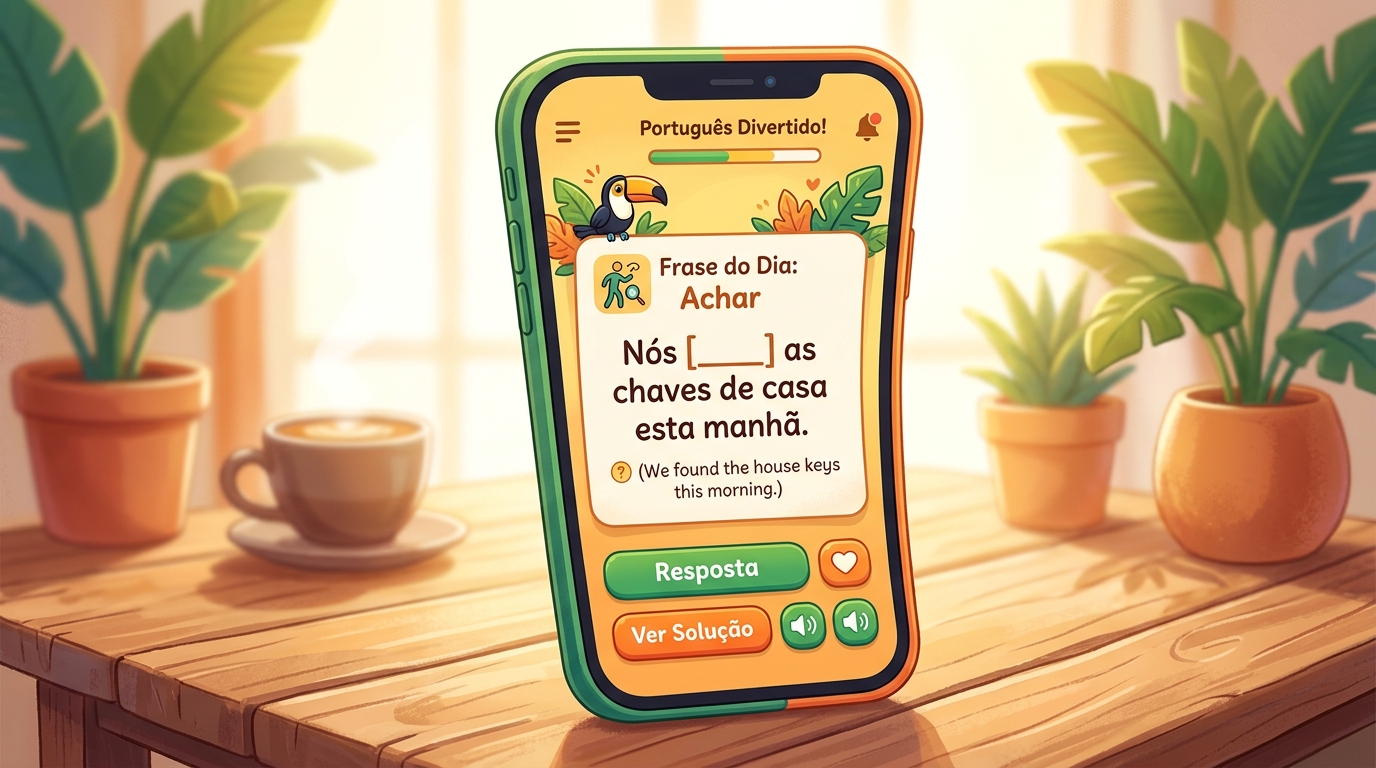
Active recall still matters. Reading contextual sentences passively won't do the job. You need to produce the word, ideally by typing it into a sentence frame with the target word blanked out.
This is roughly how we designed cards in Decko. Sentence-level prompts, cloze deletions, and the spacing algorithm doing the retention work in the background. Not because it's clever, but because the alternative (isolated word lists) has forty years of research telling us it underperforms.
When word lists actually help
I don't want to be absolutist. Word lists have a place, and pretending otherwise is dishonest.
If you're a total beginner and you need to bootstrap a starter vocabulary of 500 words to make any input comprehensible, lists are efficient. If you're prepping for a specific exam with a defined lexicon, lists are efficient. If you're cramming survival phrases before a trip next week, lists are efficient.
But past the first few hundred words, the returns collapse fast. The words you need next are polysemous, register-sensitive, collocation-heavy. They resist compression into two-column glosses. Trying to force them into that format is the study-methods equivalent of trying to describe a smell by listing its ingredients.
The mindset shift
Stop asking "what does this word mean?" Start asking "where does this word live?"
When you meet a new word, note who said it, in what situation, with what tone. Note the words it showed up next to. Note whether it felt formal or casual, warm or cold. That mesh of associations is the actual thing you're learning. The English gloss is just a rough coordinate on the map.
The learners I've seen make the fastest jumps from intermediate to genuinely functional aren't the ones with the biggest word lists. They're the ones whose vocabulary is thickly connected to real situations, real people, real sentences they've heard or read.
Their words come with context baked in. And if the research is right (which it is), that's the only way vocabulary really sticks.
Ready to put this into practice? Decko uses spaced repetition and conjugation drilling to make vocabulary stick. Start learning Brazilian Portuguese with flashcards that actually work.
Try Decko Free