Porto
Studying Portuguese? Decko turns these phrases into smart flashcards that adapt to your memory.
Try free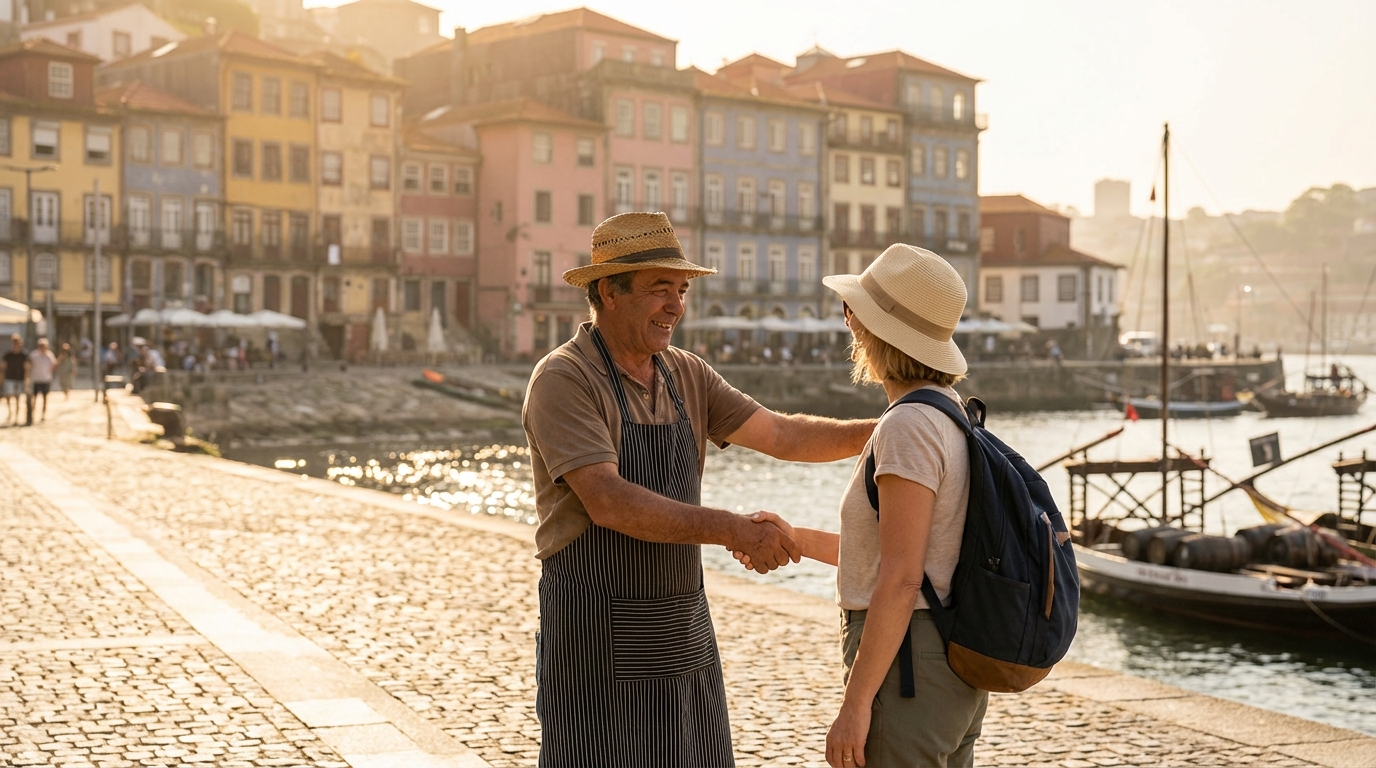
People from Porto (portuenses, or 'tripeiros') are famously direct, proud, and hardworking. Northern Portuguese pronunciation is quite different from Lisbon: vowels are more open, consonants are crisper, and the overall rhythm is faster. Do not be surprised if you studied Brazilian Portuguese and struggle to understand locals at first. They appreciate effort and will slow down if you ask.
Bom dia! Tudo bem?
Good morning! Everything good?
/bom DEE-ah! TOO-doo bayn?/
The standard greeting in Porto. Northern Portuguese pronounces vowels more openly than Lisbon. Use this in shops, cafes, and with anyone you meet.
Faz favor...
Please... / Excuse me...
/fahz fah-VOR/
The polite way to get attention or start a request in Portugal. More common here than 'por favor' at the start of a sentence. Use it to call a waiter or ask a stranger for help.
Um cimbalino, faz favor.
An espresso, please.
/oom sim-bah-LEE-noo, fahz fah-VOR/
In Porto, espresso is called 'cimbalino' (from the La Cimbali machine brand). In Lisbon they say 'bica'. Using 'cimbalino' instantly marks you as someone who knows Porto.
Um fino, faz favor.
A draft beer, please.
/oom FEE-noo, fahz fah-VOR/
In Porto, draft beer is a 'fino' (a small glass). In Lisbon the same thing is called an 'imperial'. Ordering an 'imperial' in Porto will get you a confused look or a correction.
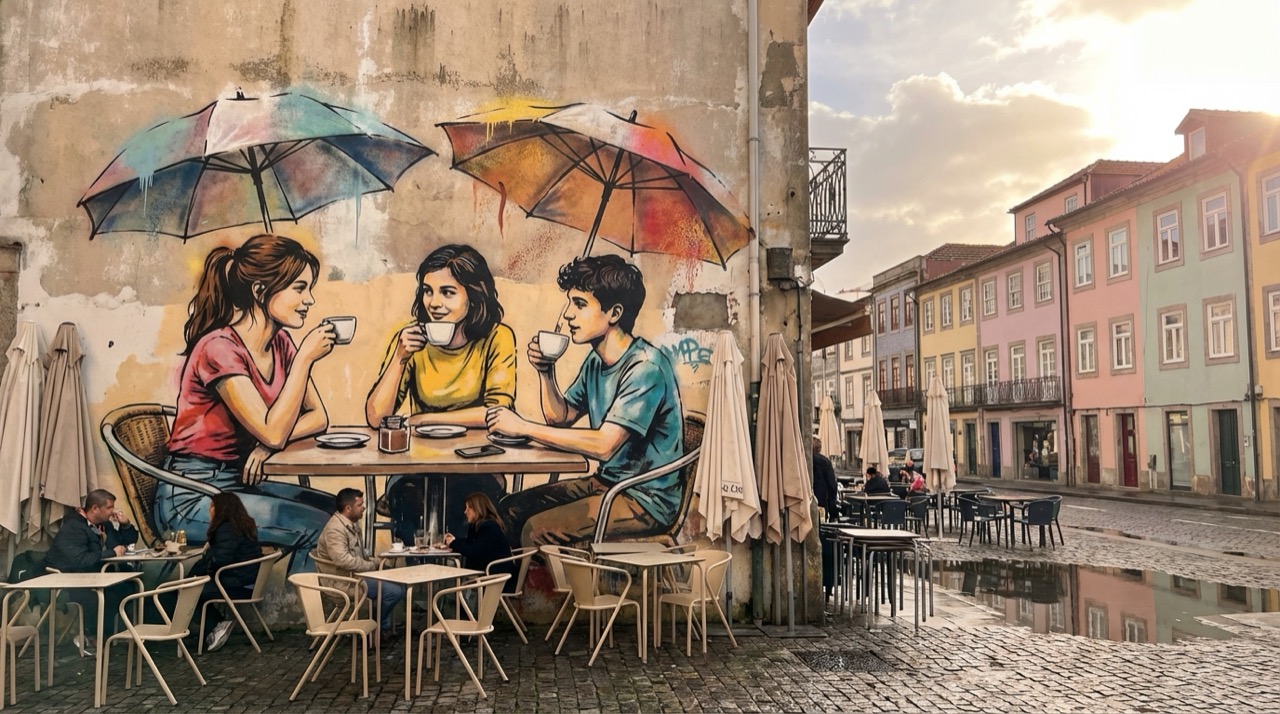
Porto has its own vocabulary that sets it apart from Lisbon and especially from Brazilian Portuguese. The accent is stronger, the vowels are more pronounced, and certain words are unique to the city. Using even a couple of these will earn you respect from locals, who are fiercely proud of their northern identity.
Ó pá!
Hey dude! / Man!
/oh PAH/
The quintessential Porto exclamation. Used to get attention, express surprise, or just start a sentence. You will hear it constantly. 'Ó pá, viste aquilo?' (Dude, did you see that?)
Ó meu!
Hey! / Mate!
/oh MEW/
Short for 'ó meu amigo' (hey my friend). Very common informal address in Porto, similar to how Australians use 'mate'. Works for strangers and friends alike.
Ó ganda...
Oh big... / What a huge...
/oh GAN-dah/
'Ganda' is Porto slang for 'grande' (big). Used as an intensifier: 'Ó ganda festa!' (What a massive party!), 'Ó ganda cromo!' (What a massive idiot!). Very northern.
Cimbalino
Espresso coffee
/sim-bah-LEE-noo/
Porto's word for espresso, named after the Italian La Cimbali coffee machines that were ubiquitous in the city. Lisbon says 'bica'. Using 'cimbalino' is a badge of Porto identity.
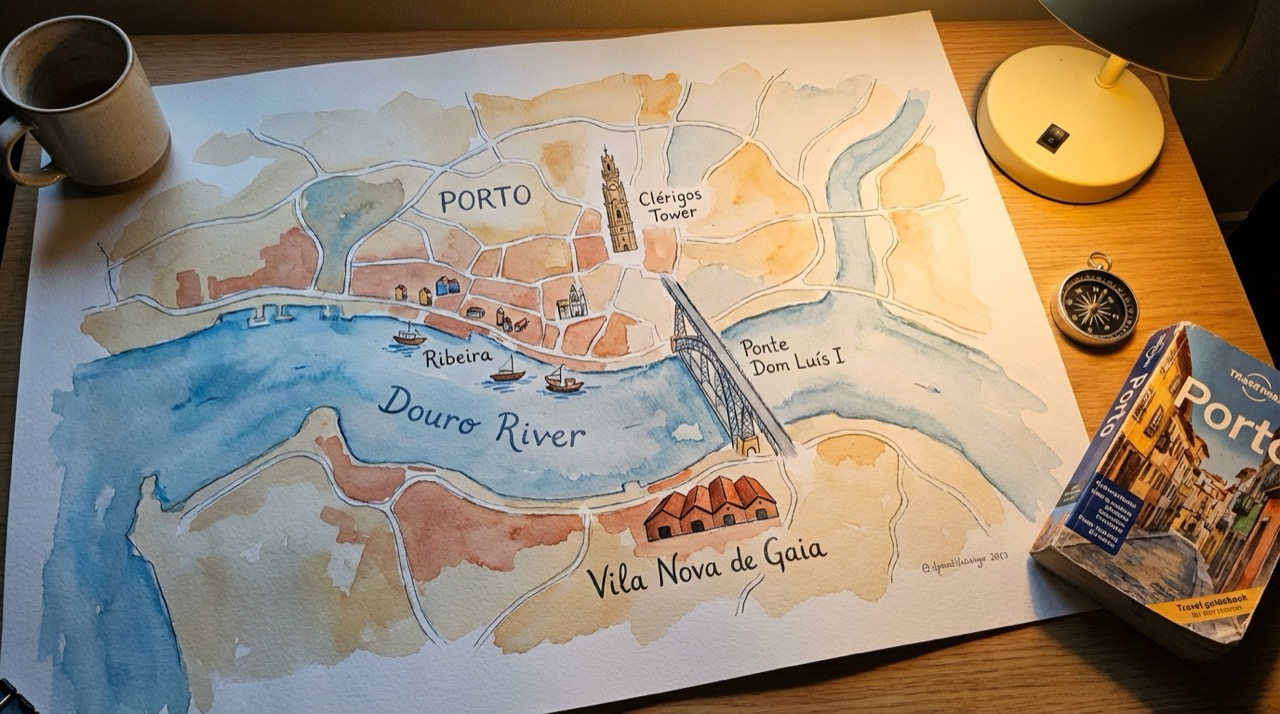
Porto is a compact, walkable city, but the hills are serious. The Douro River splits the experience: the historic center sits on the steep northern bank, while Vila Nova de Gaia on the south side holds the famous port wine cellars. Each neighborhood has a distinct feel, from medieval alleys to hipster creative districts.
Ribeira
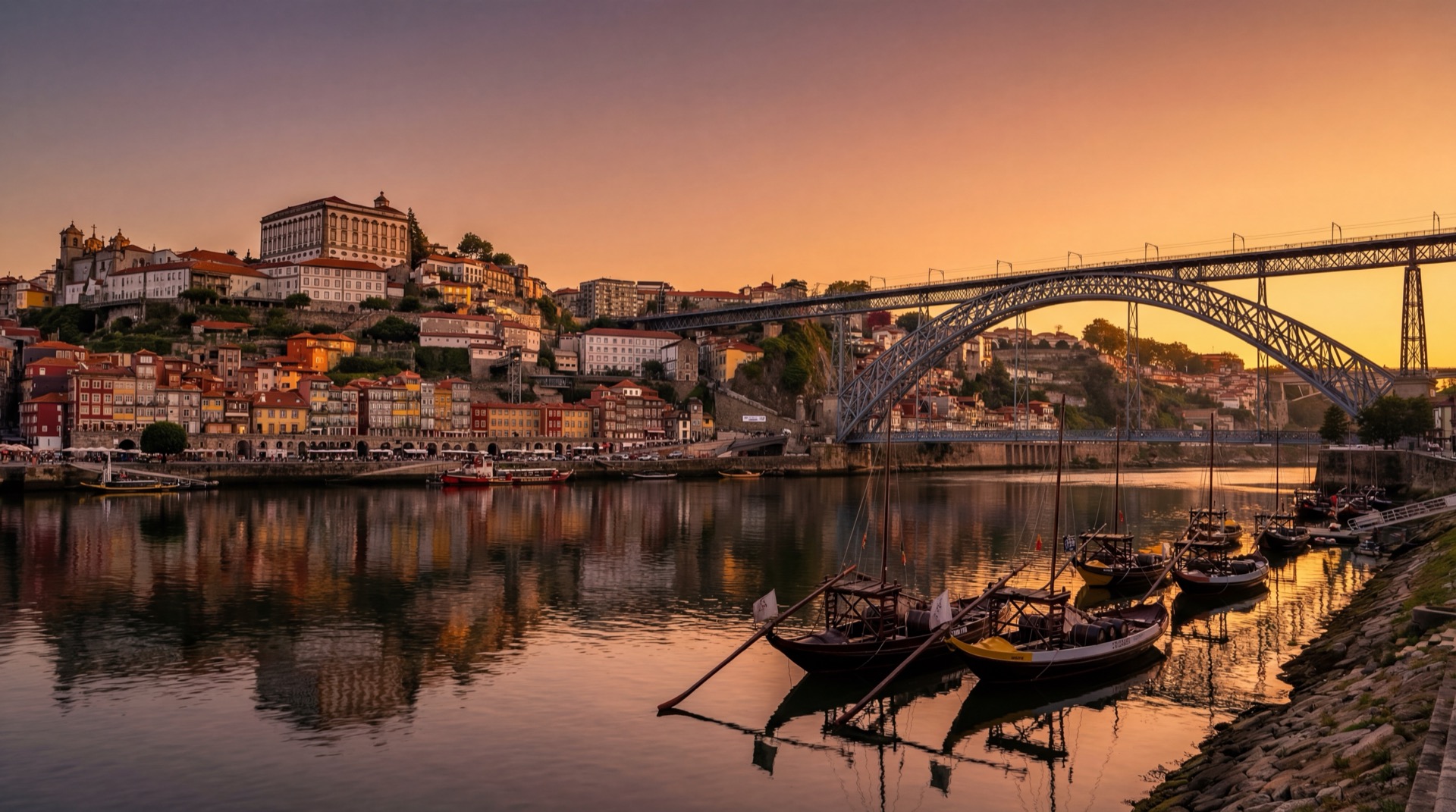
Porto's UNESCO-listed historic waterfront district. Narrow medieval streets tumble down the hillside to the Douro riverbank, where brightly painted houses lean over the water. This is the postcard view of Porto. The Cais da Ribeira promenade is lined with restaurants (tourist-priced, but the view is worth one meal). At night, the reflections of the Dom Luís I Bridge in the water are magical. Busy with tourists but genuinely beautiful.
Waterfront restaurants will have touts inviting you in. A polite 'Não obrigado, estou só a passear' (No thanks, I am just walking around) works perfectly. Or ask 'Qual é o prato do dia?' (What is the dish of the day?) for the best value.
Cedofeita
Porto's creative and bohemian heart. The Rua de Miguel Bombarda is the gallery corridor, with contemporary art spaces, vintage shops, and design stores. Further into Cedofeita, you find independent coffee roasters, natural wine bars, record shops, and some of the best casual restaurants in the city. This is where young portuenses actually hang out. Less photogenic than Ribeira but far more authentic.
In galleries and shops, greet with 'Boa tarde' (Good afternoon) when entering. It is considered rude in Portugal to enter a shop without acknowledging the staff. When leaving: 'Obrigado, bom dia!' even if you did not buy anything.
Foz do Douro
Where the Douro River meets the Atlantic Ocean. Foz is Porto's seaside district, with a long promenade stretching from the Passeio Alegre gardens to the Pérgola da Foz and the lighthouses. It is quieter and more upscale than the center. Locals come here for sunset walks, seafood restaurants, and weekend brunches. The Praia do Carneiro beach is popular in summer, and the rock pools at low tide are perfect for exploring.
At seafood restaurants in Foz, ask 'O que é que têm fresco hoje?' (What do you have fresh today?). Fish is often sold by weight: 'Quanto é o quilo do robalo?' (How much per kilo for the sea bass?).
Campanhã
Porto's up-and-coming eastern district, historically working-class and now undergoing a creative revival. The old Matadouro (slaughterhouse) has been converted into a cultural center with markets, events, and food halls. Campanhã train station connects Porto to the rest of Portugal. The neighborhood is rougher around the edges but full of energy, street art, and some of the most affordable tascas (traditional eateries) in the city.
In traditional tascas, the menu may not exist or may be recited by the waiter. Ask 'O que é que tem hoje?' (What do you have today?) and go with whatever the cook prepared. These are often the best meals in Porto.
Vila Nova de Gaia
Technically a separate city on the south bank of the Douro, but functionally Porto's other half. Gaia is where the port wine cellars are: Taylor's, Graham's, Sandeman, Cálem, and dozens more line the waterfront. The Teleférico de Gaia cable car offers spectacular views. Walking across the top deck of the Dom Luís I Bridge from Porto to Gaia is one of the city's great free experiences. The waterfront has been modernized with restaurants and bars that have the best views back across to Porto's Ribeira.
At wine cellars, book a 'prova de vinhos' (wine tasting). Ask 'Têm visita guiada em inglês?' (Do you have a guided tour in English?). To describe the wine: 'Este é doce ou seco?' (Is this sweet or dry?). Tip: the smaller, family-run cellars offer more intimate and often better experiences.
Want to actually remember these phrases?
Save them to your flashcard deck and Decko will quiz you at the perfect time using spaced repetition.
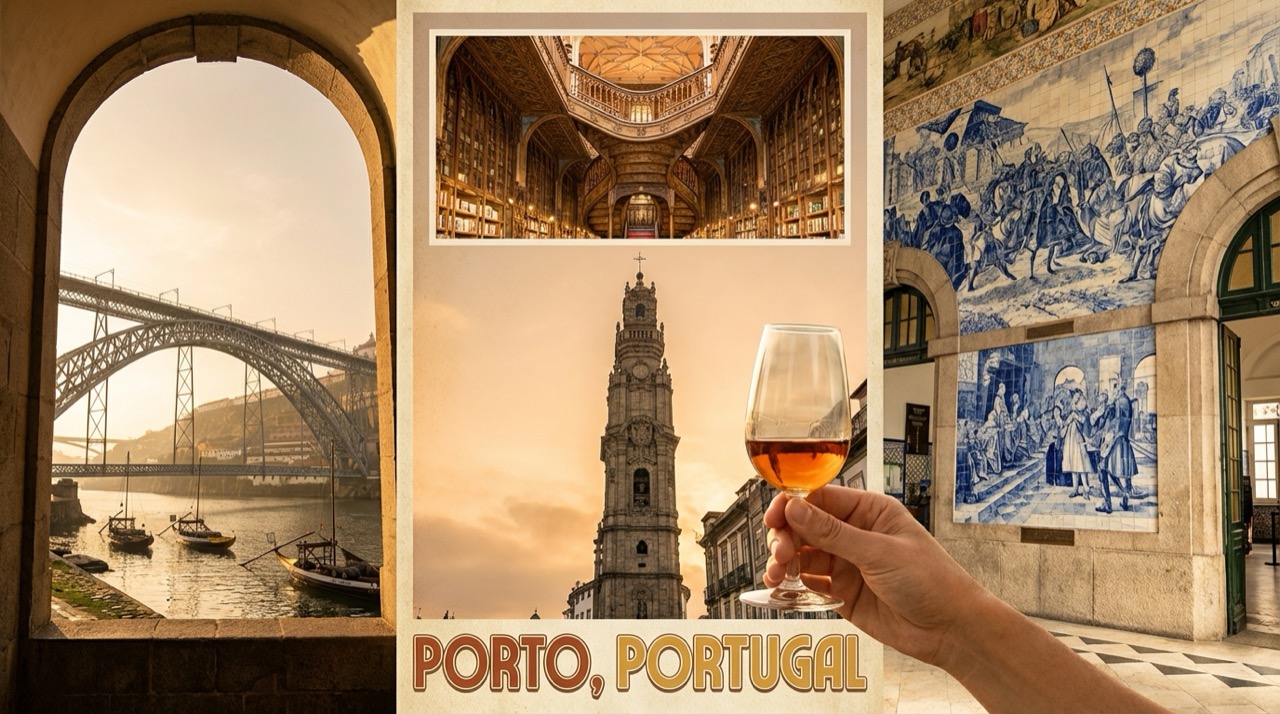
Porto packs an extraordinary density of landmarks into a small, walkable area. From one of the world's most beautiful bookshops to a train station covered in 20,000 hand-painted tiles, the city rewards slow exploration. Buy a Porto Card for unlimited metro/bus rides and discounts at museums if you plan to visit multiple sites.
Livraria Lello
One of the world's most beautiful bookshops, opened in 1906. The neo-Gothic facade opens into a stunning interior with a crimson carved wooden staircase, stained glass ceiling, and ornate shelves reaching to the upper gallery. Often cited as an inspiration for J.K. Rowling's Hogwarts (she lived in Porto in the early 1990s). The queue can be long, so buy a timed-entry voucher online. The voucher cost is deducted from any book purchase.
Buy your voucher online: 'Comprei o voucher online' (I bought the voucher online). To ask for a book recommendation: 'Pode recomendar um livro de um autor português?' (Can you recommend a book by a Portuguese author?). Try Fernando Pessoa or José Saramago.
Ponte Dom Luís I
The iconic double-deck iron arch bridge spanning the Douro, designed by a student of Gustave Eiffel and completed in 1886. The upper deck (for metro and pedestrians) offers breathtaking views 45 meters above the river. The lower deck carries road traffic. Walking across the top level from Porto to Gaia at sunset is a defining Porto experience. Free and accessible at any time.
Locals call it simply 'a ponte' (the bridge). Ask 'Como chego ao tabuleiro de cima da ponte?' (How do I get to the upper deck of the bridge?). The upper deck is accessed from the Jardim do Morro on the Gaia side or near the Sé cathedral on the Porto side.
Torre dos Clérigos
Porto's most recognizable landmark, a 76-meter Baroque bell tower completed in 1763. Climbing the 240 narrow stone steps to the top rewards you with a 360-degree panorama of the city, river, and ocean. The attached Clérigos Church is beautiful and free to enter. The tower is illuminated at night and visible from almost everywhere in the city center.
At the ticket office: 'Um bilhete para subir à torre, por favor' (One ticket to go up the tower, please). At the top: 'Pode tirar-me uma foto?' (Can you take my photo?). Portuguese uses 'tirar uma foto' rather than the Brazilian 'tirar uma foto' with different pronoun placement.
Ribeira District (UNESCO)
The entire Ribeira waterfront is a UNESCO World Heritage Site. Medieval streets twist up the hillside from the Douro, past crumbling facades draped in laundry, tiny grocery shops, and hidden churches. Beyond the tourist strip along the river, the upper Ribeira is quieter and gives a real sense of how Porto looked centuries ago. Get lost on purpose in the narrow alleys.
When exploring narrow streets and you need to pass, say 'Com licença' (Excuse me). If you are lost: 'Desculpe, estou um pouco perdido/perdida. Onde fica o rio?' (Sorry, I am a bit lost. Where is the river?). Gravity always leads you back down to the Douro.
Port Wine Cellars (Vila Nova de Gaia)
Dozens of port wine lodges line the Gaia waterfront, where port has been aged in barrels for centuries. Major houses like Taylor's, Graham's, Sandeman, Ferreira, and Cálem offer tours and tastings. Taylor's terrace has the best view. Graham's pairs their tasting with chocolate. Smaller lodges like Poças or Ramos Pinto offer more personal experiences. A port tasting is THE essential Porto activity.
Ask 'Queria fazer uma prova de vinho do Porto' (I would like to do a port wine tasting). To express preference: 'Prefiro tawny' or 'Prefiro ruby'. When tasting: 'Este é muito bom! Posso comprar uma garrafa?' (This is very good! Can I buy a bottle?).
Estação de São Bento
Porto's central train station is a work of art. The main hall is covered in approximately 20,000 azulejo tiles (hand-painted blue-and-white ceramic tiles) by artist Jorge Colaço, depicting scenes from Portuguese history. Completed in 1916, the panels show battles, royal processions, and rural life. Entry is free since it is a working train station. Visit in the morning before crowds arrive.
Even if you are not catching a train, walk in and look up. To ask about the tiles: 'Quem pintou estes azulejos?' (Who painted these tiles?). For train info: 'A que horas é o próximo comboio para Braga?' (What time is the next train to Braga?). In Portugal, train is 'comboio', not 'trem' like in Brazil.
Palácio da Bolsa
The Stock Exchange Palace, built in the 19th century by the Commercial Association of Porto. The highlight is the Salão Árabe (Arab Room), an astonishing ballroom decorated in Moorish revival style with intricate gold and polychrome patterns inspired by the Alhambra. Visits are by guided tour only (available in multiple languages). One of the most opulent interiors in Portugal.
At the entrance: 'Há visita guiada em português?' (Is there a guided tour in Portuguese?). This is a great way to practice listening comprehension. If you prefer: 'Têm em inglês?' (Do you have one in English?).
Serralves
A major contemporary art museum set in beautiful Art Deco grounds with 18 hectares of gardens, including a rose garden, a farm, and woodland trails. The white minimalist museum building by Álvaro Siza Vieira hosts rotating exhibitions of international contemporary art. The Casa de Serralves (Art Deco villa) and Treetop Walk are also worth exploring. Allow half a day for the full experience.
Ask 'Qual é a exposição atual?' (What is the current exhibition?). For the gardens: 'Posso passear nos jardins sem visitar o museu?' (Can I walk the gardens without visiting the museum?). The park alone is worth the visit on sunny days.
Mercado do Bolhão
Porto's grand 19th-century market, beautifully restored and reopened in 2022. Two floors of vendors sell fresh produce, flowers, cheese, cured meats, bacalhau (salt cod), bread, and pastries. The upper galleries have casual eateries. This is where portuenses actually shop. Go in the morning for the full experience, when vendors are loud, animated, and the produce is at its freshest.
Greet vendors with 'Bom dia!' and they will warm up immediately. Point and ask 'Quanto é isto?' (How much is this?). For bacalhau: 'Qual é o melhor para assar?' (Which one is best for roasting?). Vendors love giving food advice.
Praia do Carneiro (Foz)
A small, sheltered beach in the Foz do Douro district where the river meets the Atlantic. Popular with locals for summer swimming, though the water is cold (this is the Atlantic, not the Mediterranean). The Pérgola da Foz art deco structure sits nearby, and the Felgueiras Lighthouse marks the river mouth. Less crowded than Matosinhos beach and more charming. Sunset here is spectacular.
At the beach: 'A água está fria?' (Is the water cold?). The answer is almost always yes. 'Há nadador-salvador?' (Is there a lifeguard?). For the nearby cafes: 'Um gelado, faz favor' (An ice cream, please). Note: in Portugal it is 'gelado', not 'sorvete' like in Brazil.
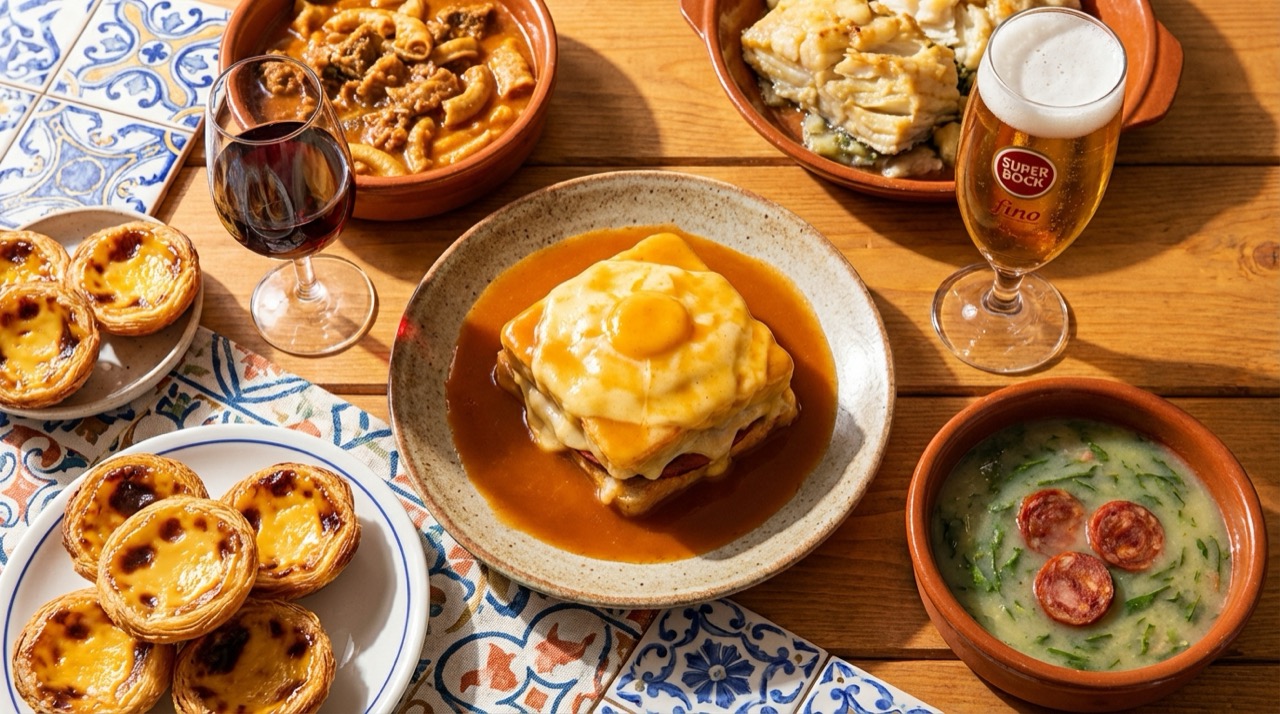
Porto is a food city through and through. Portions are enormous, flavors are bold, and the attitude is 'more is more'. The francesinha is the undisputed king of Porto cuisine, and you must eat at least one (ideally more). Lunch is the main meal, typically from 12:30 to 2:30pm. Dinner starts late, around 8pm. Tipping is not obligatory but rounding up or leaving 5-10% for good service is appreciated.
Dining Etiquette
- When you sit down at a restaurant, bread, butter, olives, and sometimes cheese or cured meat will appear on the table. These are 'couvert' and are NOT free. If you eat them, you will be charged. If you do not want them, say 'Pode levar o couvert, obrigado' (You can take the couvert away, thanks).
- In tascas (traditional eateries), the menu may be handwritten on a board or recited by the waiter. Ask 'O que recomenda?' (What do you recommend?) and trust the answer.
- Portuguese portion sizes are generous. A 'meia-dose' (half portion) is available at many restaurants and is often enough for one person.
- Wine is served with nearly every meal. House wine (vinho da casa) is typically good and cheap in Porto. Ask 'Tem vinho da casa tinto?' (Do you have red house wine?).
- Do not rush meals. Portuguese dining is social and slow. The waiter will not bring the bill until you ask.
- Super Bock is Porto's beer. Ordering a Sagres (Lisbon's beer) in Porto is a minor social offense. Stick with Super Bock and you will fit right in.
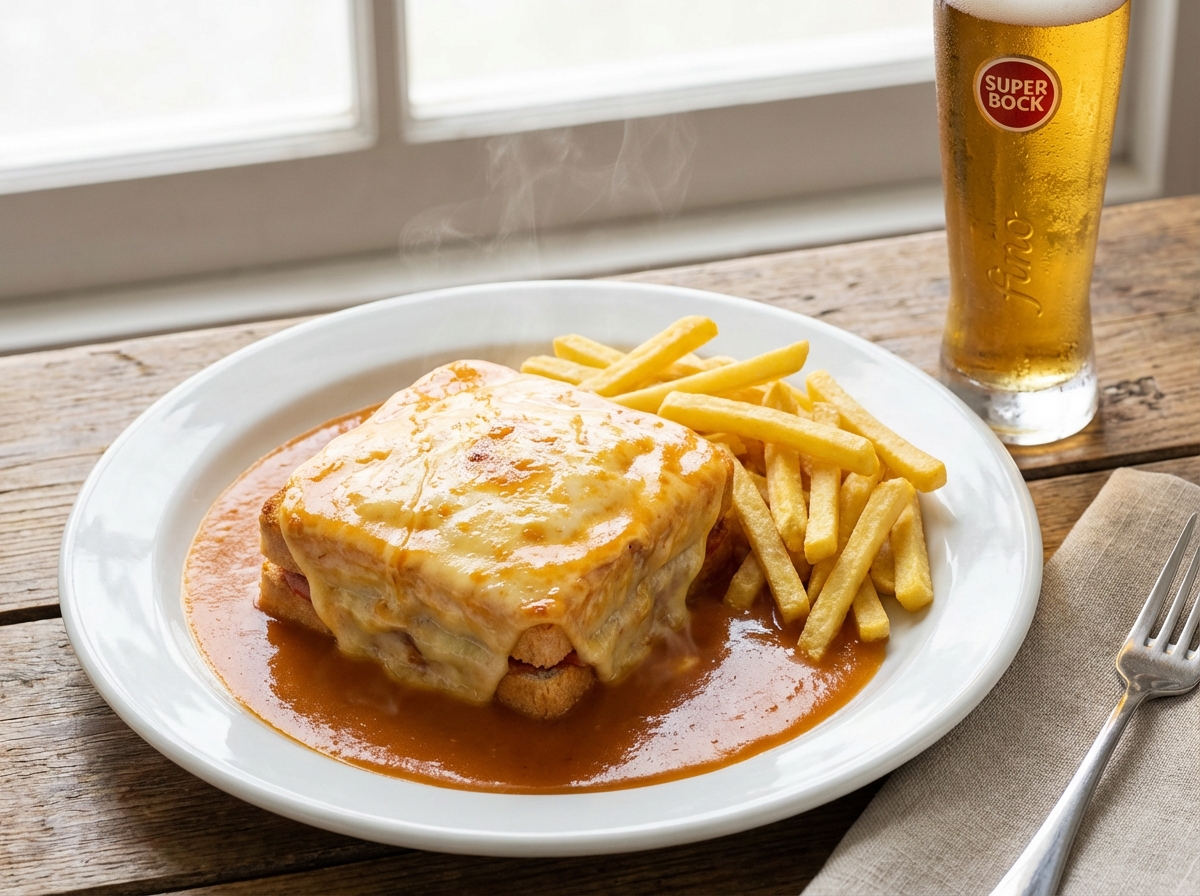
Francesinha
Porto's legendary sandwich and the city's most iconic dish. Layers of cured ham, linguiça sausage, fresh sausage, and steak are sandwiched between thick bread, covered in melted cheese, and drowned in a secret spicy tomato-beer sauce. Usually served with french fries swimming in the sauce. Every restaurant has their own sauce recipe, and portuenses will argue passionately about who makes the best one. Heavy, indulgent, and absolutely unforgettable.
How to order
'Uma francesinha com ovo e batata frita, faz favor.' (A francesinha with egg and fries, please.) The egg on top is optional but highly recommended. Pair it with a fino (draft beer). To ask about their sauce: 'O molho é receita da casa?' (Is the sauce a house recipe?).
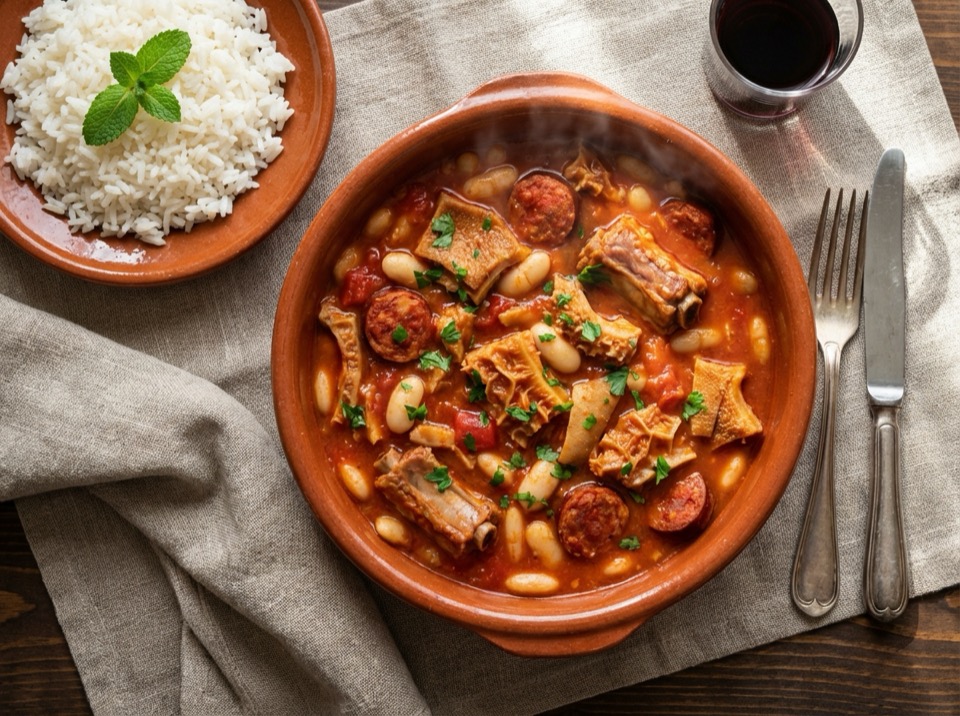
Tripas à moda do Porto
The dish that gave portuenses their nickname 'tripeiros' (tripe eaters). A hearty stew of tripe, white beans, chouriço, presunto (cured ham), chicken, and vegetables. Rich, warming, and deeply traditional. The legend says Porto citizens donated all their good meat to Prince Henry the Navigator's fleet and kept only the offal. It became a point of pride, not poverty.
How to order
'Tripas à moda do Porto, por favor.' Serve with white rice. To check availability (it is not on every menu every day): 'Hoje têm tripas?' (Do you have tripe today?). This is a dish for the adventurous, and ordering it shows genuine respect for Porto culture.
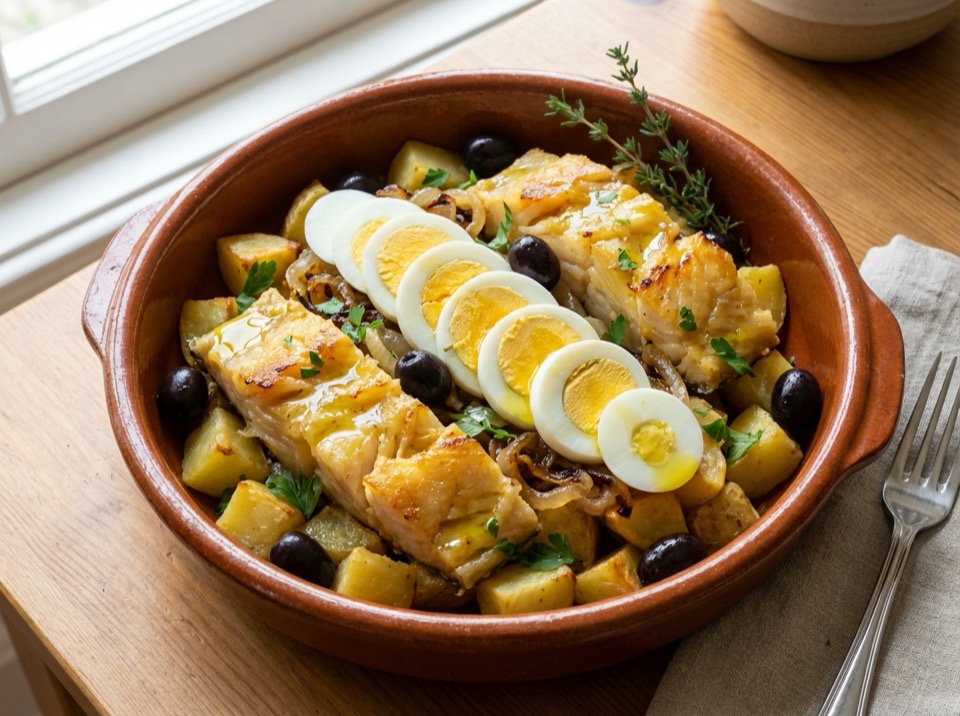
Bacalhau à Gomes de Sá
One of Portugal's most famous bacalhau (salt cod) preparations, and it was invented right here in Porto. Shredded salt cod is baked with thinly sliced potatoes, onions, garlic, and plenty of olive oil, then topped with hard-boiled eggs and black olives. Named after José Luís Gomes de Sá, a 19th-century Porto merchant. Comforting, simple, and perfectly Portuguese.
How to order
'Bacalhau à Gomes de Sá, por favor.' In some restaurants, bacalhau dishes are shared family-style. Ask 'É para quantas pessoas?' (It is for how many people?). To express that you love it: 'Está delicioso!' (It is delicious!).
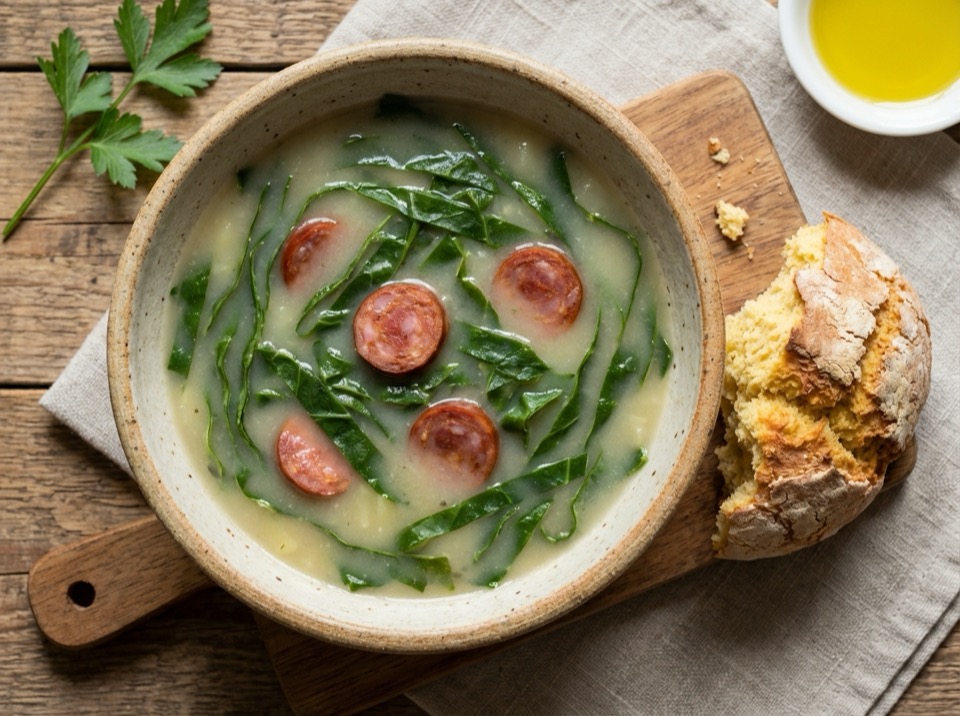
Caldo verde
A silky potato-based soup with finely shredded couve galega (collard greens) and slices of chouriço floating on top, finished with a drizzle of olive oil. Served everywhere from Michelin-starred restaurants to village festivals. The ultimate Portuguese comfort food. Especially perfect on one of Porto's many rainy evenings.
How to order
'Um caldo verde para começar, por favor.' (A caldo verde to start, please.) It is usually served as a starter. Ask 'Tem pão para acompanhar?' (Do you have bread to go with it?). Cornbread (broa) is the traditional pairing.
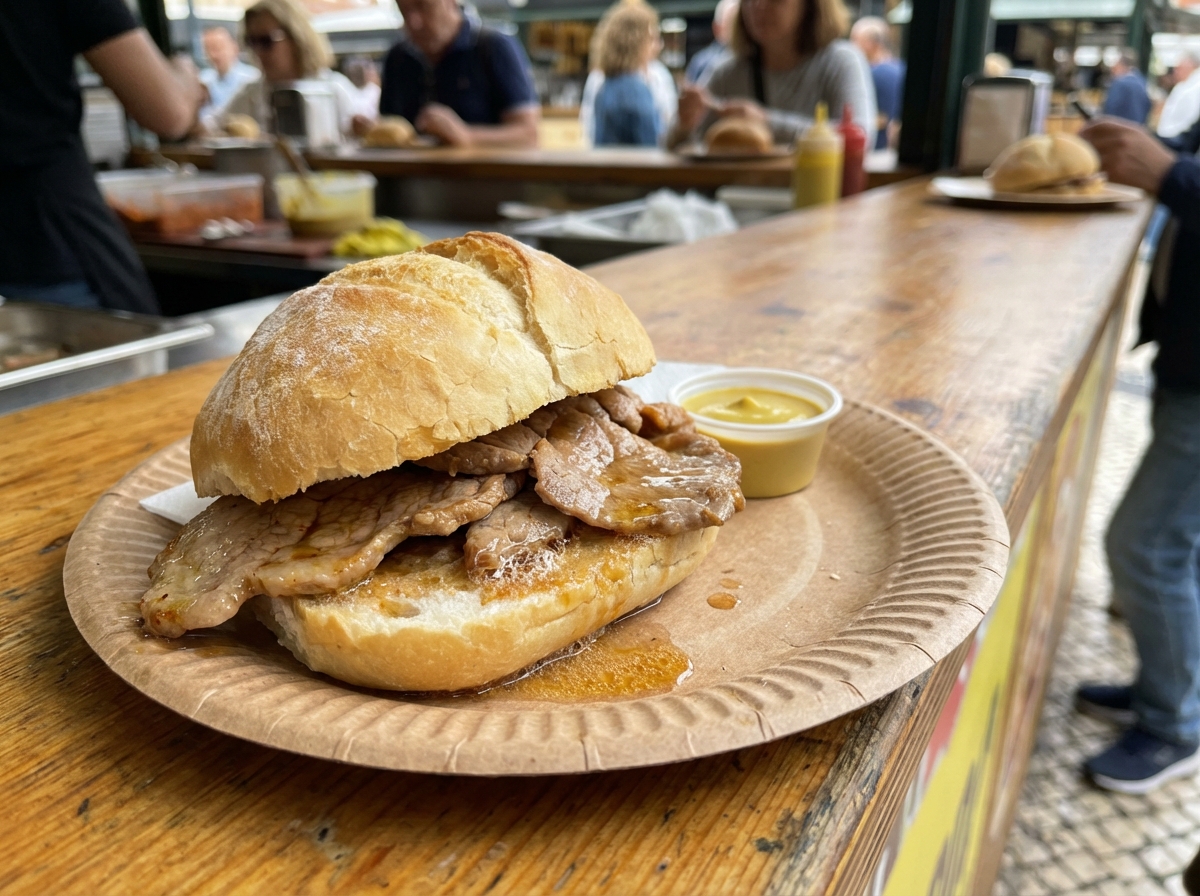
Bifana
A thin, marinated pork steak sandwich served in a soft bread roll (papo-seco). The pork is simmered in a garlicky, spicy sauce until tender. Served with mustard or piri-piri sauce. Found at tascas, market counters, and especially at the Mercado do Bolhão food stands. The bifana is Portugal's answer to fast food, and it is infinitely better.
How to order
'Uma bifana, faz favor.' At a market or counter, add 'E um fino' (And a draft beer) for the classic combo. For heat: 'Tem piri-piri?' (Do you have piri-piri sauce?). Some places will ask 'Com ou sem mostarda?' (With or without mustard?).
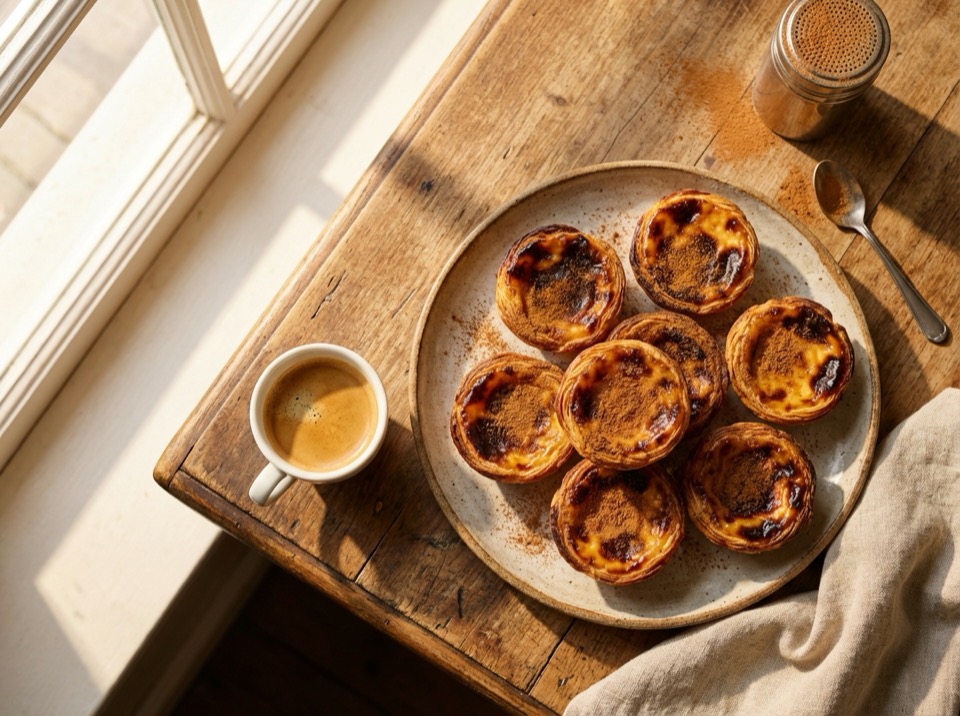
Pastel de nata
The famous Portuguese custard tart. Flaky, buttery pastry filled with a rich egg custard that is caramelized on top. While the most famous version is from Belém in Lisbon, Porto has excellent pastelarias (pastry shops) that make their own. Best eaten warm, dusted with cinnamon and powdered sugar. A cimbalino and a pastel de nata is the quintessential Portuguese breakfast.
How to order
'Um pastel de nata e um cimbalino, faz favor.' (A custard tart and an espresso, please.) For more: 'Mais dois, por favor!' (Two more, please!). Ask 'Acabaram de sair do forno?' (Did they just come out of the oven?). Fresh ones are transcendent.
Port Wine
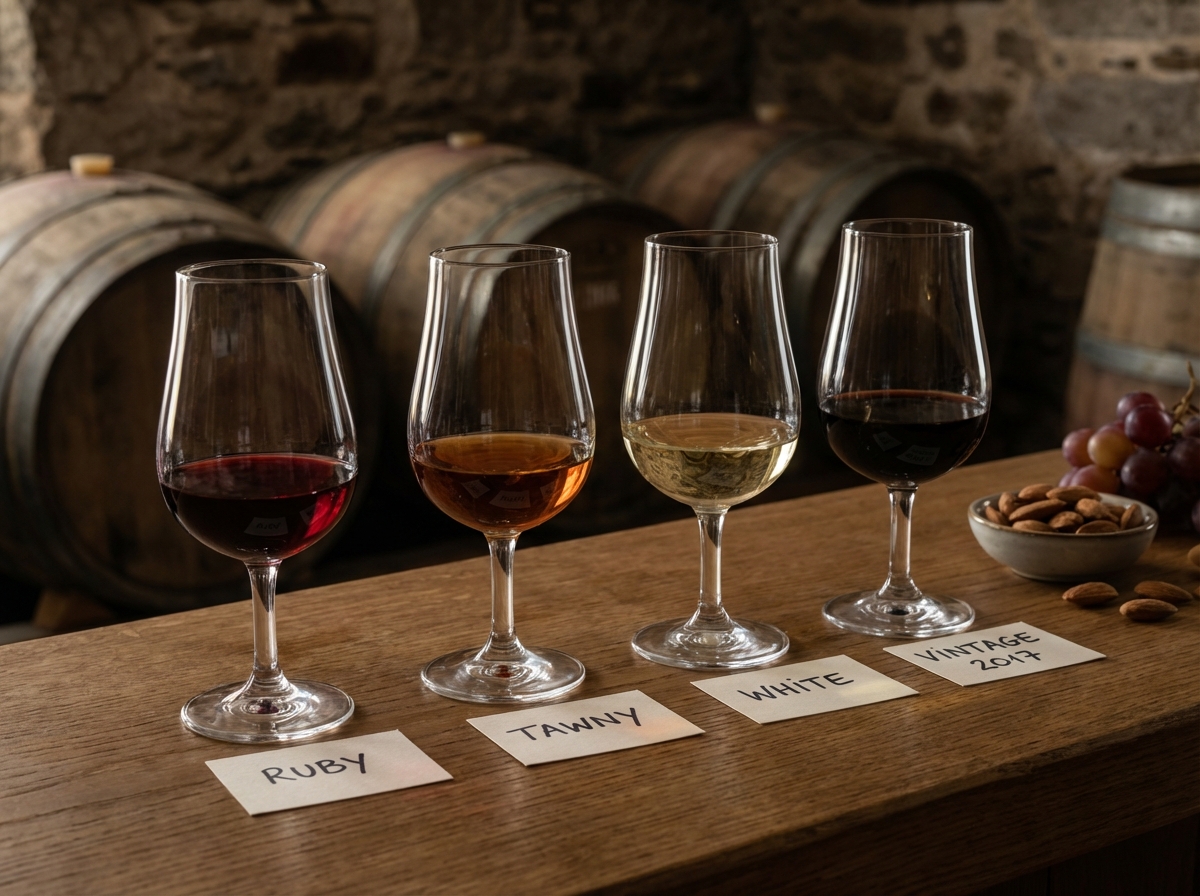
Porto's liquid gold. Fortified wine produced exclusively in the Douro Valley and aged in the cellars of Vila Nova de Gaia. Main styles: ruby (young, fruity, intense), tawny (aged in barrels, nutty, caramel notes), white (chilled as an aperitif), and rosé (modern, sweet). Vintage ports and vintage tawnies (10, 20, 30, 40 year) are the premium tier. A tasting at one of the Gaia cellars is essential.
How to order
At a bar or restaurant: 'Um cálice de Porto tawny, por favor' (A glass of tawny port, please). At a cellar: 'Queria fazer uma prova' (I would like to do a tasting). To sound knowledgeable: 'Têm um tawny de 20 anos?' (Do you have a 20-year tawny?). White port with tonic (Porto tónico) is the trendy aperitif.
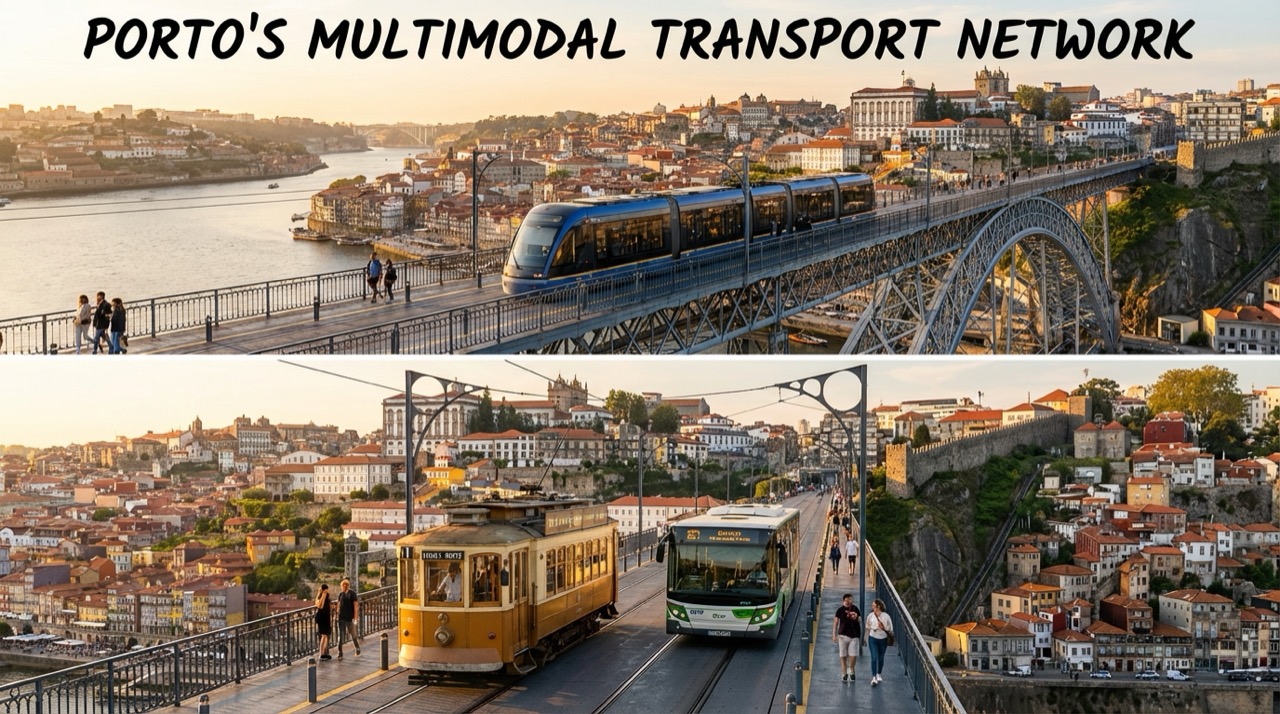
Porto is compact enough to walk almost everywhere in the center, but the hills are punishing. The metro system is modern and efficient for longer distances. The Andante card works across metro, bus, and tram. Porto's vintage tram line 1 along the river is both transport and a tourist attraction. Uber is widely available and cheap.
Metro
Modern, clean light-rail system with 6 lines covering the city and surrounding areas. The yellow line runs from the airport (Aeroporto) to the city center. Key stations: Trindade (main interchange hub), São Bento (historic center), Aliados (downtown), Jardim do Morro (Gaia side of the bridge, for port cellars). Runs from approximately 6am to 1am.
- Buy a reusable Andante card at any station (costs about 0.60 EUR plus the fare). Works on metro, bus, and tram
- The airport to city center ride takes about 30 minutes and costs only one Z4 zone ticket (roughly 2 EUR)
- Trindade station is where most lines connect. If you need to change, this is likely your transfer point
- 'Qual é a próxima estação?' (What is the next station?) is useful if you lose track
- Validate your Andante card on the yellow readers before boarding. Inspectors check regularly and the fine is steep
- The metro runs above ground for most of its route, so you get good city views on many lines
Bus (STCP)
An extensive bus network fills the gaps the metro does not cover. Useful for reaching neighborhoods like Foz do Douro, Boavista, and Campanhã. The Andante card works on buses too. Many bus stops have electronic displays showing wait times. Service is frequent during the day but reduces significantly after 9pm.
- Use the Andante card or buy a ticket on board (more expensive). Validate on the machine inside the bus
- Bus 500 runs from Praça da Liberdade to Foz do Douro and Matosinhos along the coast. A scenic, practical route
- Ask the driver 'Este autocarro vai para Foz?' (Does this bus go to Foz?) if you are unsure. Note: in Portugal it is 'autocarro', not 'ônibus' like in Brazil
- 'Pode avisar-me quando chegar a...?' (Can you let me know when we arrive at...?) works well with drivers
- Download the 'Move-me' app for real-time Porto transit information
Vintage Tram (Elétrico)
Porto has three heritage tram lines, but Line 1 is the star: it runs along the Douro riverfront from the Infante stop near Ribeira all the way out to Passeio Alegre in Foz. The vintage wooden carriages rattle along the water's edge with beautiful views the entire way. Line 22 makes a circular loop through the historic center. They are slow, charming, and part of the Porto experience.
- Line 1 (Infante to Passeio Alegre) is the most scenic and the one most worth riding. About 25 minutes end to end
- The Andante card does NOT work on heritage trams. Buy a ticket on board from the conductor (about 3.50 EUR)
- Trams get very crowded in summer. Try to go early morning or late afternoon for a seat
- 'Um bilhete, faz favor' (A ticket, please) to the conductor when boarding
- Line 22 loops through the center past Carmo Church, Clérigos, and Batalha. Good for an overview without the hills
Walking / Uber
Porto's center is very walkable, but be prepared for steep hills, cobblestone streets (wear good shoes), and the occasional surprise staircase. The walk from Clérigos Tower down to Ribeira is beautiful but your knees will feel it going back up. Uber and Bolt are cheap (most rides within the center cost 3 to 6 EUR) and perfect for hill avoidance. Taxis also exist but are more expensive and do not always use the meter.
- Download both Uber and Bolt. Compare prices as they fluctuate throughout the day
- Wear shoes with good grip. Porto's cobblestones are beautiful but treacherous, especially when wet
- The Funicular dos Guindais runs between Ribeira (river level) and Batalha (upper city). Saves a brutal hill climb for about 2.50 EUR
- If walking between Ribeira and Clérigos, take the side streets rather than the main road. More interesting and slightly less steep
- For Uber from the airport, follow signs to the rideshare pickup area on the departures level
- 'Pode ir pela Foz?' (Can you go via Foz?) if you want the scenic coastal route in an Uber
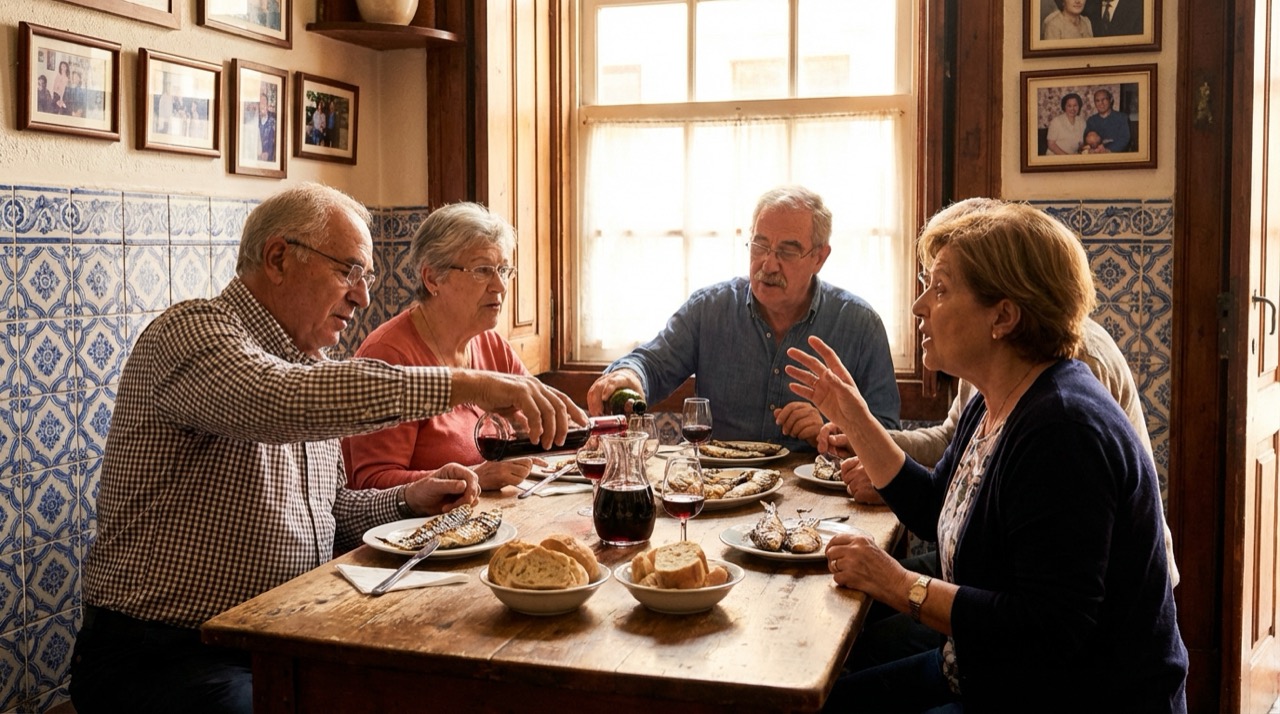
Portuenses are proud, direct, and unpretentious. They work hard, eat well, and do not suffer fools. The city has a strong identity that is distinct from Lisbon, and locals are quick to remind you of that. Porto people are less outwardly effusive than Brazilians or Lisboetas but deeply warm once you earn their trust. Respect, politeness, and a genuine interest in the city go a long way.
Do
- Learn the Porto-specific vocabulary. Saying 'cimbalino' instead of 'café' and 'fino' instead of 'imperial' shows you respect the city's identity. Locals will notice and appreciate it.
- Greet shopkeepers and restaurant staff when entering and leaving. A simple 'Bom dia' or 'Boa tarde' when you walk in is expected. Leaving without a greeting is considered rude.
- Drink Super Bock, not Sagres. This is not just a preference in Porto; it is tribal loyalty. Super Bock is the northern beer, Sagres is from the south. When in Porto, drink Super Bock.
- Try the tripas. Even if you are not an offal fan, ordering tripas à moda do Porto shows genuine respect for the city's history and identity. Locals will be impressed.
- Embrace the rain. Porto gets significant rainfall. Carry an umbrella, wear layers, and do not complain about the weather. Portuenses are proud of their resilience.
- Walk across the top of the Dom Luís I Bridge at sunset. It is free, spectacular, and the views of both Porto and Gaia are unforgettable.
- Visit the port wine cellars in Gaia and take a proper tasting. Sip slowly, ask questions, and show interest. Port wine is central to the city's economy and identity.
- Tip modestly (5-10% or round up) at restaurants. Tipping is not obligatory in Portugal, but it is appreciated for good service.
Avoid
- Do not compare Porto unfavorably to Lisbon. The rivalry is real and deep. Portuenses believe they built Portugal ('O Porto é a nação') and do not appreciate being treated as Lisbon's second city.
- Do not call espresso 'bica' (Lisbon term) or draft beer 'imperial' (also Lisbon). Use the Porto terms: 'cimbalino' and 'fino'. This matters more than you might think.
- Do not eat the couvert (bread, olives, etc.) that arrives at your table assuming it is free. It is not. You will be charged for whatever you touch. Send it back if you do not want to pay.
- Do not speak Spanish to Portuguese people and assume they will understand. Portuguese and Spanish are different languages. Start with Portuguese, even if it is basic, or politely ask if they speak English.
- Do not schedule everything tightly. Portuguese meals are slow, shops may close for lunch (1 to 3pm in traditional areas), and punctuality is more relaxed than in Northern Europe.
- Do not skip the smaller, family-run restaurants in favor of places with English menus and photos. The best food in Porto is in the tascas that look like they have not changed in 50 years.
- Do not wear high heels on Porto's cobblestone streets. The calçada portuguesa (patterned cobblestone) is charming but genuinely dangerous for unstable footwear, especially on hills and in rain.
- Do not order a francesinha for dinner and expect to eat anything else afterward. It is an enormous, heavy meal. Plan accordingly.
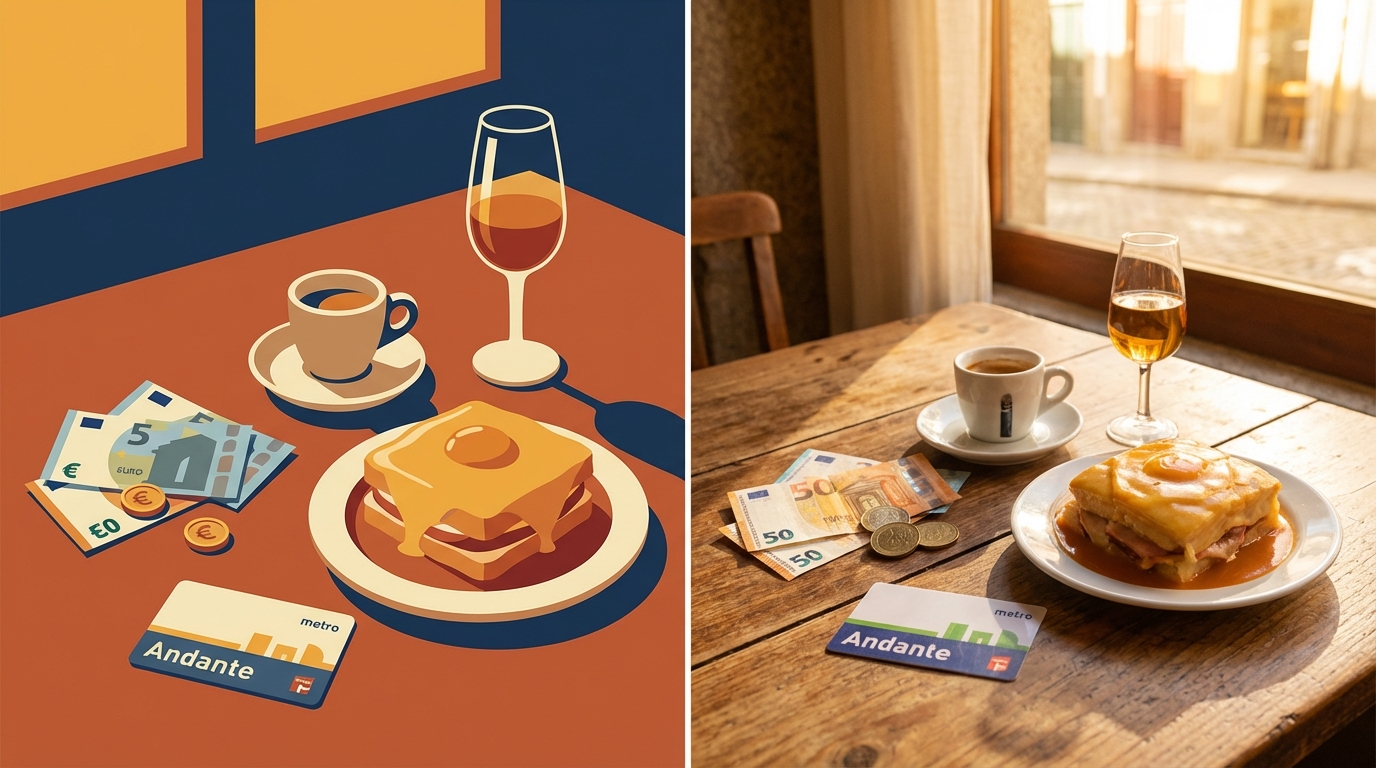
Porto is significantly cheaper than Lisbon and a bargain compared to most Western European cities. Eating out, transport, and wine are all affordable. Card payments via Multibanco/MB Way are accepted almost everywhere, but some traditional tascas and market vendors prefer cash. ATMs (called Multibanco or MB) are everywhere and do not charge withdrawal fees for most European cards.
Typical Prices
Money-Saving Tips
- The 'prato do dia' (dish of the day) or 'menu do dia' at tascas typically includes soup, main course, drink, and coffee for under 10 EUR. This is the best value lunch in the city.
- The cimbalino (espresso) at the counter costs less than sitting at a table in most cafes. Stand at the bar like a local for the cheapest coffee in Western Europe.
- Port wine tastings at smaller, family-run cellars in Gaia are often cheaper and more intimate than the big-name lodges. Some offer free basic tastings if you buy a bottle.
- The Porto Card (1, 2, 3, or 4 days) includes unlimited public transport and discounts at museums and attractions. Worth it if you plan to visit multiple sites.
- Matosinhos (one metro stop past the center) has the best and cheapest seafood restaurants in the Porto area. Locals go there for weekend fish lunches.
- Supermarkets like Pingo Doce and Continente have excellent prepared food sections and are great for budget dinners. Wine starts at about 2.50 EUR for a decent bottle.
- Many churches and public spaces in Porto are free to enter. The Sé Cathedral courtyard, Igreja de São Francisco exterior, and all bridges are free.
- Avoid eating directly on the Ribeira waterfront. Walk two blocks uphill for the same quality at half the price.
- The vintage tram Line 1 costs 3.50 EUR, but bus 500 covers a similar riverside-to-Foz route and costs 1.20 EUR with an Andante card.
- Free walking tours depart daily from Praça da Liberdade. Tip-based, and the guides are knowledgeable portuenses who share stories you will not find in guidebooks.
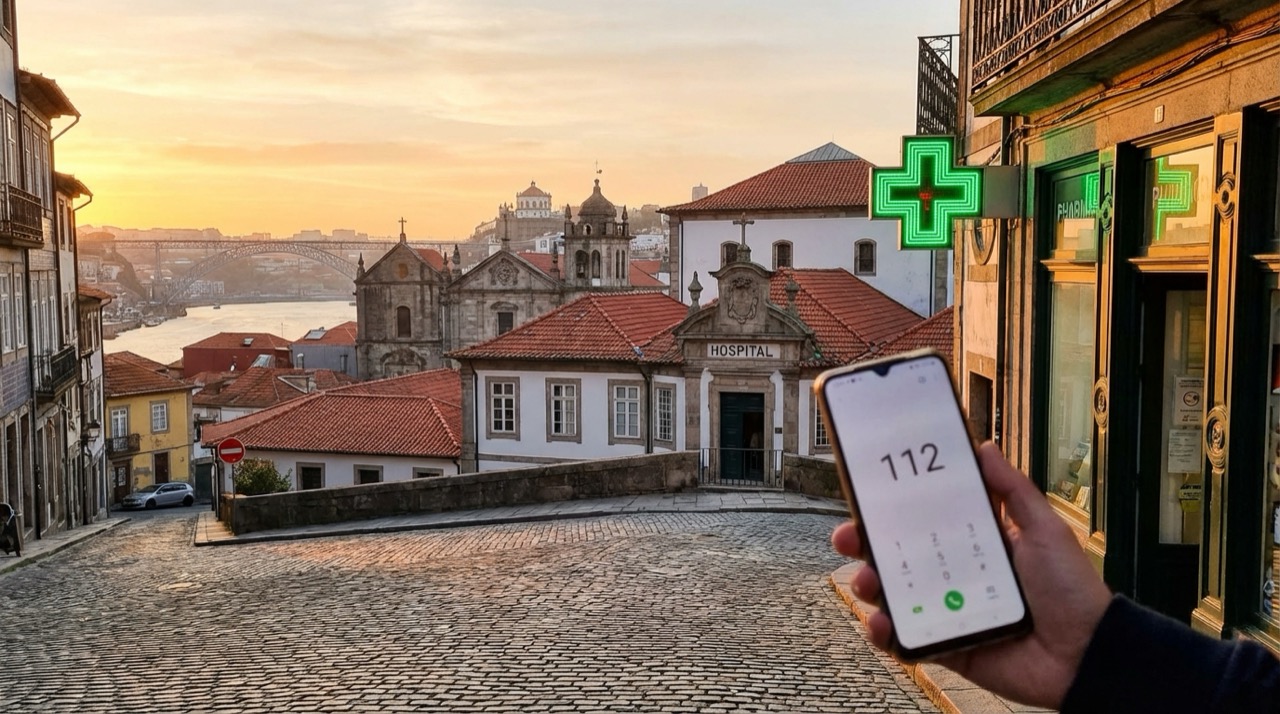
Porto is one of the safest major cities in Western Europe. Violent crime against tourists is extremely rare. The main concerns are petty pickpocketing in crowded tourist areas (Ribeira, São Bento, trams) and bag-snatching on busy terraces. Common sense and basic Portuguese emergency phrases are all you need. The European emergency number 112 works for police, fire, and ambulance.
Socorro! / Ajudem-me!
Help! / Help me!
/soh-KOH-roo / ah-ZHOO-dayn-meh/
Shout 'socorro' in an emergency to get immediate attention. 'Ajudem-me' (help me) is the European Portuguese form, slightly different from the Brazilian 'me ajudem'.
Preciso de um médico.
I need a doctor.
/preh-SEE-zoo deh oom MEH-dee-koo/
Say this at a hotel, pharmacy, or to any passerby. They will direct you to the nearest health center (centro de saúde) or hospital.
Onde fica a farmácia mais próxima?
Where is the nearest pharmacy?
/ON-deh FEE-kah ah far-MAH-see-ah mais PROH-see-mah/
Portuguese pharmacies (farmácias) can dispense many medications and offer basic medical advice. Look for the green cross sign. There is always a 'farmácia de serviço' (duty pharmacy) open 24 hours.
Ligue para a polícia!
Call the police!
/LEE-geh PAH-rah ah poh-LEE-see-ah/
European emergency number: 112 (covers police, fire, ambulance). The PSP (Polícia de Segurança Pública) handles urban policing. For tourists, the nearest police station is usually in the city center near Aliados.
Fui roubado/roubada.
I was robbed. (male/female)
/fwee roh-BAH-doo / roh-BAH-dah/
Use this at a police station (esquadra) to file a report (queixa), which you will need for insurance claims. In Porto, the central PSP station is near Praça da República.
Estou a sentir-me mal.
I am feeling unwell.
/esh-TOW ah sen-TEER-meh mahl/
European Portuguese form (using 'estar a + infinitive' instead of the Brazilian gerund). Works in any context. Portuguese people will immediately offer to help you sit down and get water.
Sou alérgico/alérgica a...
I am allergic to... (male/female)
/sow ah-LEHR-zhee-koo / ah-LEHR-zhee-kah ah/
Essential for food allergies. Common terms: marisco (shellfish), amendoins (peanuts), glúten (gluten), lactose (lactose). Porto cuisine is heavy on seafood and dairy, so this phrase is important.
Onde fica o hospital mais próximo?
Where is the nearest hospital?
/ON-deh FEE-kah oo osh-pee-TAHL mais PROH-see-moo/
Major hospitals: Hospital de Santo António (central Porto, near Jardim da Cordoaria), Hospital de São João (university hospital, further north). Urgências means emergency room.
Perdi o meu passaporte.
I lost my passport.
/per-DEE oo mew pah-sah-POR-teh/
File a report at the nearest PSP police station first, then contact your embassy or consulate. Several countries have consulates in Porto. Note: in European Portuguese, the final 'e' is pronounced more clearly than in Brazil.
Pode chamar-me um táxi, por favor?
Can you call me a taxi, please?
/POH-deh shah-MAR-meh oom TAH-ksee, por fah-VOR/
Ask hotel staff, restaurant workers, or anyone nearby. Uber and Bolt are also reliable in Porto. For emergencies, any local will help you get transport quickly.
Community Tips

Ready to learn Portuguese for real?
Take these Porto phrases with you. Decko uses spaced repetition to make sure you actually remember them when you need them.
Free forever. No credit card required.